


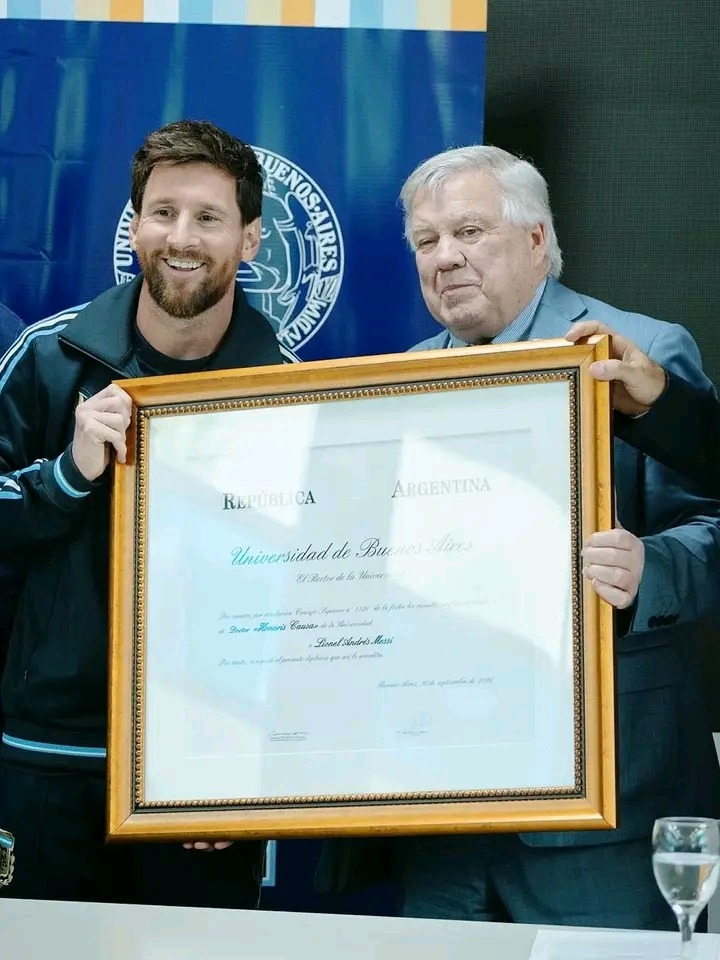
Lionel Messi was honoured with one of Argentina’s most prestigious academic distinctions as the University of Buenos Aires recognised the legendary footballer for his remarkable career and contribution to the country’s sporting identity.
The 39-year-old Argentina captain received an honorary doctorate from the prestigious university as he brought his international career with the national team towards an emotional conclusion.
Messi featured for Argentina against Benin at the Monumental Stadium in Buenos Aires on Wednesday, October 7, in what marked his final appearance for the national team.

The occasion became more than a football match as supporters celebrated a player whose career had become deeply connected with Argentina’s sporting history.
The decision to honour Messi was approved unanimously by the university’s Higher Council.
The institution recognised his career as an example of excellence, perseverance, humility and ethical conduct. The honour acknowledged not only his achievements on the football pitch but also the influence he had gained as one of Argentina’s most prominent representatives around the world.
Messi became first footballer to receive the distinction
Messi became the first footballer to receive an honorary doctorate from the University of Buenos Aires.
The university had previously recognised prominent figures from science, medicine, academia and politics. Among those who had received the institution’s honours were French scientists Françoise Barré-Sinoussi and Luc Montagnier.
University officials clarified that Messi’s doctorate was honorary and did not give him academic or professional privileges. He was not required to teach, conduct academic research or deliver lectures as part of the recognition.
Instead, the distinction represented the university’s acknowledgement of his extraordinary influence and the example he had established throughout his career.
University dean Ricardo Gelpi highlighted Messi’s achievements beyond football statistics and trophies, pointing to his humility, determination and influence on Argentine culture.
Messi’s extraordinary Argentina career
The honour came at the end of one of the most successful international careers in football history.
Before the Benin match, Messi had recorded 207 appearances for Argentina. His appearance against Benin took his international tally to 208, further extending his record as the country’s most-capped player.
He also remained Argentina’s all-time leading goalscorer with 125 goals and had provided 68 assists, making him the national team’s leading assist provider.
His greatest achievement with Argentina came at the 2022 FIFA World Cup in Qatar, where he led the country to the title and finally secured the major international trophy that had eluded him for much of his career.
Messi had also won Olympic gold with Argentina at the 2008 Beijing Games and helped the national team claim Copa América titles in 2021 and 2024.
Those achievements completed a remarkable international legacy and silenced years of criticism surrounding his inability to win a senior international trophy with Argentina.
Emotional farewell at the Monumental
The Argentina-Benin encounter carried enormous emotional significance despite being a friendly.
The match gave supporters at the Monumental Stadium an opportunity to celebrate Messi’s contribution to the national team after more than two decades of international football.
His journey with Argentina had started as a young player before developing into one of the greatest international careers in football history.
Messi’s relationship with Argentine supporters had also undergone a dramatic transformation.
After facing intense criticism following several disappointing international campaigns, he eventually became the central figure in one of the most successful periods in Argentina’s football history.
The 2022 World Cup victory proved particularly significant. The triumph completed the major achievement that had remained missing from Messi’s international résumé.
More than a footballer
The honorary doctorate reflected the extent of Messi’s influence beyond football.
His achievements had made him one of Argentina’s most recognisable ambassadors, while his professionalism, longevity and conduct had contributed to his status as a major cultural figure.
The University of Buenos Aires therefore recognised more than his goals, assists and trophies. The institution also highlighted the qualities that had defined his career and his influence on generations of Argentines.
Messi’s farewell from the national team consequently became a celebration of an extraordinary era.
From Olympic champion and Copa América winner to World Cup champion, record-breaking goalscorer and Argentina’s most-capped player, Messi ended his international journey with an exceptional list of achievements.
He also added another unique distinction to his legacy after becoming the first footballer to receive an honorary doctorate from the University of Buenos Aires.
For Argentina, it marked the closing of a historic chapter.
For Messi, it represented another extraordinary recognition of a career that had already placed him among the greatest sporting figures in history.




