



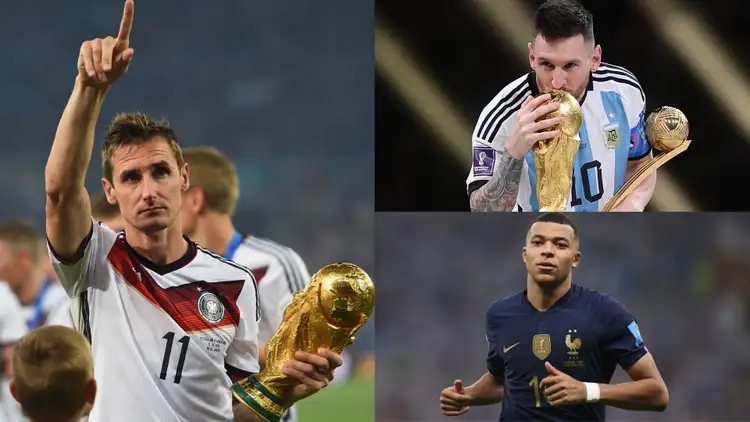
Lionel Messi has etched his name even deeper into FIFA World Cup history after extending his all-time scoring record at the tournament, moving clear of Germany legend Miroslav Klose in a landmark moment that further cements his status as the most prolific scorer on football’s biggest stage.
The Argentina captain now leads a legendary list of World Cup goal scorers that includes Kylian Mbappe, Ronaldo Nazario, Pele, Gerd Muller and Just Fontaine, in a ranking that spans generations of football greatness and highlights the evolution of attacking brilliance at the global showpiece.
Messi’s achievement comes as part of a remarkable World Cup journey that has stretched from his teenage debut in 2006 to his leadership role in the 2026 edition. Across six tournaments, the Argentine has combined longevity, consistency and decisive knockout performances to stand alone at the summit of the scoring charts.

The 36-year-old forward now boasts 18 World Cup goals in 28 appearances, surpassing Klose’s long-standing record of 16 goals. His scoring rate of 0.64 per game reflects a career defined not just by numbers, but by timing, with many of his goals arriving in crucial knockout fixtures.
Mbappe remains the closest active challenger, sitting joint second on the list with 16 goals from just 16 matches. The France star’s rapid rise has added a modern rivalry to the record books, as he continues to chase history at an extraordinary scoring pace.
Miroslav Klose, who held the record for more than a decade, remains one of the most efficient World Cup strikers in history, achieving his 16 goals across four tournaments between 2002 and 2014. Known for his intelligent movement and positioning, Klose famously broke Ronaldo Nazario’s record during Germany’s unforgettable 7–1 win over Brazil in 2014.
Ronaldo Nazario occupies fourth place with 15 goals in 19 matches, having lit up the World Cup between 1998 and 2006. The Brazilian icon delivered one of the most memorable individual performances in 2002, scoring eight goals to lead Brazil to their fifth world title and reclaiming his status as the game’s most feared striker at the time.
Gerd Muller follows closely with 14 goals in just 13 appearances, giving him the highest goals-per-game ratio among the top scorers. The German legend, nicknamed “Der Bomber,” played a key role in West Germany’s 1974 triumph and remains one of the most clinical finishers the sport has ever seen.
Just Fontaine’s extraordinary 13-goal haul in a single tournament in 1958 still stands as an unmatched record. The French forward achieved his tally in just six matches, a feat that has remained untouched for more than six decades.
Pele completes the elite group with 12 World Cup goals across four tournaments. The Brazilian great, widely regarded as one of football’s greatest ever players, won three World Cups and became a global symbol of the sport’s beauty and dominance during his era.
Behind the top seven, a host of legendary names complete the top ten and beyond, including Sandor Kocsis, Jurgen Klinsmann, Helmut Rahn, Gary Lineker, Gabriel Batistuta, Teofilo Cubillas, Thomas Muller and Grzegorz Lato, all of whom left lasting marks on World Cup history with decisive goals on the biggest stage.
Messi’s continued presence at the top of the list underlines not only his extraordinary talent but also his longevity at elite level, spanning nearly two decades of international football. His performances across multiple generations of teammates and opponents have redefined expectations for attacking consistency in modern football.
Mbappe’s rapid scoring rise has added a new layer of excitement to the record chase, with many believing the French forward could eventually challenge Messi’s record if his current trajectory continues. At just 16 appearances and already 16 goals, his efficiency remains unmatched among active players.
As the 2026 World Cup progresses, the scoring chart continues to evolve, with every goal potentially reshaping football history. Messi’s record now stands as the benchmark, but Mbappe’s pursuit ensures the battle for supremacy is far from over.
For now, the Argentine maestro sits alone at the top, having turned World Cup history into his personal stage across six unforgettable tournaments.




