


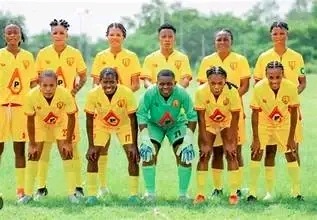
The Nigeria Football Federation (NFF) has appealed the Confederation of African Football’s (CAF) decision to annul Edo Queens’ penalty-shootout victory over Ghanaian champions Ampem Darkoa Ladies in the WAFU-B final.
The federation is asking CAF to reconsider its ruling, arguing that the Nigerian champions should not be punished for a procedural error made by match officials.
Edo Queens had appeared to secure the WAFU-B title on September 5 after defeating Ampem Darkoa 4-1 on penalties following a 2-2 draw at the 4th of August Stadium in Ouagadougou, Burkina Faso.

The victory initially handed the Nigerian champions the regional title and a place in the 2026 CAF Women’s Champions League final tournament.
However, CAF later annulled the penalty-shootout result after upholding a protest from the Ghana Football Association on behalf of Ampem Darkoa.
The continental body ruled that the final should not have gone directly to penalties after the teams were level at 2-2 following 90 minutes.
Under Article 72.4 of the CAF Women’s Champions League Regulations, a drawn final is required to go through two 15-minute periods of extra time before penalties can be used to determine the winner.
CAF therefore ordered the match to resume from the beginning of extra time, with the score remaining 2-2. If the teams are still level after the additional 30 minutes, a new penalty shootout will determine the winner.
But the NFF has now challenged the decision, insisting that Edo Queens had no role in determining the procedure used at the end of the original 90 minutes.
The federation’s position is that the Nigerian players simply followed the instructions given by the match officials. They did not request that extra time be cancelled, refuse to play it or pressure the referee to proceed directly to penalties.
According to the NFF’s argument, there was also no finding that Edo Queens had committed misconduct, manipulated the situation or deliberately breached CAF regulations.
The federation therefore believes responsibility for the procedural error should not be transferred to the Nigerian club.
CAF’s own explanation of the ruling provides important context for the NFF’s position.
According to the continental body’s decision, match officials had initially been informed that extra time would be played if the final remained level after regulation time. The teams were also reportedly informed of the procedure during the Match Coordination Meeting.
However, during the second half, the referee was subsequently instructed to proceed directly to a penalty shootout if the score remained level after 90 minutes.
The referee followed that instruction, and the match went to penalties.
Edo Queens subsequently converted their opportunities to win the shootout 4-1.
CAF later concluded that the instruction was inconsistent with the competition regulations and that the required extra time should have been played.
Crucially, however, CAF also found that neither Edo Queens nor Ampem Darkoa was responsible for the failure to play extra time. The error was attributed to an administrative instruction and the resulting failure to apply the correct competition procedure.
That finding forms a central part of the NFF’s challenge.
The federation argues that there is a distinction between correcting an irregularity and making an innocent participant suffer the sporting consequences of that irregularity.
For Edo Queens, the consequences are significant.
The Nigerian side had already celebrated the victory, received recognition as WAFU-B champions and appeared to have secured the zone’s qualification ticket for the CAF Women’s Champions League.
CAF’s subsequent ruling removed the shootout result and reopened the final, leaving the qualification place undecided.
The NFF is now asking CAF to consider whether that remedy is appropriate when the club followed the instructions of the officials and was not found responsible for the error.
The federation’s position is not that competition regulations should be ignored. Rather, it is questioning whether the appropriate remedy should effectively take away a result achieved by a team that did not cause the procedural problem.
The situation has created an unusual scenario in African club football.
The final was played on September 5, but weeks later the two teams have been instructed to return to the competition and play the 30 minutes of extra time that CAF says should originally have taken place.
The first 90 minutes remain valid, meaning the continuation will begin with the score at 2-2.
If either side takes the lead during extra time, that team will be declared the winner. If the scores remain level after the additional 30 minutes, the teams will contest another penalty shootout.
CAF has also directed that, as far as practically and legally possible, the continuation should preserve the sporting circumstances that existed at the end of regulation time. This includes issues such as player eligibility, disciplinary status, substitutions already made and the remaining substitution opportunities.
The date, venue and kick-off time for the continuation are expected to be communicated by WAFU-B in consultation with CAF and the two national football associations.
The controversy has consequently moved beyond the result of one football match.
It now raises questions about officiating, competition administration and the responsibility of governing bodies when an error occurs during a decisive fixture.
Ampem Darkoa exercised its right to protest the procedure used in the final, and CAF upheld that protest because the match went directly from 2-2 after 90 minutes to penalties.
The NFF, however, wants CAF to reconsider the impact of that decision on Edo Queens, particularly because the Nigerian club was not found responsible for the procedural mistake.
For Edo Queens, the stakes remain high.
A victory in the resumed final would restore their path to the CAF Women’s Champions League, while a defeat would end their hopes of representing WAFU Zone B in the continental competition.
Until CAF responds to the NFF’s appeal, the WAFU-B title therefore remains unresolved.
What began as a penalty-shootout victory for Edo Queens has now developed into a major administrative dispute, with the NFF insisting that the Nigerian champions should not be made to pay for an error they did not cause.




