
Connect with us

Analysis

Nigerian Lawmakers Propose 10-Year Passport Ban For Citizens Convicted Abroad

DDM News

Published

on

Share this:

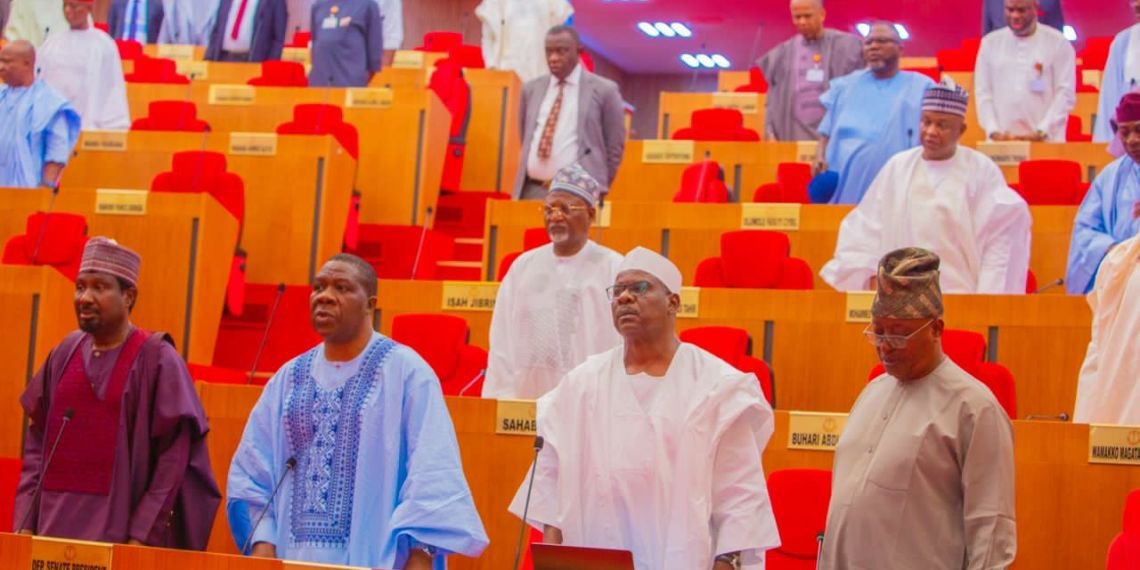
(DDM) – A controversial bill proposing a 10-year ban on the issuance of international passports to Nigerians convicted of crimes abroad and deported back to the country has passed its second reading at the Senate.

Diaspora Digital Media (DDM) gathered that the proposed law, sponsored by Senator Bello Abubakar representing Niger North, and presented by Senator Ogoshi Onawo (PDP, Nasarawa), seeks to amend the Passport (Miscellaneous Provisions) Act to protect Nigeria’s global reputation and deter criminal activity by citizens overseas.

During plenary on Tuesday, Senate President Godswill Akpabio announced the bill’s progress following a voice vote that showed overwhelming support from lawmakers.

The bill has now been referred to the Senate Committee on Interior, which has four weeks to conduct a public hearing and report back to the chamber.

According to Senator Onawo, the measure is intended to serve as a deterrent to Nigerians who “use the country’s passport to commit crimes abroad, thereby embarrassing the nation and damaging its international image.”

He said, “The implication of this amendment is that any Nigerian convicted of a crime in a foreign country would have their international passport withdrawn for 10 years.

This will discourage the commission of crimes abroad and help redeem our image.”

The lawmaker lamented that criminal acts by some Nigerians have led to global visa restrictions, noting that countries such as China, Turkey, the UAE, Canada, Germany, and France have imposed tougher entry rules on Nigerian passport holders.

Onawo further stated that the proposal would “redeem, preserve, and elevate Nigeria’s image internationally,” adding that the nation’s passport has been tainted by association with criminal offences.

READ ALSO:  A Letter To DSS And Other Intelligence Agencies ~ By Tope Fasua

High-profile Nigerian Convictions Abroad

Over the years, several prominent Nigerians have been convicted overseas for offences ranging from fraud and money laundering to human trafficking.

Former Deputy Senate President Ike Ekweremadu was sentenced to nine years in the United Kingdom in 2023 for organ trafficking.

Similarly, former Delta State Governor James Ibori was jailed for 13 years in 2012 for stealing millions from public funds, while internet fraudster Ramon Abbas (Hushpuppi) was jailed in the United States in 2022 for multiple counts of fraud and identity theft.

The Senate noted that such incidents have caused “stupendous disgrace” to Nigeria’s diplomatic image, leading to harassment and discrimination against law-abiding citizens at international airports and embassies.

Lawmakers Demand Tighter Passport Controls

Supporting the motion, Senator Babangida Hussaini (Jigawa North-West) urged the Federal Government to tighten passport issuance systems, alleging that foreigners easily acquire Nigerian passports, leading to crimes being wrongly attributed to Nigerians.

He said, “In some cases, non-Nigerians commit crimes but are profiled as Nigerians simply because they carry our passports. We must reclaim the dignity of the green passport.”

Akpabio Endorses The Bill

Senate President Godswill Akpabio supported the bill, citing examples of Nigerians being wrongfully accused abroad because of passport misuse.

He recalled an incident in Dubai, where black men committed a robbery using Nigerian passports, but investigations later showed they were not Nigerians.

“This bill will help ensure that anyone who messes up Nigeria’s image abroad faces serious consequences,” Akpabio said. “Such individuals should not just go to prison and return home freely, they should lose their passports for at least ten years.”

READ ALSO:  Igwebuikeism: Appraising Prof. Kanu’s contributions within ecology of African philosophy

Akpabio emphasized that the legislation, when passed, would “preserve the dignity of the green passport and strengthen Nigeria’s moral standing internationally.”

Broader Implications

If enacted, Nigeria would become one of the few African countries with a domestic law punishing citizens convicted abroad.

The legislation is also expected to prompt collaboration between Nigeria’s Ministry of Interior, Foreign Affairs, and Interpol, to track and enforce sanctions on deported convicts.

Analysts told DDM that while the proposed measure could protect Nigeria’s image, it also raises legal and human rights concerns, particularly regarding due process and rehabilitation of returnees.

As debates continue, the Senate Committee on Interior is expected to hold consultations with immigration experts, legal practitioners, and civil society groups before final recommendations are submitted for third reading.

If passed and signed into law, the bill would mark a significant shift in how Nigeria handles citizens’ conduct abroad, balancing national image protection with constitutional rights and international legal obligations.

 

Share this:

Analysis

It is time to let Nyesom Wike go

Published

on

You no fit bring me down, na you go go down – Wike dey warn PDP leaders
Share this:

By Onwuasoanya FCC Jones, PhD.


I was trying to write something more extensive about how the current crisis ravaging our country’s supposed main opposition Party started, but as I wrote, I realised that it was becoming too lengthy, hence, I decided to take out an important part of that long essay and publish it as a separate post, to avoid the message getting lost in the voluminous write-up, that I might still conclude and publish.

Politics, especially, democratic politicking cannot be played without factoring in public opinion. The public opinion might be informed by propaganda or outright fake news, but if it is the popular opinion, then, a responsible government must take it seriously and work to correct the wrong opinion or the actual reality.

Even in Communist States like North-Korea, Cuba and China and authoritarian democracies like Russia, Belarus and elsewhere, people’s opinions are not discarded as worthless, but they are closely monitored, and while these governments invest huge resources into State propaganda, they do not also fail to take important actions to defuse tension when public opinion is getting too negative concerning a particular action.

Nyesom Wike’s endorsement of Mr. President and his subsequent contributions towards the successful election of the President in 2023, cannot be denied, and the President has shown enough gratitude by appointing him as the Minister of the Federal Capital Territory, an appointment that should have been originally reserved for top members of the ruling Party.

While it must be acknowledged that the FCT Minister is doing some fantastic jobs in the FCT, it is also obvious that he is being distracted by his involvement in the tussle for the control of his own Party. His actions have also brought immerse reputational damage on the APC administration at the federal level, as he regularly puts himself forward as an untouchable appointee of the President, even as some of his actions could not have been possible without his access to some presidential protections.

READ ALSO:  A Letter To DSS And Other Intelligence Agencies ~ By Tope Fasua

The FCT Minister wouldn’t have had the resources and security to challenge sitting governors of his own Party to the extent of attempting to evict them from the Party’s secretariat, if he didn’t have access to enormous federal government accessories. His insistence on remaining in the PDP, while working openly for the APC, is outright political treachery, which the President must not continue to condone. If the Minister loves our Party so much and detests his own Party that much, then, he should quit the PDP officially and join the APC.

Mr. Wike is ruining our Party’s reputation before Nigerians and the international community, and the sooner the President relieves him of his job as FCT Minister, to enable him focus more resources and attention to “rebuilding” his Party and pocketing its structure, the better for us as a Party and as a nation.

Onwuasoanya FCC Jones, PhD is a former State Publicity Secretary of the All Progressives Congress.

Share this:
Continue Reading

Analysis

Wike and the Naval Officer: Where Is Citizen Nigerian?

By Bunmi Makinwa

Published

on

Share this:


It was difficult to miss the trending videos, photos and reports of Nigeria’s Federal Capital Territory (FCT) Minister Nyesom Wike and Naval Officer Lieutenant A. M. Yerima staring each other down at a property site in Abuja, the Nigerian capital, recently.

The full picture may never be known, but there are many versions of the narratives, which may or may not be from Wike’s office or the military establishment. There are numerous write-ups and analyses on whether Wike or the officer was right or wrong.

Perhaps, one day, an opportunity will present itself for various sides to tell their own versions of the event. In this digital age, there are many possibilities to colour stories, or even mislead the public.

But what happened between Wike and the naval officer was yet another portrayal of a power show (thanks to Fela Kuti, the Afro-beat King), and a failure of law and order in the society. It started a long time ago, and it is getting worse.

Individuals, institutions and governments use and misuse their authorities, their wealth, and their instruments of power including positions, guns, uniforms, security personnel… – to force their way, and achieve their objectives. Whether the objectives are right or wrong, it does not matter.

The use of established, official adjudication process is disregarded, and not even explored. Might is right.

There are real-life examples of how it happens every day. At levels small and big.

A soldier stands by the side of the highway and waves down every truck (or trailer, as we call it) that passes by.  He needs a lift, after all, he is in uniform, purportedly serving the nation. Wrong!  He is on a mission for illegal extortion. He is one of the many service personnel in uniform who accompany trucks across the country on highways. It is not official business. But they profit from the fact that there are many roadblocks manned by police, customs, immigration agents, and other unformed entities.

READ ALSO:  2023: To support Atiku, Ayu must resign as national chairman, Wike's camp insist

Some of these entities extort “monies” from truck drivers for “assisting” them through the roadblocks. A soldier sitting next to the truck driver means that the truck gets a through pass without paying an illegal toll. Instead, the soldier is “settled” by the truck driver for the “service”. It is cheaper and faster for the truck driver.

Some individuals with strong connections in the military can obtain the services of soldiers to help them secure their properties against intruders. Whoever can mobilise soldiers to secure the property has a higher claim, irrespective of whether the property is illegally acquired.

A tenant who fails in his financial obligations but can pay his way through the police or the court can scare his landlord away.

Policemen accompany criminals and “big men”, who break the law, and provide cover or security to keep others at a distance.

The rogue behaviour of these military or unformed persons are not necessarily backed or approved by their superiors or their organisations.

Yet, there are too many examples of the use/misuse of uniformed security officials for illegal purposes. It is not limited to the uniformed services. Politicians also use their positions to bend rules and circumvent normal processes and procedures.

Some senior government officials assume all manner of powers. A well-connected politician can take over public roads, public facilities and access areas, and “nothing will happen”. Having a political title is power.

Such power is used to determine who votes and how. Hence, snatching of ballot boxes and disenfranchising voters in so many ways has become the norm.

A wealthy person can “buy” security officials, or pay for the rights of ordinary persons to be taken away. An innocent citizen can be arrested for any reason, jailed or detained illegally for a long time.
If and when the citizen musters the means to go to court against the wealthy or money bag, the case could go on for years until the highest bidder prevails.

READ ALSO:  Enobong Uwah: Obeying his master's voice, by Osondu Ahirika

It is not a new trend, but it is wrong, and it must stop. It may not be easy to stop, but it can be minimised. Unfortunately, the trend is rather on the increase.

In full public glare, Wike and the naval officer demonstrated the use of “power” to determine who/what is right.

Sadly, it degenerated into another “two-fighting” power play – the one representing government power and the other, a decoy for his Oga, representing the power of the military uniform. A regular citizen could not have stood against either of them. S/he would be destroyed and “nothing will happen”.

By shouting at each other in public, Wike and the naval officer represent the unqualified use of authority that has effectively replaced the application of due process for adjudication of contending claims.

The FCT authorities and the former Chief of Naval Staff, Vice Admiral Awwal Zubairu Gambo, who is said to be the owner of the property in question, could have used other legal and dignified mechanisms of adjudication to settle the matter, without unnecessary drama. There was no need  for the “show of power.”

This legitimate process of adjudication is no longer attractive to those who have the power to determine the outcomes of their own matters. They use their positions, wealth, uniforms, and paraphernalia of office to force their way through. Those lacking such powers are denied justice.

Both Wike and the naval chief will ultimately sort out their differences. The bravado in public only reinforces the “powerlessness” of the ordinary citizen.

Citizen Nigerian has no standing against Wike and his arsenal, or the naval officer and his boss. Under these circumstances, it is immaterial whether Citizen Nigerian has genuine documents or legal claims; S/he is the loser in the game between and among the powerful in society.

READ ALSO:  Senior Iranian official reports Iran halted missile attacks on Israel after ceasefire took effect

Bunmi Makinwa is an Analyst and CEO, AUMIQUEI Communication for Leadership.

Share this:
Continue Reading

Analysis

45 Days that Changed Elections in Africa?

By Chidi Anselm Odinkalu

Published

on

Share this:


An unlikely coincidence of elections in over a period of 45 days period from the middle of September to the end of October 2025 has cast a new light on the state of democratic governance in Africa and now threatens to unscramble the ritual hollowness that has become the fate of elections on the continent under the indifferent watch of the African Union and other regional institutions in Africa. How the continent’s leaders and institutions handle the aftermath could have serious implications for the stability of the continent.

On 16 September 2025, Malawi went to the polls to elect their president. The last time the country did that in 2019, it produced results that were so transparently rigged that five judges of the Constitutional Court of Malawi wearing bullet-proof vests were needed to set aside the result declared by the electoral commission. That was only the second time in Africa’s history that a court would nullify the declared outcome in a presidential election.

The annulled result had favoured then incumbent and fifth president of the Republic, Peter Mutharika (a long-serving law professor and brother of Malawi’s third president, Bingu wa Mutharika), in a contest against Lazarus Chakwera, a theologian and pastor with the Assemblies of God Church in Malawi. In the re-run that followed the judicial nullification in 2020, Chakwera prevailed, and the people ousted Peter Mutharika from the presidency.

The contest in September 2025 pitted 85-year-old Peter Mutharika in a sequel against his nemesis, Lazarus Chakwera. In the preceding five years, President Chakwera had managed to implausibly squander the considerable civic goodwill that powered him into office. Despite being 15 years younger than President Mutharika, President Chakwera lost resoundingly to his older opponent who secured 56.8% of the vote.

Malawi may have vindicated the trust of both the voters and of the candidates in a test of the will of the people but it is an outlier in a continent that has grown used to seeing elections as charades. This reluctance for credible ballots was evident when the central African country of Cameroon went to the polls nearly one month later on 12 October 2025, to elect their president. The incumbent, Paul Biya, was a 92 year-old whose sojourn in Cameroon’s government dates back to his appointment as Chief of Staff in the cabinet of the Minister of Education in 1964. In 1975, President Ahmadou Ahidjo made him Prime Minister. On 6 November 1982, two days after the resignation of President Ahidjo on grounds of ill-health, Biya ascended to the presidency and has ruled the country for 43 years since.

READ ALSO:  A Letter To DSS And Other Intelligence Agencies ~ By Tope Fasua

At 92, Paul Biya is the oldest serving president in the world, only outlasted in office by Teodoro Obiang, president of the neighbouring Equatorial Guinea, who has been in office since he toppled his uncle, Macias Nguema, in August 1979 before executing him. In the election this year, his main opponent was Issa Tchiroma, a 35-year veteran in the cabinet of President Biya, who stepped down from the ruling Cameroon Peoples’ Democratic Movement (CPDM) and from the Cabinet in order to run against his former boss.
It took the Constitutional Council 15 days to tabulate the figures in an election which had 8.1 million registered voters with an average turnout of about 68.5%. When it eventually declared that outcome on 27 October, the Constitutional Council announced Biya as winner with 53.66% of the votes in disputed results and in an election in which he was unable to campaign because of infirmity. Independent analysts who have examined the official numbers insist he “couldn’t have won.”

With the result, Biya, who was born one month after Adolf Hitler assumed office as German Chancellor and in the month preceding the inauguration of Franklin Delano Roosevelt as the president of the United States of America – entered upon his seventh presidential term in a country in which the median age belongs to children who were born in 2006. By the time of the next election, he will be nearly one century old. In the wake of the announcement, United Nations Secretary-General, António Guterres, pointedly declined to extend congratulations to President Biya, instead focusing his attention on the need for a “thorough and impartial investigation” of the “post-electoral violence and…. reports of excessive use of force.”

READ ALSO:  Igwebuikeism: Appraising Prof. Kanu’s contributions within ecology of African philosophy

Paul Biya can at least claim that he had a genuine contest against a genuine opponent. In Côte d’Ivoire, West Africa, the contest two weeks later on 25 October 2025 pitted incumbent president, Alassane Ouattara, whose ambitions drove the country to the brink of fragmentation at the beginning of the millennium – against no one.

When the result
was announced, President Ouattara, a child of the Second World War, having been born on New Year’s Day in 1942, contrived at 83 years to award himself nearly 90% of the vote and a fourth term in office in an election from which he barred every credible competition. That was indeed a generous four percentage points lower than the 94% of the votes that he awarded himself in 2020. In power since 2010, Ouattara was supposed to be term-limited after two terms of ten years in office. At 83, he expects to rule until at least he is 88, which would still be five years younger than President Biya’s current age.

The election in Tanzania four days after Côte d’Ivoire’s took place in a graveyard. The incumbent and candidate of the ruling Chama Cha Mapinduzi (Party of the Revolution) was Samia Suluhu Hassan, who inherited the office when her principal, John Pombe Magufuli, died in March 2021.

Ahead of the contest, however, it became evident that Samia would not tolerate a contest. Under her leadership, the government unleashed what Amnesty International described as a “wave of terror” designed to make her candidacy unopposed and the ruling party unchecked in its march to a pre-determined seventh decade in power. On the day of the contest on 29 October, protests unexpectedly erupted in key cities, such as Dar-Es-Salaam, Arusha, Mbeya, and Mwanza. Under cover of a media blackout complemented by an internet shutdown imposed on the day of the ballot, Samia’s government orchestrated a campaign of targeted mass murder in population centres suspected to be opposition strongholds.

READ ALSO:  Naira Abuse: Import of Court Judgment on Cubana Chief Priest

President Samia’s electoral commission declared her winner with 87% voter turnout and nearly 98% of the vote. As Tanzanians in different parts of the country woke up to find bodies on their courtyards with fatal injuries from unknown persons and morgues overflowing with fresh cadavers reportedly being disappeared under instructions of the government, President Samia turned up at a military base in new capital city, Dodoma, where on the fourth night following the vote, she was stealthily inaugurated for a new term.

Initial estimates putting the casualty count in the hundreds were quickly eclipsed by more updated tallies of over 3,000 killed in under 72 hours. Fresh reporting by the New Humanitarian put the number over 5,000 and suggests that the casualty count may indeed be over 10,000. Around the country, initial trepidation gave way to alarm at the scale of the massacre. That alarm has now been ousted by outrage.

Meanwhile, for the first time in their histories, official election observer missions deployed by the African Union (AU) and the Southern African Development Community (SADC) both concluded separately that the election in Tanzania “did not comply with AU principles.” This caught many people unprepared. Now both institutions are scrambling to figure out what to do. There is an emerging consensus that President Samia is illegitimate. The leaders of both institutions must articulate consequences and citizens have a right to expect them to do so clearly.

The consensus is also growing around the urgent need for an independent, international investigation and accountability. Meanwhile, Tanzania’s young people prepare for nationwide protests on 9 December 2025. The symbolism is significant: it is World Anti-Corruption Day; it is the anniversary of the adoption of the Genocide Convention; and it is Tanzania’s Independence Day.

A lawyer and a teacher, Odinkalu can be reached at chidi.odinkalu@tufts.edu.

Share this:
Continue Reading

Latest from DDM TV

LATEST NEWS

Turkey Shocks Abuja With Sudden Visa Policy Shift For Nigerian Business Community

Ten Countries Leading the Global Shift to E-Passports

Trump Claims to Dismantle U.S. Education Department Amid Controversy <p><span style='color:#808080;font-size:18px;'><i>DDM News</i></span></p>

Headmistress Struck Off After Alcohol Found in School Office <p><span style='color:#808080;font-size:18px;'><i>DDM News</i></span></p>

Anambra Closes School After Unsafe Learning Conditions Exposed <p><span style='color:#808080;font-size:18px;'><i>DDM News</i></span></p>

BREAKING: Diaspora Digital Media Launches Weekly Blockchain Program With DAMA <p><span style='color:#808080;font-size:18px;'><i>DDM News</i></span></p>

ASUU Threatens Nationwide University Shutdown Over Unmet Demands <p><span style='color:#808080;font-size:18px;'><i>DDM News</i></span></p>

APC Halts Taraba Governor’s Defection Event Amid National Outrage Over Kebbi School Attack <p><span style='color:#808080;font-size:18px;'><i>DDM News</i></span></p>

Subscribe to DDM Newsletter for Latest News

Trending

Copyright © 2023 -2024 Diaspora Digital Media (DDM) www.diasporadigitalmedia.com. All Rights Reserved . NOTE: All opinion articles published on Diaspora Digital Media are ENTIRELY those of the authors and do not necessarily reflect the opinion of the publishers.

Get Notifications from DDM News Yes please No thanks

