


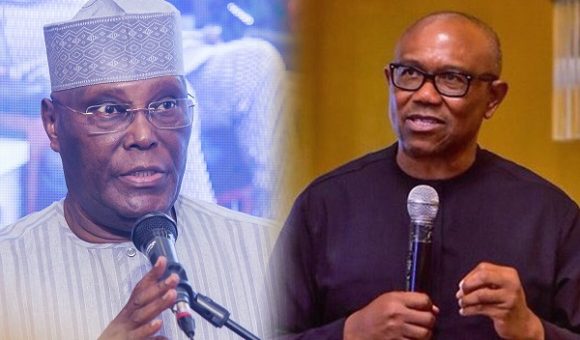
Former Anambra State Governor and 2027 presidential hopeful Peter Obi has rejected former Vice President Atiku Abubakar’s proposal to restore fuel subsidy if elected president, arguing that subsidy removal remains necessary but the funds saved must be properly managed.
Obi spoke on Monday at the Nigerian Bar Association conference in Port Harcourt, Rivers State, where presidential candidates and other political figures debated Nigeria’s economy, security and governance ahead of the 2027 election.
Atiku, the presidential candidate of the African Democratic Congress in 2027, has said he would restore fuel subsidy if elected, despite campaigning for its removal during the 2023 presidential election.
Obi, who is the presidential candidate of the Nigerian Democratic Congress, disagreed with the proposal, saying poor management of subsidy savings was not sufficient reason to reverse the policy.

“I subscribe and I maintain that we need to remove subsidy. Mismanagement of the proceeds should not be the reason for not removing it,” Obi said.
According to him, the government should have provided alternatives for Nigerians while investing the resources recovered from subsidy removal in ways that would benefit the people.
“What we have today is that that removal and the attendant resources being recovered is also being mismanaged and stolen,” he said.
Obi said he had anticipated the need for an organised approach to subsidy removal and had outlined his position in his manifesto ahead of the 2023 election.
“Go to my manifesto, I said it before, I said I will do it in an organised manner and whatever we recover would be invested appropriately,” he said.
President Bola Tinubu removed petrol subsidy during his inauguration in May 2023, a decision that triggered a sharp rise in petrol prices and intensified concerns over the cost of living.
Opposition candidates clash over economy, security
The subsidy debate was part of a wider clash among opposition presidential candidates at the NBA conference, where they presented competing positions on Nigeria’s security, economy and governance.
Former Rivers State governor and ADC vice-presidential candidate Rotimi Amaechi said Nigeria’s economy could be stabilised through massive job creation, increased local production and policies that would put more money in the hands of citizens.
Amaechi also highlighted projects executed during his tenure as Rivers governor, including more than 500 primary schools, over 300 health centres and more than 200 roads.
He promised that an Atiku-Amaechi administration would ensure a more equitable distribution of political appointments across the country.
African Action Congress presidential candidate Omoyele Sowore called for a change of government, arguing that Nigeria’s security challenges could not be effectively addressed under the current leadership.
He also said he had consistently opposed fuel subsidy because, in his view, the policy mainly benefited the elite and governors.
Social Democratic Party candidate Adewale Adebayo also called for a change in leadership and proposed a three-tier policing structure involving federal, state and local government police.
Former Cross River State governor Donald Duke said leadership was at the root of Nigeria’s challenges, arguing that getting the country’s leadership right would have a multiplier effect across other sectors.
Gbajabiamila defends state police plan
Meanwhile, President Tinubu’s Chief of Staff, Femi Gbajabiamila, defended the administration’s move to introduce state police.
Speaking in a keynote address titled “Policing in Transition,” Gbajabiamila said the proposed reform was intended to address weaknesses in Nigeria’s centralised policing system.
He warned that centralised policing without adequate safeguards could create further problems, saying the proposed system would require strong institutional protections.
Gbajabiamila acknowledged concerns that state police could be abused by governors against political opponents, asking: “Who polices the police?”
He said Nigeria had about one police officer for every 650 people, compared with an international benchmark of one officer to 450 people.
He also identified the deployment of officers to administrative and escort duties as another major challenge, stressing the need for better training, professionalism and institutional safeguards.
The NBA conference provided a major platform for 2027 presidential hopefuls to set out their positions on fuel subsidy, security, policing, economic management and governance ahead of the general election.




