


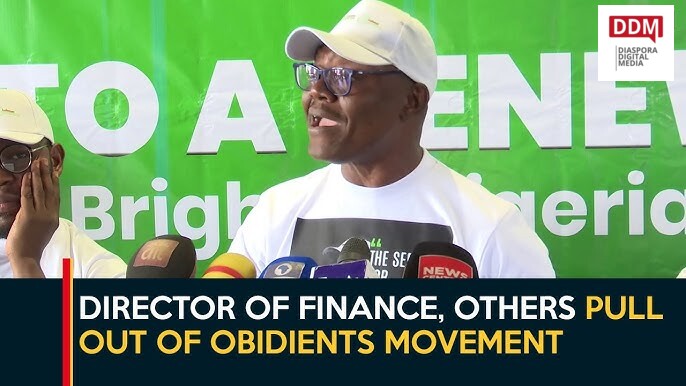
A fresh wave of internal tension has emerged within Nigeria’s once-formidable grassroots political force, the Obidient Movement, following the resignation of its Director of Finance, Dr Peter Agada, a development that is already stirring conversations about the future cohesion and strategic direction of the movement ahead of the 2027 general elections. The Obidient Movement, which rose to national prominence as a powerful support base for Peter Obi during the 2023 presidential race under the Labour Party Nigeria, now finds itself grappling with questions of structure, leadership, and long-term sustainability.
Agada formally announced his resignation during a press conference in Abuja, where he did not only confirm his departure but also unveiled a new political platform known as “The Movement Nigeria,” signaling what many observers interpret as a strategic repositioning within Nigeria’s evolving political landscape. His decision, he explained, was not driven by personal grievances or conflicts, but rather by what he described as persistent structural and organizational deficiencies within the Obidient Movement.
In a candid and revealing address, Agada expressed frustration over what he termed a lack of coordination and communication within the movement’s leadership framework. He disclosed that despite holding a critical role as Director of Finance, he had increasingly found himself excluded from key meetings and decision-making processes. For an organization that once prided itself on inclusivity and collective energy, this revelation raises serious concerns about internal management and governance.
DDM News gathered that Agada’s critique goes beyond mere administrative lapses, touching on deeper concerns about institutional maturity. According to him, the absence of a well-defined structure is fundamentally incompatible with his professional background and expectations, particularly as a seasoned architect with decades of experience in structured environments. His remarks highlight a growing perception among some insiders that the movement, while vibrant and impactful during the 2023 elections, may not have fully transitioned into a sustainable political institution capable of long-term engagement.

The Obidient Movement itself was born out of a unique convergence of youth activism, digital mobilization, and widespread public dissatisfaction with Nigeria’s traditional political class. Drawing momentum from the #EndSARS protests and a broader demand for accountability and reform, the movement quickly evolved into a nationwide phenomenon. It energized millions of young Nigerians and played a pivotal role in reshaping political discourse during the last election cycle. However, since the conclusion of the elections, questions have persisted about its ability to maintain unity and evolve into a structured political force.
Agada’s exit appears to amplify those concerns. During his address, he emphasized that his newly launched platform, The Movement Nigeria, would operate on a fundamentally different model—one that is not built around any single political figure. In distancing the new initiative from established political personalities, including Obi and other prominent figures, Agada underscored his desire to create a more decentralized and ideologically driven movement. He also rejected the notion of centralized funding, insisting instead on a democratized financial structure supported by collective contributions from members.
Interestingly, Agada also clarified the nature of his relationship with Peter Obi, noting that it was strictly professional rather than personal. This revelation may come as a surprise to many supporters who often assume close personal ties between key figures within political movements. According to Agada, his interactions with Obi were limited, despite his significant role within the movement, a detail that further underscores the organizational gaps he referenced.
DDM News understands that the leadership of the Obidient Movement has responded cautiously to the development, seeking to downplay its potential impact. Dr Yunusa Tanko, the National Coordinator of the movement worldwide, acknowledged Agada’s departure but framed it within the broader context of ongoing restructuring efforts. According to Tanko, the movement is transitioning away from a directorate system to a more collegiate model of leadership, which he believes will foster greater inclusivity and reduce the likelihood of similar grievances in the future.
Tanko also hinted at the fluid nature of political alignments as Nigeria approaches another election cycle, suggesting that movement between platforms is to be expected. He emphasized that the Obidient Movement remains intact and committed to its core objectives, even as it adapts to new realities. However, his admission that he had not formally received Agada’s resignation letter adds another layer of uncertainty to the situation, raising questions about internal communication and coordination.
Political analysts argue that this development may be an early indicator of broader realignments within Nigeria’s opposition landscape. As preparations for the 2027 elections gradually intensify, various political actors and support groups are likely to reassess their positions, strategies, and alliances. For a movement like the Obidient Movement, which was largely built on momentum and public enthusiasm rather than rigid institutional frameworks, the challenge will be to maintain coherence while evolving into a more structured entity.
The emergence of The Movement Nigeria also introduces a new variable into the equation. While it remains unclear how much traction the platform will gain, its emphasis on decentralization and collective ownership could resonate with segments of the population that are disillusioned with personality-driven politics. At the same time, the proliferation of new movements could fragment the opposition space, potentially weakening collective efforts to challenge established political forces.
As the dust settles, the resignation of Agada serves as both a warning and an opportunity for reflection within the Obidient Movement. It highlights the urgent need for stronger institutional frameworks, clearer communication channels, and a more cohesive leadership structure if the movement hopes to remain relevant in Nigeria’s fast-evolving political environment. Whether this moment will lead to meaningful reform or further fragmentation remains to be seen, but one thing is certain: the road to 2027 is already shaping up to be as dynamic and unpredictable as ever.




