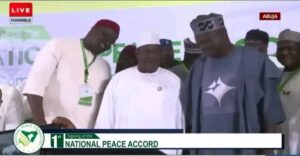
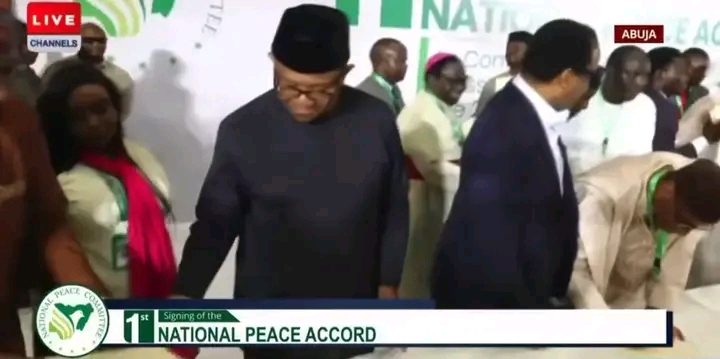
President Bola Ahmed Tinubu, former Anambra State Governor Peter Obi, human rights activist Omoyele Sowore and other presidential candidates contesting Nigeria’s 2027 election have signed the National Peace Accord ahead of the commencement of campaigns.
The presidential candidates endorsed the agreement at a ceremony in Abuja, pledging to support peaceful political activities and respect the democratic process as Nigerians prepare for another major electoral contest.
The event brought together leading contenders from different political parties, providing a rare moment of unity among politicians who will soon be competing for the country’s highest elective office.

The signing of the accord comes as political activities gather momentum ahead of the 2027 general elections. The Independent National Electoral Commission has already published the credentials and details of presidential candidates submitted by their respective political parties. Tinubu is representing the All Progressives Congress, while Obi is the presidential candidate of the Nigeria Democratic Congress. Atiku Abubakar is listed as the African Democratic Congress candidate, while Sowore is contesting under the African Action Congress.
The National Peace Accord is designed to encourage political candidates and parties to commit themselves to peaceful campaigns, responsible political communication and respect for the outcome of the electoral process.
For Nigeria, the agreement has particular significance because previous election cycles have been accompanied by allegations of violence, intimidation, inflammatory statements and clashes between supporters of rival political parties.
The appearance of Tinubu, Obi and Sowore at the same ceremony therefore carries considerable political symbolism.
Tinubu enters the 2027 contest as the incumbent President and APC presidential candidate, seeking another term in office. His administration is expected to campaign on its economic reforms, infrastructure projects, security policies and other programmes under the Renewed Hope Agenda.
Obi, meanwhile, returns to the presidential contest on a different political platform after his highly competitive campaign in the 2023 election. He is now the candidate of the NDC and is expected to present himself as one of the major alternatives to the ruling party.
Sowore, a longtime human rights activist and publisher, is also returning to the presidential race under the AAC. He has consistently positioned himself as a critic of Nigeria’s political establishment and has campaigned for fundamental changes to the country’s political and economic system.
The presence of these figures at the peace ceremony highlights the competitive nature of the forthcoming election.
Despite their significant political differences, the candidates have publicly committed themselves to a process that should allow Nigerians to choose their preferred leaders without fear or intimidation.
The agreement also places responsibility on political parties and their supporters.
Election violence is not always caused directly by candidates themselves. Supporters, local political groups and other actors can contribute to tensions through inflammatory speeches, misinformation and confrontations.
The peace accord therefore seeks to establish a broader commitment to responsible political conduct before, during and after the election.
The development comes only days after the conclusion of the Osun State governorship election, which has generated renewed debate about election security and political violence.
Former President Goodluck Jonathan recently warned against the growing presence of governors, senior politicians and large security entourages during off cycle elections, arguing that such practices could threaten democratic stability if they become normalised.
Sowore himself has already expressed scepticism about the effectiveness of peace accords.
Following the Osun election, he criticised the peace agreement, pointing to deaths recorded during the poll despite the existence of similar commitments. His criticism has raised questions about whether signing an agreement is enough to prevent election violence or whether stronger enforcement mechanisms are required.
That criticism adds an interesting dimension to his decision to participate in the latest peace accord.
For the agreement to have meaningful impact, political observers argue that candidates must go beyond signing documents and ensure that their supporters respect the rules of democratic competition.
The 2027 election is expected to be one of Nigeria’s most closely watched political contests in recent years. Major political parties have already selected their presidential candidates, while alliances and campaign structures are being developed across the country.
The election will also test the strength of Nigeria’s democratic institutions.
INEC will be expected to conduct a transparent process, while security agencies will have the responsibility of protecting voters, electoral officials and materials without taking sides.
The commission’s chairman has previously stressed the need for security personnel to maintain political neutrality during elections and warned against making military deployment a regular feature of the electoral process.
For Nigerian voters, the peace accord provides an opportunity to demand better conduct from political leaders.
Citizens will ultimately be responsible for choosing the next president, but their ability to exercise that choice freely depends heavily on the political environment created by candidates, parties and security agencies.
The signing ceremony also sends a message to supporters across the country that political competition should not become a justification for violence.
With the campaign season approaching, the candidates will soon take their messages directly to voters. Their policies, records, promises and leadership abilities will face intense scrutiny.
The real test of Tuesday’s agreement, however, will come when the campaign becomes more competitive and political interests become more difficult to reconcile.
For now, the signing represents a public commitment by some of Nigeria’s most prominent presidential contenders to pursue their ambitions through peaceful democratic means.
Whether that commitment translates into responsible campaigns and a violence free election will depend on the actions of the candidates, their supporters and the institutions responsible for managing the 2027 electoral process.
As Nigeria moves towards another decisive presidential election, the hope is that political differences will remain within the boundaries of democratic competition and that the final decision will ultimately belong to the Nigerian electorate.