World
Russia Holds Nuclear Drills After US Freezes Putin-Trump Meeting

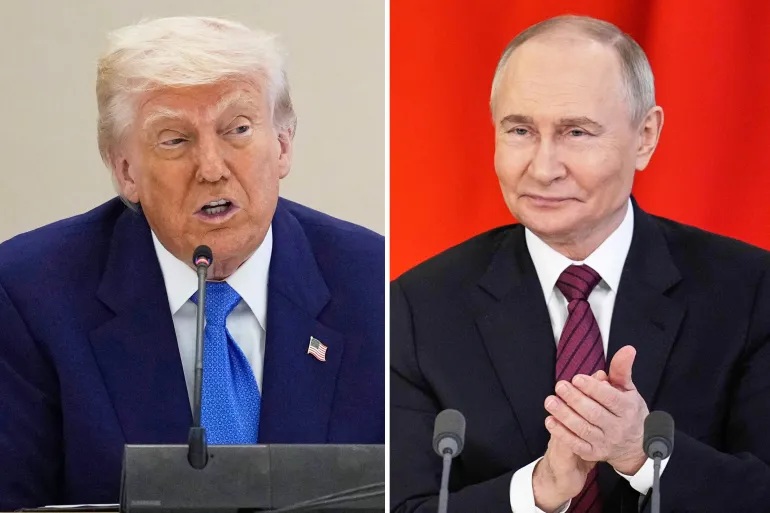
Russia on Wednesday conducted major nuclear weapons drills, just one day after the United States delayed the planned Putin-Trump summit in Hungary, further escalating global tensions over the Ukraine war.
The Kremlin released footage showing General Valery Gerasimov, head of the Russian General Staff, briefing President Vladimir Putin on the exercise.
The training included simulated launches of intercontinental ballistic missiles (ICBMs), capable of striking targets across continents, including the United States.
At several points during the ongoing conflict in Ukraine, Putin has invoked Russia’s nuclear strength as a warning to Kyiv and its Western allies.

The latest drills come as NATO conducts its own nuclear deterrence exercises, adding to global concerns of an arms escalation.
Putin and US President Donald Trump had agreed last week to hold a high-level peace summit in Hungary, aimed at breaking the deadlock in the Ukraine conflict.
But after a tense round of diplomatic calls on Monday, the White House confirmed Trump had no immediate plans to meet Putin, with Trump saying he “did not want a wasted meeting.”
Despite Washington’s postponement, Moscow insists preparations for the summit are ongoing.
Kremlin spokesman Dmitry Peskov told reporters that while “the dates haven’t been set yet,” careful groundwork was required before such a meeting could take place.
The diplomatic setback followed renewed disputes over Russia’s peace demands.
According to three diplomatic sources, Moscow had repeated its insistence that Kyiv surrender full control of the Donbas region, rejecting Trump’s earlier suggestion that both sides hold their current positions along existing front lines.
Russia’s Deputy Foreign Minister Sergei Ryabkov told state media RIA that the summit preparations were “continuing” and that there were “no major obstacles.”
He acknowledged the process was “difficult,” but added, “that’s precisely what diplomats are for.”
Meanwhile, violence flared again overnight as Russia and Ukraine exchanged heavy missile fire.
Ukrainian authorities reported six deaths, including two children, following strikes on Kyiv and nearby areas, which also triggered nationwide power outages.
Military analysts say Moscow’s nuclear drills were a clear message to Washington, signaling that Russia remains ready to project power while negotiations stall.
The timing of the exercises just hours after Trump’s decision to delay the summit suggests a deliberate show of defiance.
The drills also highlight the fragile state of global diplomacy, as both superpowers struggle to balance military pressure with political dialogue.
Western officials fear that without concrete progress toward a ceasefire, further military posturing could push Europe closer to a prolonged standoff.

World
UK Issues Fresh Travel Alert as Insecurity Worsens in Nigeria
The United Kingdom has issued a new travel advisory, warning its citizens to avoid large parts of Nigeria due to worsening insecurity, terrorism, and violent crime.
The Foreign, Commonwealth and Development Office (FCDO) released the update on GOV.UK, urging British nationals in Nigeria to exercise “extreme caution”, review safety measures, and maintain contingency plans.
According to the advisory, insecurity is now widespread across all regions, with incidents of kidnapping, intercommunal clashes, and violent crime rising sharply.
“Insecurity is increasing across Nigeria. Kidnapping, violent crime, and intercommunal violence occur throughout all regions of Nigeria,” the FCDO said.
The UK government advised against all travel to six northern states Borno, Yobe, Adamawa, Gombe, Katsina, and Zamfara citing a high and growing threat from Boko Haram and Islamic State West Africa.
The warning also covered transport hubs, religious sites, and large gatherings, where terrorist attacks are most likely to occur. The FCDO added that humanitarian workers and facilities could be direct targets of extremists.
“Humanitarian personnel, vehicles, supplies, and infrastructure can be targeted by terrorists and criminals,” the statement added.
The UK further warned against all but essential travel to Bauchi, Kaduna, Kano, Kebbi, Jigawa, Sokoto, Niger, Kogi, Plateau, and Taraba states, along with the outer suburbs of Abuja in the Federal Capital Territory (FCT).
It noted that violent crime, including armed robbery and kidnapping, has spread from Abuja’s outskirts into wealthier central areas. As a result, British staff in Nigeria have been ordered to restrict movements to central Abuja.
The advisory also flagged occasional protests and unrest in the capital, urging British nationals to stay informed, avoid demonstrations, and comply with security directives.
In the North-East, the FCDO described the region as unstable despite ongoing military operations. It warned that retaliatory attacks could occur and noted that deteriorating conditions in Maiduguri might make evacuation “extremely difficult.”
The warning extended to riverine areas of the Niger Delta, including Delta, Bayelsa, Rivers, Akwa Ibom, and Cross River states. The UK cited the presence of militant groups, frequent kidnappings, and attacks on oil and gas facilities as reasons for concern.
“Militant groups are active across the Niger Delta region and have carried out many attacks on oil and gas infrastructure,” it said.
In the South-East, the UK highlighted the activities of secessionist groups and frequent clashes with security forces, noting that while foreigners are rarely targeted, they risk being caught in crossfire.
The South-West, including Lagos, was also listed as an area of concern. The advisory said armed robbery, carjacking, mugging, and kidnapping are common, especially on the mainland and at night.
Although large-scale terrorist attacks remain rare in the region, the FCDO recalled that Islamic State West Africa had claimed two attacks in 2022.
World
Trump Snubs G20 Summit, Revives ‘White Genocide’ Claims Against South Africa
United States President Donald Trump has announced that no American official will attend this year’s G20 Summit in South Africa, accusing President Cyril Ramaphosa’s government of grave human rights abuses.
Trump, who had earlier delegated Vice President JD Vance to represent him, made a sudden U-turn, declaring a total boycott of the summit.
“It is a total disgrace that the G20 will be held in South Africa,” Trump said in a post on Truth Social, his social media platform.
“No U.S. government official will attend as long as these human rights abuses continue.”
The American leader repeated his controversial claim that white Afrikaner farmers are being “killed and slaughtered” and that their farms are “illegally confiscated.”
He also confirmed that the 2026 G20 Summit would take place in the United States at his own golf resort in Miami, Florida.
South Africa’s foreign ministry reacted sharply, calling Trump’s remarks “regrettable.”
In a statement, it said the government looked forward to hosting a “successful and inclusive summit” scheduled for November 22–23 in Johannesburg.
“The characterisation of Afrikaners as an exclusively white group is ahistorical,” the ministry said.
“Furthermore, the claim that this community faces persecution is not substantiated by fact.”
Pretoria reaffirmed its G20 theme, “Solidarity, Equality, Sustainability,” and emphasized that its focus remained on global cooperation and shared development goals.
“Drawing on our journey from division to democracy, South Africa is uniquely positioned to champion genuine solidarity,” the ministry added.
Trump’s stance has deepened tensions between Washington and Pretoria.
Since returning to the White House in January, he has repeatedly targeted South Africa, claiming a “white genocide” is underway a claim long dismissed by rights groups and the South African government.
Earlier this year, Trump confronted President Ramaphosa in the Oval Office, playing a video that alleged a campaign against white farmers.
The South African leader rejected the claim, saying there was no policy promoting violence or land seizures against any racial group.
Trump’s administration has also moved to slash the U.S. refugee quota to 7,500 per year, giving priority to white South Africans. Meanwhile, the White House has imposed 30 percent tariffs on South African goods the highest in sub-Saharan Africa.
The diplomatic rift widened further after South Africa filed a genocide case against Israel at the International Court of Justice (ICJ), a move that drew sharp criticism from Washington.
Despite the backlash, Pretoria said it remains committed to hosting global leaders and promoting unity at the summit.
World
Russia Reacts to Trump’s Military Threat Against Nigeria
Russia has declared that it is closely watching Nigeria following U.S. President Donald Trump’s recent threat to order military action in the West African country.
The statement came from the Russian Foreign Ministry’s spokeswoman, Maria Zakharova, during a press briefing in Moscow on Friday.
She said Moscow was “closely monitoring the situation” after Trump announced that he had directed the Pentagon to prepare “military options” for Nigeria.
Trump claimed his move was to protect Christian communities from what he described as a wave of genocidal attacks by radical Islamist groups.
Zakharova warned that Washington must act responsibly and respect international law. “We are closely monitoring this issue and call on all parties involved to strictly comply with international legal norms,” she said.
Her statement was in response to a question from Turkey’s Anadolu news agency, which asked about Moscow’s position on Trump’s controversial remarks.
Trump had made the comments on November 1, declaring that the United States “cannot stand by while thousands of Christians are being killed.”
It could be recalled that Trump posted on his Truth Social that Nigeria was facing an “existential threat” due to ongoing terrorist violence.
He vowed that his administration would be “ready, willing, and able to protect our great Christian population around the world.”
Trump also instructed several U.S. lawmakers, including Congressman Barry Moore and House Appropriations Chairman Tom Cole, to investigate the killings and report back to him.
His comments sparked intense global reactions.
Religious leaders in Nigeria, including the Pentecostal Fellowship of Nigeria (PFN), backed his claims of Christian persecution but urged cooperation rather than confrontation.
Meanwhile, the Nigerian government rejected Trump’s allegations, with President Bola Tinubu insisting that Nigeria protects freedom of religion and the rights of all faiths.
In recent months, renewed attacks on Christian villages in Plateau, Benue, and Kaduna States have reignited global concern about religious violence in Nigeria.
Western analysts warn that Trump’s military threat could escalate diplomatic tensions between Washington, Abuja, and now Moscow.
Russia’s decision to monitor the situation highlights the growing international dimension of Nigeria’s security crisis one that now involves the world’s top military powers.
-
Analysis6 days agoEmpty Diplomacy, Real Graves… A Reply to Nigeria’s Ministry of Foreign Affairs
By Sa'adiyyah Adebisi Hassan
-
World News6 days agoMilitary action on terrorists in Nigeria could be ground troops, air strikes — Trump
-
News5 days agoJUST IN: Soldiers facing terror allegations escape from military custody
-
World News4 days agoI will name Nigerian officials linked to Christian genocide — Senator Ted Cruz
-
Economy5 days agoCBN Releases Names Of Heavy Defaulters, Amount
-
Opinion7 days agoWhen the Hunter Becomes the Hunted: How the APC is Tasting the Karma of 2015
-
News5 days agoDon’t Bomb Bandits, Negotiate With Them – Islamic Cleric Tells US
-
News3 days agoBREAKING: Nnamdi Kanu writes Trump, calls for US inquiry in S’east killings
-
World3 days agoUS Congress Introduces Nigeria Religious Freedom Accountability Bill
-
Analysis6 days agoChristian Genocide: Fellow Muslims — Let’s Face Facts
By Sa'adiyyah Adebisi Hassan