


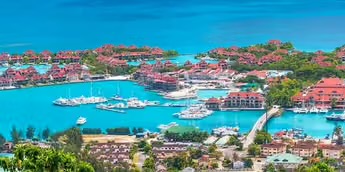
Seychelles is preparing to make one of the most ambitious investment moves in its economic history, with the island nation planning a $2 billion fund designed to transform three critical sectors and strengthen its position as a strategic player in Africa’s rapidly evolving economy.
The proposed fund signals a major shift in the way Seychelles intends to approach long-term development.
Rather than relying heavily on its traditional tourism-driven economy, the country is looking to channel substantial capital into sectors capable of generating new sources of income, creating jobs, attracting international investment and strengthening its economic resilience.
The plan is particularly significant for a country widely regarded as Africa’s richest nation on a per-capita basis.

Seychelles has built much of its prosperity around tourism, fisheries and services, but the government is increasingly looking towards new opportunities that can deliver sustainable growth beyond the conventional sectors that have powered its economy for decades.
At the heart of the strategy is the creation of a large investment vehicle capable of financing projects with long-term economic and strategic value.
The $2 billion target is substantial relative to the size of the Seychelles economy, suggesting that the government sees the fund as more than an ordinary development programme.
It is being positioned as a mechanism that could help transform the country into a more diversified and investment-oriented economy.
One of the most intriguing areas of focus is agriculture and food security.
For an island nation that imports a significant proportion of the food consumed by its population, increasing domestic production could have major economic implications.
Seychelles has limited land available for large-scale agricultural production, making conventional expansion difficult.
However, new technologies, controlled-environment agriculture, aquaculture and other modern production methods could allow the country to produce more food without requiring vast amounts of land.
That ambition is becoming increasingly important as food security moves higher on the global economic agenda.
Europe and North America, in particular, are facing growing pressure to strengthen their food systems, diversify supply chains and secure access to agricultural products and inputs.
Africa, with its large amount of arable land and growing agricultural potential, is increasingly being viewed as an important part of the solution.
Seychelles wants to position itself within this changing environment by investing in agricultural systems and related industries that can serve both domestic needs and potentially wider regional markets.
The second major area of opportunity is the blue economy.
With its location in the Indian Ocean and an enormous maritime territory relative to its landmass, Seychelles possesses a natural advantage that few countries can replicate.
Its ocean resources provide opportunities in fisheries, aquaculture, marine biotechnology, renewable energy, tourism and other ocean-related industries.
The government has previously placed the blue economy at the centre of its development strategy, recognising that the sea surrounding the islands represents an economic asset rather than simply a geographical feature.
The planned investment could help unlock more value from these resources while encouraging greater participation from private investors.
For Seychelles, the objective is not simply to extract more resources from the ocean.
There is increasing emphasis globally on sustainable exploitation, meaning that future industries must generate economic value while protecting marine ecosystems.
This could create opportunities for Seychelles to develop expertise in areas such as sustainable fisheries, marine research, ocean technology and conservation-linked finance.
DDM News understands that the third pillar of the strategy is expected to focus on another sector with significant long-term potential, reinforcing the government’s broader objective of creating an economy that is less dependent on tourism.
Tourism will remain central to Seychelles, given its beaches, biodiversity and reputation as a premium international destination.
However, the vulnerability of tourism-dependent economies became particularly clear during the COVID-19 pandemic, when international travel restrictions caused tourism activity to collapse across much of the world.
For Seychelles, that experience highlighted the need to build additional economic pillars.
A stronger and more diversified economy would give the country greater protection against external shocks, including global recessions, geopolitical disruptions, climate-related events and sudden changes in international travel.
The $2 billion fund could therefore become an important instrument for reducing that vulnerability.
It also has the potential to attract foreign capital.
Large development funds can provide governments with the ability to participate directly in strategic projects while using public resources to encourage much larger private-sector investments.
If structured effectively, every dollar committed by the government could potentially attract additional capital from international investors, development institutions and businesses.
That multiplier effect could make the proposed fund significantly more powerful than its headline $2 billion value suggests.
For international investors, Seychelles offers several advantages.
The country has political stability compared with many emerging markets, a relatively high-income population and a strategic location along important Indian Ocean routes.
Its small domestic market, however, remains a limitation. Any major investment strategy must therefore look beyond the islands themselves and consider how Seychelles can connect its businesses to larger African, Asian and international markets.
This is particularly relevant to the blue economy, financial services and technology-driven industries, where geographical limitations can be less restrictive.
Seychelles’ strategy also comes at a time when investors are increasingly looking towards Africa for opportunities beyond traditional commodities.
The continent is experiencing rapid population growth, urbanisation and technological adoption, creating demand for infrastructure, food, energy, financial services and innovative industries.
Although Seychelles is geographically small, its government appears determined to use its economic strengths and strategic location to participate in that broader transformation.
The proposed fund could give the country the financial capacity to take calculated positions in sectors that may become increasingly important over the next decade.
But managing such a large fund will come with substantial challenges.
A $2 billion investment vehicle would require strong governance, transparent decision-making, professional fund management and clear investment criteria.
The larger the pool of capital, the greater the need to ensure that political considerations do not override commercial discipline.
Seychelles will also need to ensure that projects financed through the fund produce measurable economic benefits rather than simply becoming expensive government initiatives.
For a country of Seychelles’ size, the stakes are particularly high.
Poorly selected investments could place significant pressure on public finances, while successful projects could fundamentally reshape the country’s economic future.
The government will therefore need to balance ambition with careful risk management.
The opportunity, however, is enormous.
If Seychelles can successfully deploy the capital into productive sectors, the resulting industries could create new employment opportunities, increase exports, attract foreign investment and reduce dependence on imported goods.
The strategy could also help the country establish itself as a hub for specialised industries in the Indian Ocean.
DDM News reports that Seychelles’ proposed $2 billion fund represents a bold attempt to turn the country’s geographical limitations into economic advantages.
Instead of competing with larger African economies on the basis of population or landmass, Seychelles is betting on capital, location, expertise and high-value industries.
The ambition is clear: build an economy capable of generating wealth from the land, the ocean and emerging industries while maintaining the environmental qualities that have made Seychelles one of the world’s most valuable tourism destinations.
The success of the plan will ultimately depend on execution.
Seychelles may be small, but its proposed investment ambition is anything but small.
A $2 billion fund could give the island nation an opportunity to build economic sectors that extend well beyond its traditional tourism base and establish new links with investors and markets around the world.
At a time when Europe and North America are increasingly looking towards Africa to help address challenges ranging from food security to supply-chain resilience and sustainable resource development, Seychelles is positioning itself to participate in that opportunity.
The country’s next economic chapter may therefore not be defined solely by luxury resorts, beaches and tourism.
It could increasingly be shaped by investment, food production, ocean industries and strategic economic diversification.
For Seychelles, the $2 billion plan is not simply a funding proposal.
It is a bet on what the island nation can become and an attempt to ensure that its economic future is built on more than the attractions that made it wealthy in the first place.




