


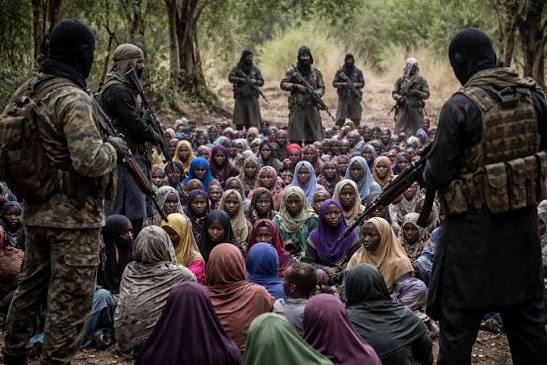
Nigeria’s kidnapping crisis is increasingly taking on the characteristics of an organised and highly profitable criminal economy, with a single Boko Haram faction reportedly accounting for about N7 billion in ransom payments during a 12-month period.
The development highlights how terrorism and kidnapping have become increasingly interconnected, turning abductions into a major source of funding for armed groups operating across the country.
According to findings from SBM Intelligence’s report, The Capture of Nigeria’s Kidnap Economy, 7,825 people were abducted in 1,411 incidents between July 2025 and June 2026.
At least 1,142 people were killed in violence connected to kidnapping during the period, demonstrating the devastating human cost behind the financial figures.

Across the country, kidnappers reportedly demanded an estimated N22.86 billion in ransom, while victims and their families paid about N7.78 billion.
What stands out from the figures is that approximately N7 billion of the amount paid went to Jama’atu Ahlis Sunna Lidda’awati Wal-Jihad, commonly known as JAS, a Boko Haram faction, from only eight recorded cases.
The figures reveal a significant change in the economics of kidnapping in Nigeria.
While ransom demands declined compared with the previous reporting period, the amount actually collected increased sharply.
In the earlier period, kidnappers demanded roughly N48 billion but collected only N2.56 billion, representing a collection rate of about 5.35 percent.
During the latest period, demands fell by more than half, yet actual payments more than tripled, producing a collection rate of approximately 34 percent.
DDM News reports that this shift suggests that kidnapping is becoming increasingly concentrated in the hands of groups with greater organisational capacity, territorial influence and the ability to conduct mass abductions.
Rather than relying solely on numerous small-scale operations, powerful armed groups can now generate enormous sums from a handful of carefully targeted incidents.
The JAS figures demonstrate the scale of that transformation.
The faction reportedly demanded N9.2 billion across eight cases and collected about N7 billion, translating to a collection rate of roughly 76 percent. By comparison, unaffiliated kidnappers demanded N13.49 billion across 146 cases but collected only about N719.4 million, or approximately 5.3 percent.
The difference illustrates the advantage that organised terrorist groups have in the ransom economy.
Smaller criminal groups may struggle to convince families to meet high demands or may lack the capacity to hold large numbers of victims.
Terrorist organisations, however, can use mass abductions, prolonged captivity and the threat of violence to exert greater pressure on families, communities and authorities.
Two major incidents were particularly responsible for the huge ransom figure attributed to JAS.
In April 2026, fighters reportedly operating under JAS commander Ali Ngulde abducted 416 people from Ngoshe in Gwoza, Borno State.
The group demanded N5 billion, which was reportedly paid in full.
Another major incident occurred in November 2025, when 315 pupils and staff were abducted from St Mary’s School in Papiri, Niger State.
The abduction reportedly generated a N2 billion ransom.
Together, the two incidents accounted for N7 billion, almost 90 percent of all ransom payments recorded nationally during the period and almost the entire amount attributed to JAS.
The scale of these incidents demonstrates why mass kidnapping has become financially attractive to heavily armed groups.
Instead of conducting numerous separate operations involving smaller numbers of victims, an organised group can target a school, village or community and potentially secure a much larger financial return from a single operation.
Beyond the immediate financial loss suffered by families, the expansion of the ransom economy carries wider consequences for Nigeria’s economy.
Families may be forced to sell assets, borrow money or exhaust their savings to secure the release of relatives.
Businesses operating in affected communities can also suffer as workers become afraid to travel, commercial activities decline and investment is discouraged.
The concentration of kidnapping in northern Nigeria remains particularly concerning.
During the period covered by the report, the region accounted for 93.7 percent of recorded victims, with 7,334 people abducted.
The Northwest alone recorded 680 incidents involving 4,771 victims.
Zamfara State recorded the highest number of victims among individual states, with 236 incidents and 1,921 people abducted.
These figures underline the severe security pressures facing communities where kidnapping has become a persistent threat to livelihoods, mobility and economic activity.
For communities already struggling with poverty and limited economic opportunities, the kidnapping economy creates an additional layer of vulnerability.
Farmers may abandon their fields because of insecurity, traders may reduce movement between communities, and families may relocate from areas considered unsafe.
Over time, such disruptions can affect food production, local commerce and household incomes.
The financial incentives created by ransom payments also make it more difficult to dismantle kidnapping networks.
Where criminals believe that abductions can generate substantial returns, the practice can become self-sustaining.
Money obtained from ransom payments can potentially be used to acquire weapons, recruit fighters, maintain operational networks and finance further attacks.
This makes kidnapping more than a conventional criminal problem.
It becomes a security and economic challenge requiring coordinated responses from security agencies, financial institutions, communities and policymakers.
DDM News notes that tackling the problem will require more than rescuing victims after abductions occur.
Authorities must also work to disrupt the financial structures supporting criminal and terrorist networks.
Intelligence-led operations, stronger border controls, improved surveillance and better coordination between security agencies could help prevent large-scale abductions and weaken the organisations responsible.
The findings also reinforce the importance of protecting vulnerable institutions, particularly schools and rural communities.
The abduction of hundreds of pupils and staff from a school demonstrates how insecurity can directly threaten education and force families to make difficult decisions about whether their children can safely attend school.
Ultimately, the N7 billion figure represents more than money transferred through ransom payments.
It reflects a dangerous evolution in Nigeria’s kidnapping crisis, where powerful armed groups are demonstrating the capacity to turn mass abductions into highly lucrative operations.
The challenge before Nigeria is therefore not only to rescue victims and arrest individual kidnappers but to dismantle the economic system that makes kidnapping profitable.
Until the financial incentives behind mass abductions are weakened, the country risks seeing kidnapping continue to evolve from a fragmented criminal activity into a sophisticated source of funding for terrorism and organised violence.




