


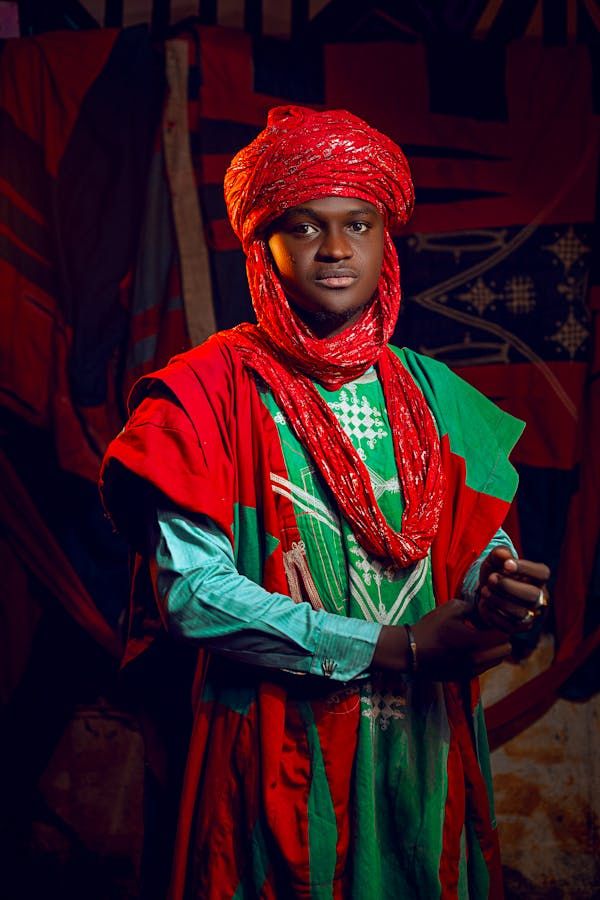
The Babban Riga, meaning “big gown” in Hausa, is far more than a traditional piece of clothing. For generations, the flowing robe has served as a powerful symbol of Hausa identity, social status, religious devotion, craftsmanship and cultural heritage. Recognised by its generous size, wide sleeves and elaborate embroidery, the Babban Riga has remained one of the most distinctive forms of traditional male attire associated with the Hausa people of northern Nigeria and the wider West African region.
The history of the Babban Riga is closely connected to the development of textile production, trade, Islamic culture and social institutions across the Sahel. Although similar flowing robes exist among several West African peoples and are known by different names, the garment is specifically called riga or babban riga in Hausa. Museums such as the Metropolitan Museum of Art identify the riga as the Hausa name for the large ceremonial robe that is also known as agbada in Yoruba and boubou in Francophone West Africa.

The garment developed within a region where clothing had to serve both practical and cultural purposes. The hot, dry climate of the Sahel meant that loose-fitting clothing could provide protection from intense sunlight while allowing air to circulate around the body. Historical accounts of the broader West African boubou tradition connect the development of these flowing robes with Hausa, Mande, Songhai-Zarma, Kanuri and other trans-Saharan communities whose traders and travellers needed clothing suitable for the harsh conditions of the region.
Over time, however, the Babban Riga became much more than protection from the weather. It developed into a garment associated with prestige and authority. Members of the aristocracy, traditional rulers and wealthy members of society could distinguish themselves through the quality of their robes, the richness of their fabrics and the complexity of their embroidery. A particularly elaborate Babban Riga could communicate the social standing of its wearer without the need for words.
Historical museum collections provide evidence of how far back this tradition goes. The British Museum holds a Hausa-made riga from Nigeria dated to approximately 1887–1891. The robe was constructed from numerous narrow strips of hand-woven cotton that were sewn together, with extensive embroidery around the front, shoulders and pocket. The museum describes it as one of the earliest carefully documented examples of the Hausa riga.
Other surviving examples demonstrate that these garments were not cheaply or casually produced. Some were made from indigo-dyed cotton, while others incorporated silk obtained through long-distance trade. One historical riga in the Cleveland Museum of Art, dating from the late nineteenth century to around 1910, contains cotton, silk and indigo and is described as a prestige garment worn by elite Nigerian men.

The production of the Babban Riga itself reflects the sophistication of Hausa textile craftsmanship. Traditionally, the fabric could be woven by joining narrow strips of cloth into a large garment. Hausa weaving communities developed distinctive methods of producing these textiles, while embroidery added another layer of artistic expression. According to the Spencer Museum of Art, Hausa men traditionally wove cotton cloth on horizontal treadle looms in wide strips, which were subsequently assembled into the large gown. Embroidery could incorporate locally produced wild silk known as tsamiya, which was spun into thread before being used for decoration.
The embroidery is one of the features that makes the Babban Riga particularly recognisable. Designs may appear around the neckline, chest, shoulders, front pocket and back. Among the traditional motifs is the aska takwas, translated as “eight knives,” a geometric pattern that appears in several historical Hausa robes. Some traditional designs were believed to have protective qualities, while others reflected the artistic and religious environment in which the garments were produced.
Religion also played an important role in the development and symbolism of the garment. Hausa society has a long history of Islamic scholarship and religious practice, and Islamic influence can be seen in aspects of Hausa art and clothing. The Spencer Museum notes that Hausa embroidery represents a combination of indigenous designs and Islamic traditions, with Qur’anic calligraphy sometimes appearing alongside Hausa symbols. White, for example, could carry associations with religious piety, making certain white robes especially appropriate for religious ceremonies.
The Babban Riga was also traditionally worn as part of a larger ensemble rather than as an isolated garment. A man might wear it over a long-sleeved shirt or tunic and trousers, while completing the appearance with a traditional cap or turban. Among members of the Hausa aristocracy, the complete outfit could also include a turban known as rawani and a long hooded cloak called alkyabba. The Bowers Museum describes this combination as part of the formal appearance historically associated with the Hausa male aristocracy of the Kano Emirate.
For DDM News, the story of the Babban Riga is therefore not simply a story about fashion. It is a story about how clothing can preserve the memory of a people. Every piece of embroidery, every woven strip and every carefully constructed sleeve reflects generations of knowledge passed from one generation to another.
The garment also demonstrates the importance of trade in shaping West African fashion. Silk and other materials used in some historic robes were obtained through wider commercial networks. The Royal Collection Trust notes that imported silk used in a Hausa riga provides evidence of the community’s connections with Europe and the wider trans-Saharan trading world.
Interestingly, the value of some Babban Riga garments was so high that they could remain within families for generations. The Metropolitan Museum of Art notes that fine prestige robes could become family heirlooms, passed from father to son and worn during major celebrations such as weddings and funerals.
The tradition of embroidery has also evolved. Research on Hausa hand embroidery in northern Nigeria shows that embroidery on voluminous Babban Riga garments was historically dominated by men, although women increasingly became involved in the craft as embroidery practices changed and machine production became more common.
Today, the Babban Riga continues to occupy an important place in Nigerian culture. While modern fashion has introduced new fabrics, colours, cuts and embroidery techniques, the essential identity of the garment remains recognisable. It continues to appear at weddings, religious celebrations, traditional ceremonies, political gatherings and other important occasions.
Modern designers have also helped the Babban Riga move beyond strictly traditional settings. Contemporary versions can be produced in lighter fabrics and more fashionable cuts, while retaining the wide silhouette and decorative embroidery that distinguish the original garment. This ability to adapt is one reason the Babban Riga has survived through changing generations and changing ideas about fashion.
The garment’s continued popularity also reflects the broader resilience of African traditional fashion. In an era when global fashion trends move rapidly through social media, traditional garments are increasingly being reinterpreted rather than abandoned. The Babban Riga has consequently become both a cultural inheritance and a modern fashion statement.
Its importance extends beyond the Hausa community as well. Related forms of the flowing robe are worn across West Africa, with different names and regional variations. The Metropolitan Museum explains that similar prestige robes can be found throughout the region, while the riga remains the Hausa term for the garment.
Ultimately, the history of the Babban Riga is a history of identity, craftsmanship, status, religion and adaptation. What may appear at first glance to be simply a large flowing gown is actually the product of centuries of cultural development and artistic skill.
From the traditional looms where narrow strips of cotton were woven, to the hands of skilled embroiderers who created intricate motifs, and eventually to today’s fashion designers who reinterpret the garment for a modern audience, the Babban Riga has continued to evolve without losing its cultural significance.
For DDM News, the enduring presence of the Babban Riga offers a powerful reminder that traditional fashion is not merely about what people wore in the past. It is also about who they were, what they valued and how they chose to express their identity. As generations continue to wear and reinvent the Babban Riga, the garment remains a visible connection between Hausa history and the modern world—a symbol of heritage that continues to command respect, elegance and cultural pride.




