


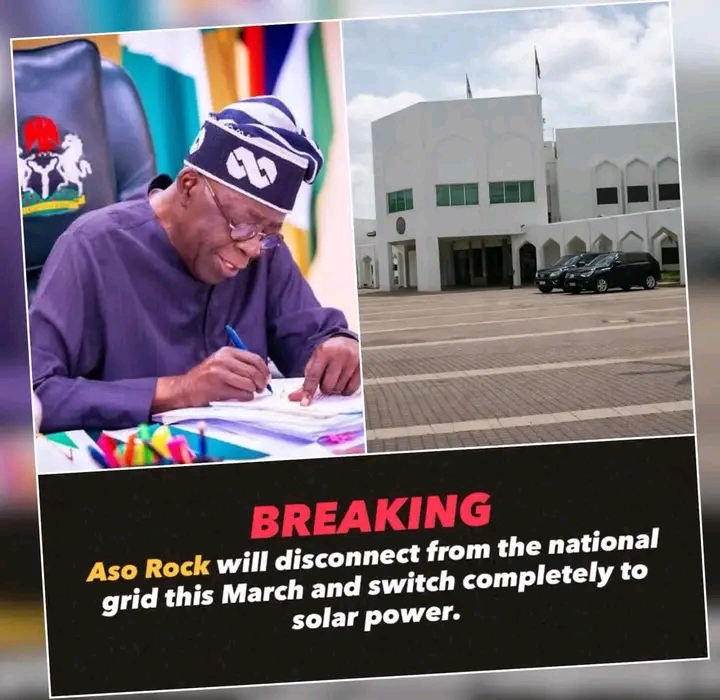
(DDM) – Nigeria’s seat of power is preparing to abandon the national electricity grid, a move that is already raising difficult questions about the country’s long-standing power crisis.
Diaspora Digital Media (DDM) gathered that the Aso Rock Presidential Villa will disconnect from the national grid by March 2026 and begin generating its own electricity through a dedicated solar power system.
The announcement was disclosed by officials from the State House.
The project involves installing a large solar energy facility with battery storage capable of powering the entire presidential complex.

Solar panels will generate electricity during the day.
Stored battery power will then supply electricity at night and during cloudy periods.
Officials say the goal is to guarantee a constant 24-hour electricity supply for the Presidential Villa.
But the decision has sparked debate across Nigeria because it comes against the backdrop of persistent electricity shortages nationwide.
Why the decision is controversial
Nigeria has struggled with unstable electricity for decades.
The national grid frequently suffers system collapses and widespread outages.
Millions of homes and businesses rely on expensive diesel generators to survive.
Critics say the decision for the Presidential Villa to abandon the grid sends a troubling message.
It suggests the government may be solving power problems internally while ordinary citizens continue to face unreliable electricity.
The political context
The controversy is heightened because reliable electricity was a key campaign promise during the 2023 elections.
President Bola Ahmed Tinubu repeatedly pledged to improve Nigeria’s electricity supply if elected.
He promised reforms aimed at stabilizing the national grid and boosting power generation.
Three years later, many Nigerians still experience daily power outages.
For some critics, the Presidential Villa’s move appears to contradict the broader goal of fixing the national power system.
Nigeria’s power reality
Nigeria’s electricity generation capacity remains far below demand.
The country of over 200 million people typically generates between 3,500 and 5,000 megawatts for the national grid.
Energy experts say Nigeria needs at least 30,000 megawatts to meet basic demand.
The shortage has forced institutions, companies, and households to develop independent electricity solutions.
Many businesses now rely heavily on solar power systems, inverters, and diesel generators.
The Presidential Villa’s decision reflects this growing shift toward off-grid electricity.
Why solar is becoming attractive
Solar power is gaining popularity in Nigeria because of the country’s strong sunlight throughout the year.
Solar systems can provide reliable electricity without relying on the national grid.
Battery storage allows solar energy to power buildings overnight.
Although the initial installation cost can be high, solar energy often becomes cheaper over time compared to diesel generators.
This is one reason many Nigerian banks, hospitals, universities, and offices are now installing solar power systems.
What it means going forward
Supporters of the Villa’s solar project argue that critical government facilities must have uninterrupted electricity for security and operational reasons.
However, critics say the move highlights the urgent need to fix Nigeria’s national grid.
If the country’s most important government complex cannot depend on the national grid, many Nigerians ask what hope exists for ordinary citizens.
For now, the plan for Aso Rock Presidential Villa to operate independently of the grid may guarantee power inside the seat of government.
But it also underscores a deeper national challenge.
Until Nigeria fixes its electricity system, more institutions may continue to abandon the grid entirely, leaving millions of citizens trapped in a costly cycle of generators and unreliable power.




