


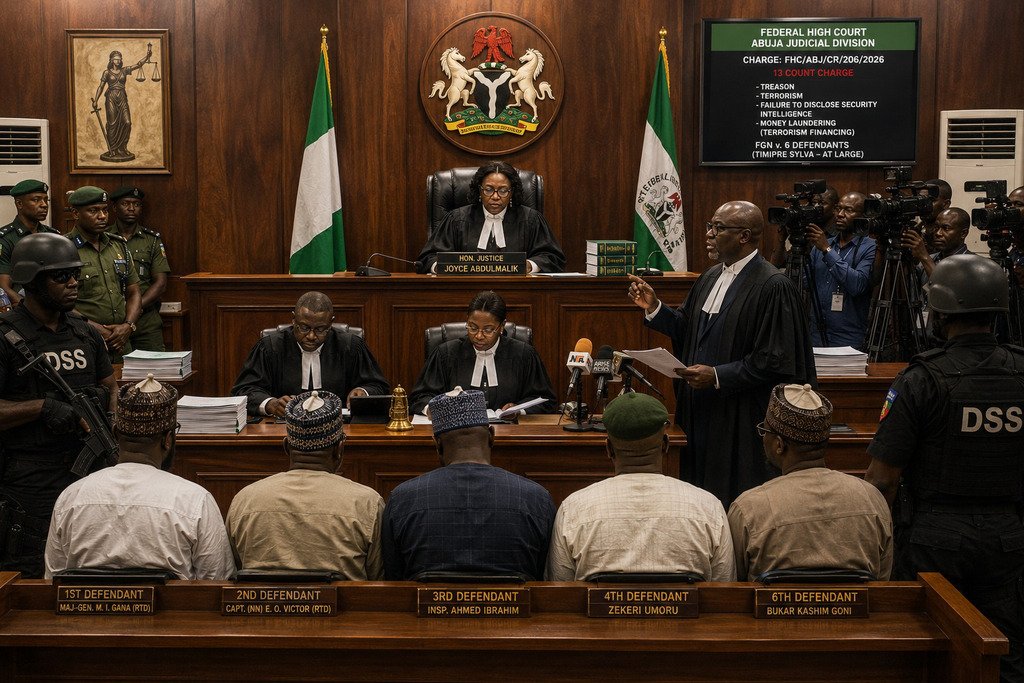
Fresh details have emerged in the ongoing trial over an alleged coup plot targeting President Bola Tinubu and senior government officials, as one of the accused persons narrated before the Federal High Court in Abuja how discussions allegedly unfolded around gaining access into Nigeria’s most protected seat of power — the Presidential Villa.
The account came from Zekeri Umoru, identified in court proceedings as one of the defendants standing trial in connection with allegations ranging from treason and terrorism-related offences to alleged concealment of security intelligence and financial activities linked to terrorism funding.
Umoru, who worked with Julius Berger Nigeria Plc in the Maintenance Department within the Presidential Villa, appeared at the centre of dramatic revelations after a recorded video statement was played in open court before Justice Joyce Abdulmalik.
According to the video evidence presented during proceedings, Umoru told investigators that discussions allegedly took place around creating vulnerabilities within the Villa’s operational systems as part of a broader plan to gain access to the highly secured complex.

Among the issues allegedly discussed, Umoru claimed there were conversations surrounding the possibility of disrupting electricity supply to the Presidential Villa. According to his account, such a move was considered as one of several ideas that could potentially create confusion and open opportunities for movement within the complex.
However, Umoru maintained that he opposed such thinking and cautioned those involved that tampering with the electricity infrastructure would immediately trigger suspicion, investigations and possible detention of workers assigned to duty at the time.
His statement suggested that he viewed such a move as impractical and highly risky given the intense security architecture surrounding the nation’s presidential residence.
The fourth defendant further alleged that the initiative was linked to discussions involving Colonel Mohammed Ma’aji, who investigators identified as the alleged mastermind behind the operation.
According to Umoru’s account, Colonel Ma’aji allegedly approached him indirectly through Police Inspector Ahmed Ibrahim, another defendant in the matter, with financial inducements intended to facilitate recruitment efforts inside the Presidential Villa.
Umoru told investigators that he was allegedly offered money to identify and recruit individuals who worked within the Villa’s internal environment.
The categories of persons allegedly targeted for recruitment, according to his testimony, included military personnel stationed within the complex, operatives of the State Security Service (SSS), and workers attached to Julius Berger operations inside the Villa.
He stated that the intended recruitment exercise was projected to involve between 18 and 19 individuals.
In another startling aspect of his testimony, Umoru alleged that he was informed that access into the Presidential Villa could still be achieved even if internal collaborators refused to cooperate.
According to him, Colonel Ma’aji allegedly expressed confidence that force could be used to achieve entry into the facility.
Umoru claimed that conversations later evolved into discussions about alternative entry methods into the Villa.
One of such alleged proposals, according to him, involved using an ambulance access route.
He told investigators that Inspector Ahmed Ibrahim allegedly demanded the sum of N100 million from the alleged mastermind to facilitate that access arrangement.
However, Umoru claimed the proposal did not move forward because the amount requested was considered excessive.
According to the statement played in court, Umoru alleged that despite rejecting that route, the alleged mastermind maintained confidence that access into the Villa could still occur by force, although such an attempt, according to Umoru’s account, could lead to violence and casualties.
The defendant further told investigators that as discussions progressed, he became increasingly uneasy.
He described reaching a point where he no longer felt comfortable with the direction events appeared to be taking.
According to his testimony, he repeatedly attempted to return money allegedly handed to him because he feared the consequences of being associated with any operation involving the Presidential Villa.
He reportedly told investigators that penetrating the Villa’s security structure “was no child’s play,” reflecting the seriousness with which he viewed the implications of the alleged plan.
Addressing another allegation raised during investigation, Umoru denied claims that he had access to the Presidential Villa’s solar power facility or that he intended to interfere with electricity systems within the complex.
He insisted that allegations linking him to plans to sabotage internal power infrastructure were untrue.
The court also heard his explanation for why he did not immediately alert security agencies after becoming aware of the alleged discussions.
According to Umoru, Inspector Ibrahim allegedly discouraged him from reporting the matter and advised him to delete messages connected to the conversations.
He further claimed he was instructed to avoid further communication with Colonel Ma’aji due to what was described as an ongoing audit process at their office.
The proceedings formed part of an ongoing trial-within-trial being conducted by the Federal High Court to determine whether statements obtained from the six defendants were made voluntarily and should therefore be admissible during the substantive trial.
Justice Abdulmalik subsequently adjourned proceedings to May 21 for continuation of the hearing.
The Federal Government, acting through the Office of the Attorney-General of the Federation, had earlier filed a 13-count charge before the court.
The case, marked FHC/ABJ/CR/206/2026 and filed on April 20 by the Director of Public Prosecutions of the Federation, Rotimi Oyedepo (SAN), names six defendants in the matter.
Those listed include retired Major General Mohammed Ibrahim Gana, retired Captain Erasmus Ochegobia Victor, Inspector Ahmed Ibrahim, Zekeri Umoru, Bukar Kashim Goni and Abdulkadir Sani.
Also referenced in the proceedings is former Minister of State for Petroleum Resources, Timipre Sylva, who was identified in the charge documents as being at large.
As proceedings continue, the court is expected to determine preliminary legal questions surrounding the admissibility of evidence before substantive arguments begin on the allegations. The defendants remain accused persons before the court, and the allegations are yet to be proven in a final judgment. DDM News will continue to monitor developments as the case unfolds and provide updates as new details emerge from the courtroom. For observers of Nigeria’s political and security landscape, the case has already drawn national attention because of the sensitive institutions and individuals referenced in the proceedings. DDM News reports that the outcome of the ongoing legal process may shape public discourse around national security, accountability and the handling of high-profile criminal allegations in Nigeria.
Source: Premium Times




