


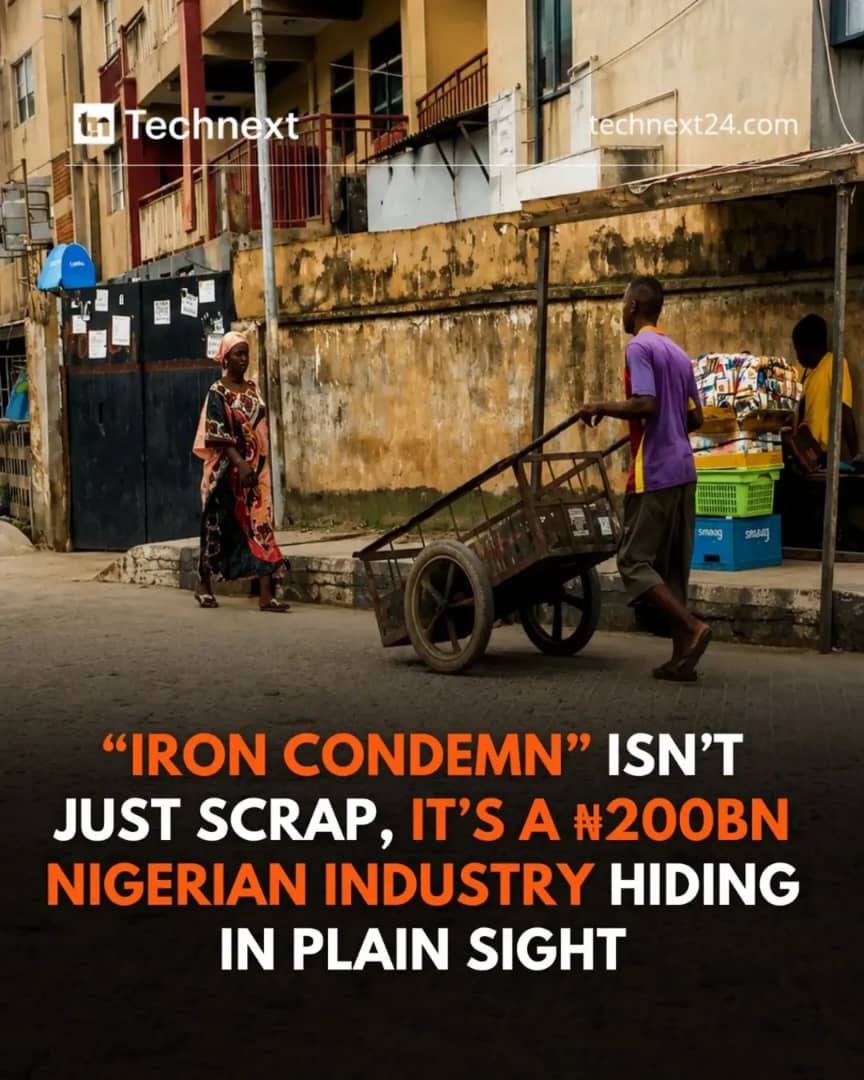
When next you want to go into business, perhaps you should think beyond the businesses that look attractive on the surface. Think about “iron condemn.”
To many Nigerians, the phrase “iron condemn” immediately brings to mind scavengers pushing wheelbarrows through neighbourhoods, calling out for unwanted metals, old appliances, damaged car parts, wires, batteries and other discarded materials. It is easy to look at the people moving from street to street collecting these items and assume that they are simply dealing in waste.
But behind that familiar street activity is a much larger and surprisingly profitable business ecosystem.
What looks like rubbish to one person can represent valuable inventory to another. What has become useless inside a home, workshop, factory or construction site can still have considerable economic value once it enters the scrap-metal supply chain.

Across Nigeria, thousands of people participate in this informal economy, from street scavengers and small-scale collectors to junkyard operators, metal dealers, recycling companies and exporters. In Lagos, one of the country’s biggest commercial centres, the business has become particularly visible around major scrap markets and industrial areas.
At the bottom of the chain are the scavengers.
These are the people who move around communities searching for discarded metals. They collect old refrigerators, damaged generators, air-conditioners, vehicle parts, electrical cables, metal doors, pipes, cooking equipment and countless other items. Some may earn around ₦5,000 to ₦12,000 in a day, depending on how much they collect, what type of materials they find and the prevailing market prices.
For many people, that daily income may appear modest. But the real business opportunity becomes clearer as the materials move further up the value chain.
The scavenger sells to a dealer. The dealer aggregates larger quantities and sorts them according to type and quality. Larger merchants then buy from multiple dealers, markets, factories, companies, demolition sites and other sources. Eventually, the materials can be supplied to recycling plants, manufacturers or exporters.
That is where the economics become much more interesting.
Different metals command very different prices. Iron may sell for hundreds of naira per kilogram, while aluminium can be worth considerably more. Brass attracts an even higher price, while copper remains one of the most valuable commonly traded scrap metals.
Depending on quality, location, market conditions and the buyer, copper can command prices running into thousands of naira per kilogram. This explains why experienced dealers are not simply buying “scrap.” They are buying according to composition, weight, purity and future resale value.
A pile of old electrical wires, for example, may look worthless to an untrained eye. An experienced dealer sees copper.
A damaged air-conditioner may look like a useless appliance. A scrap dealer sees aluminium, copper and other recoverable materials.
An abandoned vehicle may appear to be nothing more than an old car. Someone in the scrap business sees metal, parts and components that can be separated and sold individually.
This ability to identify value is one of the biggest skills in the business.
According to accounts from dealers operating around major scrap markets such as Owode-Onirin in Lagos, experienced traders can move substantial volumes of material and generate significant profits when they have reliable suppliers and buyers. Some dealers who operate at a larger scale say that their weekly earnings can reach millions of naira during favourable periods, although such figures vary greatly depending on volume, expenses, prices and access to supply.
The business also rewards knowledge.
Some dealers spend years learning how to distinguish different metals and identify valuable materials hidden inside objects that others would immediately discard. The difference between ordinary scrap and a valuable metal can sometimes be determined by colour, weight, texture, density, magnetism or other practical tests.
That knowledge can become a competitive advantage.
Someone who knows exactly what they are buying can avoid paying premium prices for low-value materials while identifying items that contain more valuable metals. In an industry where tonnes of materials may change hands, even a small difference in purchasing decisions can have a significant impact on profit.
This is why the scrap-metal business is much more than collecting rubbish.
At the larger end of the market, businesses handle tonnes of metal every day. Materials are sorted, cleaned, processed, compressed, melted or otherwise prepared for recycling and manufacturing. Some eventually become new products such as steel bars, nails, pipes, sheets, automobile components and other industrial materials.
In other words, the “condemn” collected from Nigerian streets can eventually return to the economy as something completely different.
This is also where the environmental importance of the industry becomes clear. Scrap collection helps remove unwanted metal from streets, compounds, abandoned buildings and industrial spaces while providing raw materials that can be reused rather than simply discarded.
Yet despite the money involved, the sector remains heavily informal.
Many operators work without the sophisticated systems associated with larger industries. They face intense competition, changing commodity prices, transportation costs, security challenges and difficulties accessing reliable supply. Some traders also complain about harassment and other challenges associated with operating within an informal economy.
There are also risks for anyone considering entering the business. Scrap prices can change quickly. Transportation can eat into margins. Buying stolen materials can create serious legal problems. Poor sorting can lead to losses, while unreliable buyers can affect cash flow.
That means anyone looking to enter the industry must understand that collecting scrap is only one part of the business. The bigger opportunity lies in building a structured operation around sourcing, sorting, pricing, storage, transportation and reliable buyers.
The entrepreneur who begins with a small collection point can gradually build relationships with mechanics, construction companies, manufacturers, households, demolition contractors and other businesses that regularly generate metal waste.
Instead of waiting for scavengers to bring materials, a more organised operator can create a network of suppliers.
That is where the informal street business can begin transforming into a serious enterprise.
Nigeria’s growing urban population, construction activity, manufacturing sector and automobile market will continue to generate enormous quantities of discarded materials. The question is not whether waste will exist. The question is who will build the business systems capable of turning that waste into economic value.
And that is the lesson hidden inside the words “iron condemn.”
The person pushing a wheelbarrow may see a day’s income. The small dealer may see stock. The major merchant may see tonnes of inventory. The recycler sees raw materials. The manufacturer sees inputs for production. The entrepreneur sees an entire industry.
As DDM News examines Nigeria’s emerging business opportunities, the scrap-metal trade is a reminder that profitable businesses are not always found in glamorous offices, expensive shops or fashionable industries. Sometimes they are hiding in the things people throw away.
So, the next time you hear someone shouting “iron condemn” on the street, don’t be too quick to dismiss the business behind the voice.
What one person considers useless may be another person’s raw material, another person’s inventory and, potentially, another person’s fortune.
As the saying goes, one man’s food is another man’s poison.
In Nigeria’s scrap-metal economy, however, one person’s waste can quite literally become another person’s wealth.
And for an entrepreneur willing to understand the market, build legitimate supply networks and operate professionally, “iron condemn” may be more than scrap. It could be the beginning of a very serious business.




