


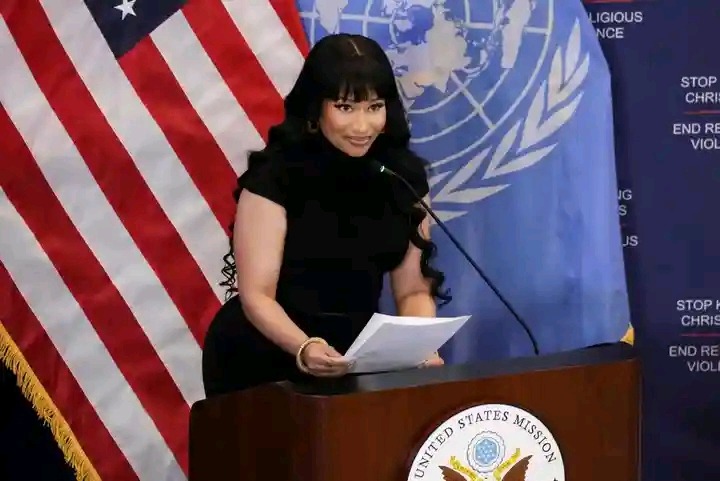
American rapper Nicki Minaj has revealed that her Nigerian pastor and strong connection with Nigerian fans inspired her to speak publicly about reports of violence against Christians in Nigeria, calling on celebrities and social media influencers to use their platforms to raise awareness.
The award-winning musician made the disclosure during an X Takeover event at Tesla’s Giga Texas facility in Austin, Texas, where she discussed her decision to draw attention to the reported persecution of Christians and encouraged other influential personalities to join the conversation.
Minaj explained that her connection to Nigeria was partly personal because her pastor is Nigerian. She also pointed to the support she receives from Nigerian fans, popularly known as Barbz, as another reason the country’s challenges matter to her.

“For Nigeria personally, my pastor is from Nigeria, so I have a link to Nigeria because of him. And of course, I have a lot of Nigerian barbs, but what I started seeing was the brutality with which Christians are being treated there just for being Christian,” she said.
Her remarks highlight how personal relationships and international fan communities can influence the issues celebrities choose to address publicly. Although Minaj is not Nigerian, she said her connection to the country helped draw her attention to reports of attacks against Christian communities.
The rapper expressed concern that the issue had not attracted what she considered sufficient attention from prominent public figures. She questioned why more celebrities and influencers were not speaking about the reported violence, suggesting that some might hesitate to address controversial subjects because they are not always popular in public discourse.
“And I thought, why isn’t anyone making a big deal out of this, you know? And sometimes when things aren’t cool to talk about, people don’t talk about it,” Minaj added.
She urged entertainers, online personalities and other public figures to look beyond issues that dominate popular culture and pay attention to humanitarian concerns affecting vulnerable communities.
Minaj also indicated that she wanted to do more than simply discuss the situation. She expressed hope that her intervention would encourage a wider group of influential personalities to speak out and help bring international attention to the plight of Christians facing violence in Nigeria.
“So right now, actually, I’m hoping that more celebrities or people, influencers, I’m hoping that they come aboard the train to start speaking out about what’s happening to Christians in Nigeria. And I look forward to doing more to help in that way, in that cause,” she said.
Her appeal places the responsibility for raising awareness beyond governments and religious organisations, highlighting the potential role of entertainers and digital influencers in shaping international conversations about human rights and religious freedom.
Minaj has a substantial global following, giving her comments the potential to introduce the subject to audiences who may not closely follow Nigeria’s security situation. Celebrity involvement can attract public attention to humanitarian concerns, although sustained progress generally depends on reliable information, responsible advocacy and practical efforts to protect affected communities.
Nigeria has faced persistent security challenges in several regions, including attacks by armed groups, insurgency, banditry and communal violence. Christian communities have suffered attacks, killings and displacement in some areas, while Muslims and other groups have also experienced serious violence.
The causes and circumstances of these incidents differ. Some attacks have been linked to extremist ideologies, while others occur amid criminal activity, local disputes, competition over land and resources, or broader security breakdowns. Consequently, individual incidents require careful investigation to establish the perpetrators, motives and circumstances.
Minaj’s comments specifically focus on violence against Christians and the importance of ensuring that reports of religiously motivated attacks receive international attention. Her position has contributed to ongoing discussions about religious freedom, the protection of worshippers and the responsibility of authorities to safeguard communities.
For Nigeria, the issue remains significant because insecurity has affected communities across different parts of the country, forcing some residents to flee their homes and disrupting livelihoods, education and religious activities. Calls for protection and accountability have therefore continued to feature in discussions about the country’s security challenges.
Minaj’s intervention also raises questions about how public figures can contribute meaningfully to such discussions. Beyond drawing attention to reported attacks, advocates can encourage the verification of information, support humanitarian assistance and call for effective measures to protect civilians regardless of their religious beliefs.
By linking her interest in Nigeria to her pastor and Nigerian supporters, Minaj has offered a personal explanation for why she chose to speak out. Her call for more celebrities and influencers to join the discussion signals her desire to broaden awareness of the issue.
Whether her appeal will lead to further public commitments from other entertainers remains to be seen. However, her comments have brought renewed attention to reports of violence against Christians in Nigeria and the wider debate over religious freedom and civilian protection.




