


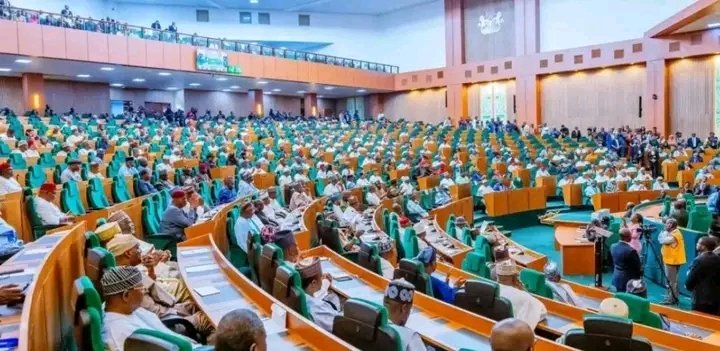
ABUJA, Nigeria — The House of Representatives has withdrawn its version of the state police bill to consider President Bola Tinubu’s proposal, marking a significant procedural shift in the legislative process as both chambers now move to harmonise the two versions before transmitting the constitutional amendment to state assemblies for ratification.
The House of Representatives had passed its version of the State Police Bill on June 10, while the Senate approved the Executive Bill transmitted by President Tinubu on June 24. Both chambers are now set to constitute a joint harmonisation committee to reconcile differences in their separately passed versions before producing a unified bill for transmission to the 36 state Houses of Assembly.
The Senate version of the bill contains 26 clauses, while the House version has 18, with notable differences in several constitutional amendments proposed by both chambers. A comparison of the two versions showed that while the House made limited amendments to Sections 34, 35, 39, 42, 89, 129, 153 and 197 of the Constitution, the Senate amended Sections 84, 89, 121, 124, 129, 157, 158, 160, 197, 201 and 202.
Both chambers proposed a new Section 214 to replace the existing constitutional provision establishing the Nigeria Police Force. However, the Senate introduced 15 new sub-clauses under the section, compared with seven contained in the House version. The two chambers also differed in the structure of Section 215, which deals with the appointment and control of the police.

The Senate version also contains seven transitional provisions to guide the establishment of state police and introduces substantial amendments to the Second, Third and Fourth Schedules of the Constitution, whereas the House amended only the Second and Third Schedules.
Deputy Speaker of the House of Representatives and Chairman of the House Committee on Constitution Review, Benjamin Kalu, said a conference committee would be constituted after the House resumes from recess to harmonise the differences. House spokesman Akin Rotimi also confirmed that the committee would reconcile the two versions before the final document is transmitted to the states.
“There is nothing fundamental. What remains is to cross the t’s and dot the i’s so that both chambers can produce a single version for transmission to the states,” Kalu said. He expressed confidence that the harmonisation process would be completed shortly after lawmakers resume, adding that once the unified bill is ready, it would be transmitted to the state legislatures the same day.
The proposed legislation seeks to establish a dual policing structure, allowing state police services to operate alongside the existing Federal Police Service. Under the proposed framework, each state’s police service will be headed by a Commissioner of Police appointed by the governor and confirmed by the State House of Assembly.
To prevent abuse, the proposed law empowers the Federal Police Service to intervene temporarily in a state’s policing operations under clearly defined circumstances, including a breakdown of public order, administrative incapacity, gross violations of fundamental rights or threats to national security. Any intervention must be authorised by the President, limited in scope and duration, and remain subject to judicial review.
The bill also bars existing regional and community security outfits, including Amotekun, Ebube Agu and Hisbah, from automatically transforming into state police services or exercising police powers, including the power to bear firearms, unless expressly authorised by the Constitution and an Act of the National Assembly.
Support for the proposal has continued to grow, with the Conference of Speakers of State Houses of Assembly pledging to give the bill expeditious consideration once it is transmitted. Lagos State Governor Babajide Sanwo-Olu has also declared that the state is prepared for state policing, saying Lagos would leverage the expertise of retired security professionals if the legislation becomes law.
The constitutional amendment will require the approval of at least two-thirds of the State Houses of Assembly before it can be presented to the President for assent. Under Section 9 of the Constitution, a constitutional amendment bill must be passed by both chambers of the National Assembly, each by a two-thirds majority, in identical terms. Following passage by both chambers, the bill must be transmitted to the 36 State Houses of Assembly, where it requires the approval of at least 24 of them, before it is forwarded to the President for assent.
As the harmonisation process unfolds, the National Assembly is set to produce a unified version of the bill for transmission to the state legislatures, bringing Nigeria closer to what could become one of the most consequential security reforms since the country’s return to democratic governance in 1999.




