


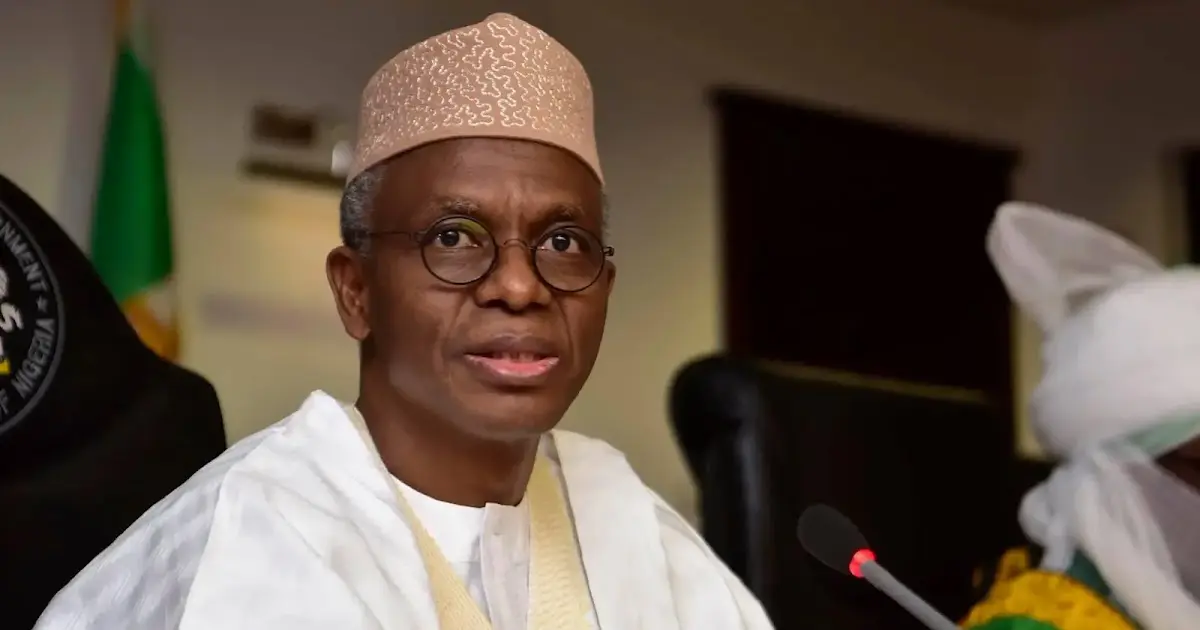
A forensic investigator with the State Security Service (SSS), Segun Kayode, has told the Kaduna State High Court that former Kaduna State Governor Nasir El-Rufai and some of his associates allegedly earmarked $600,000 for payments to officials of the Economic and Financial Crimes Commission (EFCC) and intermediaries.
Kayode, the first prosecution witness in the ongoing trial, made the allegation on Tuesday while testifying before Justice Darius Khobo at the court sitting in Kawo, Kaduna.
He said the alleged payments comprised $500,000 and $100,000, adding that forensic audio recordings captured conversations involving El-Rufai and individuals suspected to be his associates.
According to the witness, the conversations centred on alleged efforts to frustrate an EFCC investigation into a company identified as Singularity.

Kayode told the court that a Senior Advocate of Nigeria, AU Mustapha, Jimi Lawal and Bashir El-Rufai were among those allegedly mentioned in the recordings.
He alleged that Mustapha and Lawal were directed to meet one Ahmadu Sule to obtain a template previously used in the liquidation of another company, with the intention of applying a similar process to Singularity.
The witness further alleged that the discussions involved plans to liquidate the company in Nigeria and Mauritius, where it was reportedly under investigation by the Nigerian Financial Intelligence Unit.
Kayode also told the court that the recordings contained discussions about preventing the EFCC from investigating IHS, which he described as a company listed on the New York Stock Exchange.
The allegations formed part of the prosecution’s evidence against the former governor and have yet to be established by a judicial determination.
Defence challenges witness testimony
Before Kayode began his testimony, El-Rufai’s lead counsel, Paul Erokoro, challenged his appearance as a prosecution witness.
Erokoro argued that the investigator’s name and a summary of his proposed evidence were missing from the prosecution’s proof of evidence, making it difficult for the defence to prepare adequately.
He maintained that the omission undermined his client’s right to a fair hearing, insisting that the defence was entitled to know the evidence it would be required to answer.
However, Ayodeji Adedipe, counsel to the Independent Corrupt Practices and Other Related Offences Commission (ICPC), urged the court to dismiss the objection.
Adedipe argued that Kayode had been subpoenaed and that the absence of his name and evidence summary from the proof of evidence did not automatically make his testimony inadmissible.
He told the court that the subpoena was issued and signed on June 30, 2026, adding that the defence would have the opportunity to cross-examine the witness.
Erokoro maintained that his objection went beyond the validity of the subpoena, arguing that the prosecution had not provided sufficient information for the defence to prepare its case.
He cited Section 210 of the applicable Administration of Criminal Justice Law, 2017, contending that the prosecution should have served the subpoena on the defence.
In his ruling, Justice Khobo acknowledged that Kayode’s name and summary of evidence were absent from the prosecution’s proof of evidence but held that the records showed the witness had been subpoenaed.
The judge ruled that the omission did not automatically render the testimony inadmissible, provided the defence was allowed to cross-examine him. He consequently overruled the objection and directed Kayode to proceed.
Court admits investigator’s findings
After Kayode submitted a hard copy of his findings to the court clerk, the defence raised another objection, arguing that the document should have been served earlier to allow counsel sufficient time to examine it.
The court ruled that the defence could obtain a certified true copy of the document admitted as Exhibit One for examination.
The decision allowed the proceedings to continue, with the defence expected to scrutinise the findings and challenge the investigator’s evidence during cross-examination.
The hearing lasted nearly eight hours, from 12:26pm to 8:18pm. About two hours were spent playing the recorded conversations presented by the prosecution.
The court adjourned the case until November 30 and December 1, 2026, for the continuation of cross-examination, following agreement between the prosecution and defence.
El-Rufai arrived at the court premises at about 11:50am, ahead of the scheduled noon hearing, amid tight security. He was accompanied by Isa Ashiru, the African Democratic Congress governorship candidate in Kaduna State.
His appearance followed an order by Justice Khobo directing the ICPC to produce him in court for the resumed proceedings.
The previous sitting had been adjourned on Monday after the former governor failed to appear. The court was informed that he had requested access to his personal physician to review medical test results.
Appeal court had rejected bail request
The resumed hearing came days after the Court of Appeal in Kaduna dismissed El-Rufai’s appeal challenging the state high court’s refusal to grant him bail.
In its judgment delivered on October 9, the appellate court upheld the lower court’s decision, ruling that the former governor had not established sufficient grounds to justify its intervention.
El-Rufai has remained in ICPC custody since February 18, 2026, over allegations of financial misconduct relating to his administration of Kaduna State between 2015 and 2023.
The investigation followed a petition by the Kaduna State House of Assembly to the ICPC over the alleged diversion and mismanagement of more than ₦423 billion in public funds during his eight-year tenure.
The allegations remain subject to the ongoing legal proceedings.




