


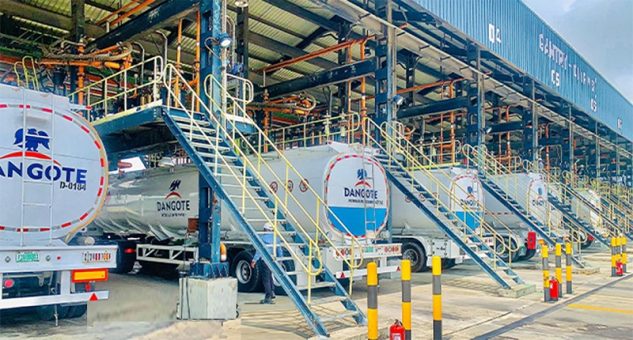
The Dangote Petroleum Refinery has warned that it may redirect some of its petrol production to export markets as rising imports create uncertainty over domestic demand and make it increasingly difficult to plan production and inventory levels.
The refinery raised the concern after imported Premium Motor Spirit (PMS), commonly known as petrol, accounted for about 43 per cent of the petrol supplied to the Nigerian market in July.
The development has raised questions about the future balance between locally refined petroleum products and imported supplies, particularly as the Dangote Refinery has the capacity to produce enough petrol to meet a significant portion of Nigeria’s domestic demand.
According to the refinery, the continued issuance of petrol import licences has made it more difficult to predict how much of the product will be required from domestic refiners.

This uncertainty, it said, creates commercial difficulties for maintaining large petrol inventories specifically for the Nigerian market.
The refinery explained that it has consistently maintained adequate petrol reserves and dedicated substantial resources to ensuring that the domestic market receives sufficient supplies.
However, the increasing presence of imported petrol is changing the commercial environment in which the refinery operates.
When large volumes of imported petrol enter the market alongside locally refined products, domestic refiners face greater uncertainty over how much of their production can be sold locally.
This can make inventory planning more complicated because petrol production and storage decisions are generally made ahead of actual market demand.
For a refinery operating at a large scale, the ability to accurately forecast demand is particularly important.
Production needs to be planned around expected consumption, available storage capacity, crude supply and distribution arrangements.
If the market is suddenly supplied with significant quantities of imported petrol, a refinery may be left holding inventories that take longer to sell.
The Dangote Refinery’s warning therefore reflects a broader concern about the relationship between domestic refining and petroleum imports in Nigeria.
For years, Nigeria depended heavily on imported refined petroleum products because domestic refineries were unable to consistently meet national demand.
The opening and expansion of the Dangote Refinery has changed that situation by providing Nigeria with a major new source of locally refined products.
The refinery has invested heavily in its operations and has sought to increase its contribution to the domestic petroleum market.
Its ability to produce petrol locally is expected to reduce Nigeria’s dependence on imports and help retain more value within the country.
However, the continued arrival of imported petrol means the transition from an import-dependent market to one increasingly supplied by domestic refining is not straightforward.
DDM News reports that the 43 per cent share of imported PMS recorded in July highlights the scale of competition facing local refining operations.
The development could also have implications for the refinery’s future production strategy.
If domestic demand becomes difficult to predict because of competing imported supplies, exporting part of its petrol production could become a commercially attractive alternative.
Export markets could provide the refinery with another outlet for products that might otherwise remain in domestic storage.
The possibility of exporting petrol would represent an important development for Nigeria.
The country has historically spent substantial amounts of foreign exchange importing refined petroleum products.
A shift towards exporting refined petrol could potentially transform Nigeria from a major importer of petroleum products into a significant exporter.
However, the ability to achieve this will depend on several factors, including production costs, international petrol prices, logistics, shipping expenses and the competitiveness of Nigerian refined products in foreign markets.
The refinery’s warning also brings attention to the importance of creating a predictable regulatory and commercial environment for domestic refiners.
Large-scale refineries require significant investments and long-term planning.
Investors and operators need confidence that there will be sufficient market demand for locally produced petroleum products.
Frequent changes in supply patterns or uncertainty over import volumes can make it more difficult for refiners to determine how much product to produce and store.
The Dangote Refinery argued that the continued issuance of petrol import licences reduces visibility over future supply volumes.
This means the refinery may not be able to accurately determine the level of domestic demand it should plan for over a particular period.
For a market with substantial daily petrol consumption, even relatively small changes in demand or supply can result in significant inventory movements.
The issue is also important for consumers.
Competition between imported and locally refined petrol could potentially create pricing pressure in the market.
If importers are able to bring products into Nigeria at competitive prices, domestic refiners may face pressure to keep their own prices competitive.
At the same time, increased local refining could reduce exposure to international shipping and import-related costs over the longer term.
Nigeria’s petrol market has historically been sensitive to changes in international crude prices, exchange rates and foreign exchange availability.
The country’s dependence on imports meant that fluctuations in these areas could quickly affect the domestic price and availability of petrol.
The emergence of a large domestic refinery offers an opportunity to reduce some of those vulnerabilities.
However, that opportunity can only be fully realised if local refining capacity is matched with a stable and predictable market.
The government has repeatedly emphasised the importance of ending Nigeria’s dependence on imported refined petroleum products.
The Dangote Refinery has become central to that ambition because of its large production capacity and its ability to supply multiple petroleum products.
Its operations could help strengthen Nigeria’s energy security while also supporting the development of a domestic petroleum value chain.
DDM News understands that the current situation raises a broader question about how Nigeria balances short-term fuel supply needs with its long-term goal of developing domestic refining capacity.
Petrol imports may remain necessary when domestic production cannot fully satisfy demand or when temporary supply disruptions occur.
However, excessive or poorly coordinated imports could potentially undermine the ability of domestic refiners to plan production and maintain commercially sustainable operations.
The challenge for policymakers will therefore be finding a balance that protects consumers while encouraging local refining.
Ensuring adequate petrol supply remains essential because PMS is widely used for transportation, electricity generation and commercial activities across Nigeria.
Any disruption in supply can have consequences that extend beyond filling stations, affecting transportation costs, food distribution, businesses and household expenses.
At the same time, building a sustainable domestic refining industry requires market conditions that allow refiners to operate efficiently and compete fairly.
The Dangote Refinery’s warning could therefore encourage renewed discussions among regulators, refiners, importers and other stakeholders about the future structure of Nigeria’s petrol market.
A more coordinated approach could help reduce uncertainty while ensuring that consumers continue to have access to adequate supplies.
The refinery’s potential move to export petrol also demonstrates how quickly Nigeria’s position in the global petroleum market could change.
A country that once relied heavily on imported petrol could eventually become an exporter of refined products if domestic refining capacity continues to expand.
That transition would have implications for Nigeria’s foreign exchange earnings, trade balance and position within the regional petroleum market.
For now, however, the immediate concern remains the growing share of imported petrol in the domestic market.
With imports accounting for about 43 per cent of petrol supplied in July, the Dangote Refinery is facing a market where demand is becoming more difficult to predict.
The company’s warning suggests that unless there is greater clarity around future import volumes, it may have to consider alternative markets for some of its production.
Exporting petrol could provide the refinery with greater flexibility and allow it to maintain production even when domestic demand is uncertain.
However, the development also underscores the need for Nigeria to establish a petroleum market that can support both consumer interests and the growth of domestic refining.
The long-term objective should be a stable market where local refineries can operate efficiently, consumers have reliable access to affordable petroleum products and imports are used strategically when necessary.
As Nigeria continues to strengthen its domestic refining capacity, how the country manages this balance could determine whether the benefits of local refining are fully realised.
The Dangote Refinery’s latest warning therefore goes beyond a dispute over petrol imports.
It highlights the broader challenge of transforming Nigeria’s petroleum industry from one heavily dependent on imported refined products into a more self-sufficient and export-oriented energy sector.




