


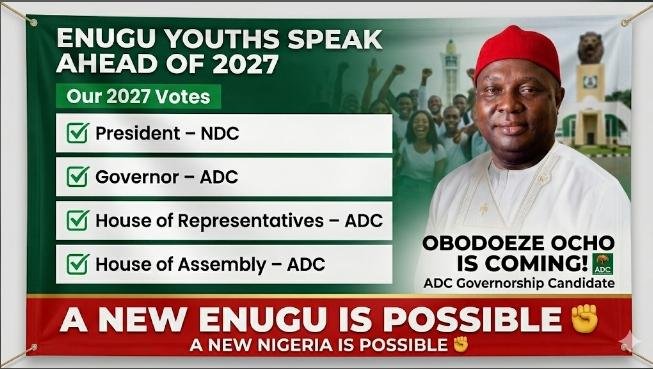
ENUGU, ENUGU STATE – A group of youths in Enugu State has publicly outlined their preferred political choices ahead of the 2027 general elections, signalling early grassroots mobilisation and political alignment within the state.
The youths, operating under a grassroots mobilisation structure for a new Enugu on Sunday at the state capital, declared support for different candidates across elective positions, including the presidency, governorship, and legislative offices.
According to the group, their proposed voting direction includes support for the Nigeria Democratic Congress (NDC) at the presidential level and the African Democratic Congress (ADC) for governorship and legislative seats in Enugu State.
The African Democratic Congress, African Democratic Congress, has in recent months intensified its mobilisation efforts across several states as it seeks to expand its influence ahead of the 2027 elections.

Speaking to the journalist, the group also promoted the governorship ambition of a candidate identified as “Obodoeze Ocho,” describing him as a key figure in their vision for what they called a “new Enugu.”
They expressed confidence that their preferred candidates would bring improved governance, youth inclusion, and developmental progress to the state.
The mobilisation message emphasized themes of political change, civic participation, and the desire for alternative leadership at both state and national levels.
Political observers note that such early declarations are increasingly common in Nigeria’s political space, particularly among youth-driven movements and grassroots organisations.
Analysts say while these declarations reflect growing political engagement, they do not yet represent official electoral outcomes or party endorsements at the national level.
The Nigeria Democratic Congress, New Democratic Congress, and other emerging political platforms continue to gain visibility among segments of young voters advocating for political reform and new leadership structures.
Stakeholders note that youth participation is expected to play a significant role in shaping electoral dynamics as political activities gradually build toward 2027.
The group’s message also highlighted slogans promoting a “new Enugu” and a “new Nigeria,” reflecting broader sentiments among politically active youth populations across the country.
However, political analysts caution that Nigeria’s electoral outcomes are influenced by complex factors including party structures, voter turnout, and established political networks.
As campaigns and mobilisations continue to emerge across states, attention remains focused on how youth movements will translate their enthusiasm into measurable electoral influence.
The declaration adds to the growing wave of early political positioning and alignment across Nigeria ahead of the next general elections.




