


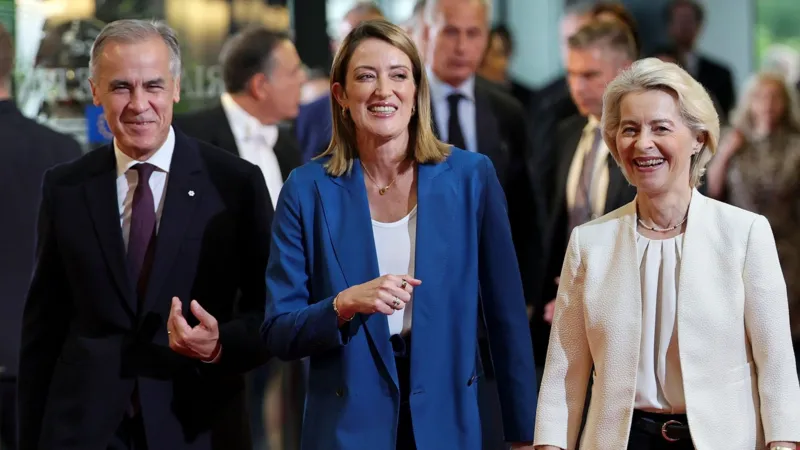
European Commission President Ursula von der Leyen has backed a proposal for Canada to become the European Union’s first “associate member”.
Speaking at the European Parliament in Strasbourg on Wednesday, von der Leyen said she wanted to work towards “opening the door” to Canada, with closer cooperation in key sectors.
Canadian Prime Minister Mark Carney, who was present during the address, has called for a “unique alliance” with the EU.
Canada’s relations with the United States have become increasingly tense, with trade disputes between Ottawa and Washington escalating in recent months.

Without directly mentioning US President Donald Trump, von der Leyen said closer ties with Canada would not be directed against any country.
“This is not a partnership against anyone else, but for our common strength,” she said.
She added that partnerships were a “strategic choice for Europe” in response to what she described as a fracture in the international rules-based system.
Carney is expected to address the European Parliament on Thursday.
Areas of cooperation
Von der Leyen said the EU and Canada shared similar positions on issues including artificial intelligence, climate change and geopolitics.
She cited cooperation on Ukraine, defence, raw materials and supply chains, saying both sides “believe in democracy”.
She proposed closer cooperation with Canada in manufacturing, technology, AI, defence, energy, critical minerals and economic security.
However, the EU does not currently have an “associate membership” category, meaning any such arrangement would require a new framework and could take years to establish.
Earlier this year, German Chancellor Friedrich Merz suggested that Ukraine could be given a similar status, although the proposal received mixed reactions.
Several Western Balkan countries, including Albania, Bosnia and Herzegovina, Montenegro, North Macedonia and Serbia, are pursuing full EU membership.
Georgia and Moldova are also seeking membership.
Meanwhile, 10 of the EU’s 27 member states have yet to ratify a free-trade agreement with Canada that was reached nearly a decade ago.
Some EU governments may prefer to strengthen existing trade and defence arrangements with Canada rather than create a new form of membership.
Von der Leyen said the EU’s relationship with Canada should be taken to “the highest level possible”.
EU proposes European Security Council
In her address, von der Leyen also proposed creating a European Security Council involving countries including the United Kingdom, Ukraine and Canada.
She said the proposal was aimed at strengthening cooperation on security as Europe faces what she described as growing risks from Russia.
“For a long time, we have discussed a leaders’ format focused on the security of our continent, with partners like Canada, Norway, Ukraine, the United Kingdom and others involved,” she said.
Von der Leyen said the EU would continue strengthening its cooperation with NATO and that increased European defence spending would be aligned with the alliance.
The proposed council could have a mechanism for calling emergency meetings when a member believes it is under threat, similar to NATO’s Article 4.
Support for the idea has grown since Russia’s full-scale invasion of Ukraine in 2022, although some countries have raised concerns that a European Security Council could duplicate or compete with NATO.
EU plans tougher social media rules
Von der Leyen also addressed the cost of living, technological changes and their impact on jobs and society.
She proposed talks with leading AI companies on managing the development of advanced AI systems and called for reducing bureaucracy for businesses across the EU.
The Commission also plans to propose restrictions on social media use by children, including a ban on accounts for those under 13.
Children aged 13 to 15 would only be allowed to create social media accounts under parental supervision.
On migration, von der Leyen said the EU would develop a new emergency mechanism to help member states respond to sudden mass movements of migrants.
She said the mechanism would only be activated under clearly defined conditions and for a limited period, while protecting fundamental rights.
Human rights groups have raised concerns that such measures could result in vulnerable migrants, including women and children, being denied protection under international law.




