


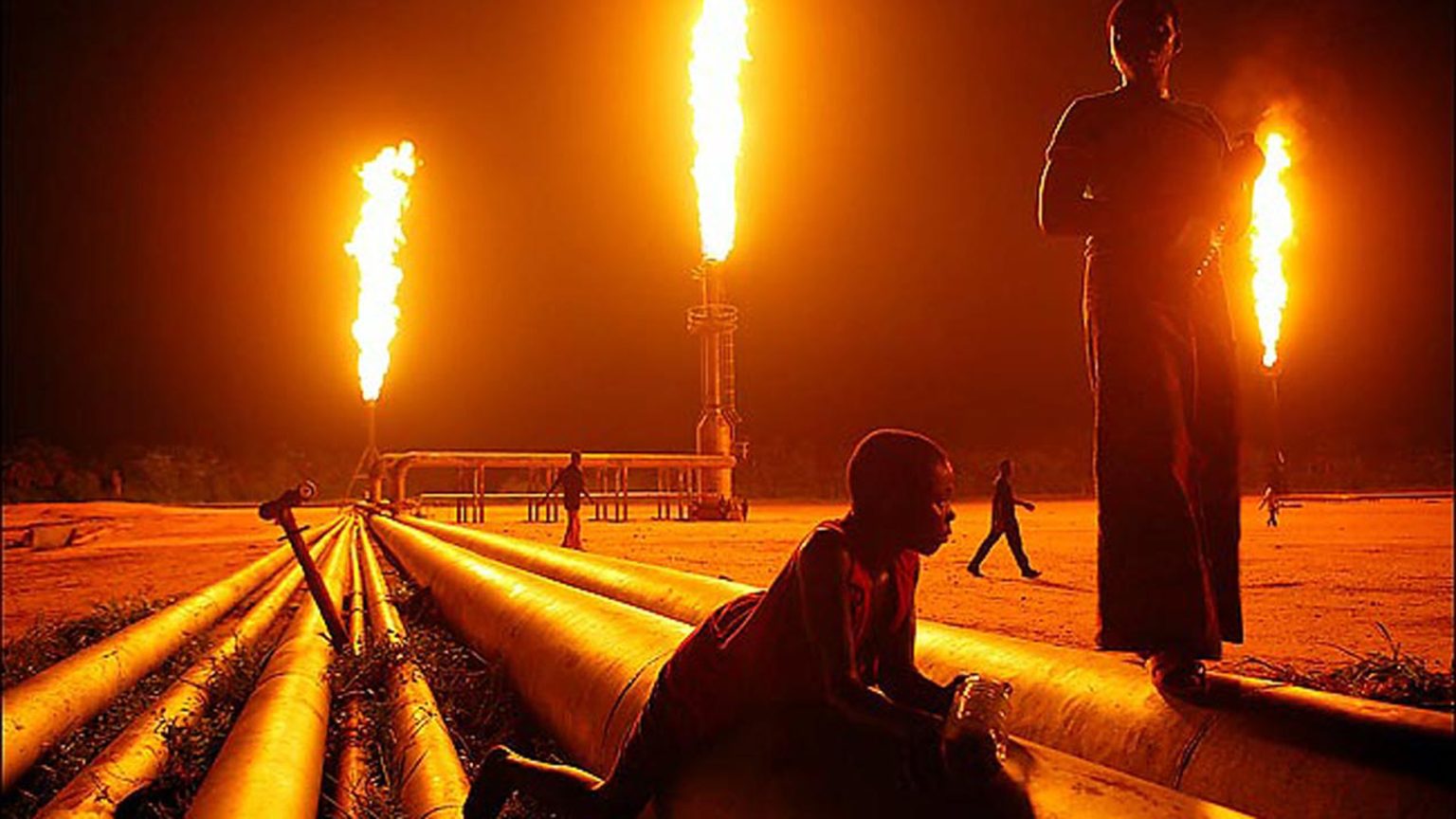
Nigeria’s Federal Government is tightening its response to persistent gas flaring, warning investors that failure to develop awarded flare-gas projects could lead to the revocation of their permits.
The warning comes after the country generated N521.87 billion from gas-flaring penalties in 2025, yet significant volumes of natural gas continued to be burned instead of captured and converted into commercially useful products.
The latest position signals a shift in the government’s approach to tackling a problem that has remained unresolved despite years of financial penalties, regulatory interventions and commercialisation initiatives.
The Nigerian Upstream Petroleum Regulatory Commission, NUPRC, issued the warning as it reviewed the implementation of the Nigerian Gas Flare Commercialisation Programme, NGFCP.

NUPRC Chief Executive, Oritsemeyiwa Eyesan, disclosed the position during a working visit to the Minister of State for Petroleum Resources, Gas, Ekperikpe Ekpo, in Abuja.
According to the regulator, investors who have received flare-gas site awards must demonstrate meaningful progress in developing and utilising the sites. Those that fail to meet the expected requirements could face regulatory action, including the withdrawal of their awards.
Eyesan explained that the Commission evaluates the performance of beneficiaries one year after an award is granted to determine whether sufficient progress has been made.
The warning is particularly significant because the NGFCP was created to move Nigeria beyond simply penalising companies for gas flaring. Its broader objective is to turn gas that would otherwise be wasted through flaring into an economic resource capable of supporting industries, power generation, investment and employment.
Under the programme, 43 flare-gas sites were initially identified, while 27 sites have so far been awarded for development.
The government’s renewed enforcement position suggests that it is no longer willing to allow investors to hold flare-gas opportunities without demonstrating clear steps towards actual development.
For Nigeria, the stakes are considerable.
Gas remains one of the country’s most important natural resources, with Nigeria possessing substantial reserves that could support domestic energy supply and industrial development.
However, the continued practice of gas flaring means that large quantities of potentially valuable resources are still being lost into the atmosphere.
DDM News reports that NUPRC recorded N521.87 billion in gas-flaring penalty collections in 2025 against an annualised target of approximately N699.84 billion.
Although the amount represents significant revenue, it also raises a bigger question about whether penalties alone can effectively discourage companies from flaring gas.
The collection figures varied considerably throughout the year.
Gas-flaring penalties generated only N839 million in January, representing a small fraction of the monthly target. Collections subsequently increased to N10.29 billion in February and N55.20 billion in March.
By June, collections had reached N68.94 billion, while September produced the highest monthly collection of N69.08 billion.
October also recorded a strong performance of N61.90 billion before collections fell to N51.84 billion in November and N48.86 billion in December.
Despite the substantial sums generated from penalties, gas flaring remained a persistent feature of Nigeria’s oil and gas industry.
The situation highlights the difficult balance between regulation and investment.
If penalties are too low, companies may consider them an acceptable cost of doing business instead of investing in expensive infrastructure required to capture, process and transport associated gas.
On the other hand, simply increasing penalties may not solve the infrastructure and commercial challenges that prevent gas from being effectively utilised.
Industry stakeholders have therefore continued to argue that Nigeria needs a stronger combination of enforcement, investment incentives and infrastructure development.
The economic opportunity is substantial.
Between January 2025 and June 2026, Nigeria reportedly produced about 4.132 trillion standard cubic feet of gas and utilised more than 3.823 trillion standard cubic feet.
During the period, approximately 301.60 billion standard cubic feet of gas was flared.
At an estimated prevailing gas price of $2.84 per million British thermal units, the flared gas represented a potential market value of about $888 million.
While this figure should not be interpreted as money that could immediately have been earned by the Nigerian economy, it demonstrates the scale of the resource being lost.
Capturing the gas requires gathering systems, processing facilities, pipelines, transportation infrastructure and reliable markets.
These infrastructure gaps remain among the biggest challenges facing Nigeria’s gas sector.
The World Bank has also continued to identify Nigeria among the countries with significant gas-flaring activity. Its 2025 Global Gas Flaring Tracker Report indicated that Nigeria remained among the world’s largest gas-flaring countries, with flaring increasing alongside higher oil production.
The challenge is particularly important for oil-producing communities in the Niger Delta, where gas flaring has long been associated with environmental degradation and concerns over public health.
Beyond the economic argument, environmental campaigners have repeatedly called for stronger action to end routine flaring and reduce the effects of petroleum production on host communities.
The Federal Government has set a target of ending routine gas flaring by 2030, making the successful implementation of the commercialisation programme increasingly important.
The Minister of State for Petroleum Resources, Gas, Ekperikpe Ekpo, has urged stakeholders to accelerate the implementation of the programme so that Nigeria can move closer to its flaring-reduction objectives.
For investors, the latest warning also introduces greater urgency.
Companies that received awards under the commercialisation programme now face increased pressure to show that their projects are moving from approvals and planning into actual development.
This could encourage serious investors to accelerate construction, secure financing and establish partnerships needed to commercialise flare gas.
However, the government will also need to ensure that the regulatory environment supports investment.
The commercialisation of flare gas can involve substantial capital expenditure, particularly where flare sites are located far from existing processing facilities or major markets.
Shared infrastructure, financing mechanisms and stronger gas-to-power opportunities could therefore become important components of the next phase of Nigeria’s gas strategy.
The objective should not simply be to punish companies for failing to develop projects.
It should also be to create conditions in which capturing and commercialising gas becomes more economically attractive than continuing to flare it.
For Nigeria, the opportunity extends beyond reducing environmental damage.
A more effective gas-utilisation framework could provide additional fuel for electricity generation, support manufacturing and industrial activities, expand LPG and CNG supply, create new investment opportunities and strengthen government revenue.
DDM News understands that the latest regulatory warning reflects growing pressure on the government to demonstrate measurable progress in converting Nigeria’s gas resources into economic value.
The N521.87 billion collected in gas-flaring penalties shows that the government can generate substantial revenue from enforcement.
But the continued presence of gas flaring shows that revenue collection and environmental enforcement are not the same as solving the underlying problem.
The next phase of Nigeria’s strategy will therefore depend on whether regulators can combine tougher enforcement with practical investment incentives and infrastructure development.
If the government follows through with licence and award revocations, investors that fail to develop their allocated flare-gas sites could lose valuable opportunities.
For those willing to invest, however, the same policy could create room for new players to enter the sector and develop projects that convert previously wasted gas into commercially valuable energy.
Nigeria’s gas challenge is therefore becoming less about whether the country has enough gas and more about whether it can build the infrastructure, markets and investment framework required to use what it already has.
With billions of naira already generated from penalties and hundreds of billions of cubic feet of gas still being flared, the government’s latest warning represents a stronger push to ensure that Nigeria’s gas wealth is no longer simply burned away.




