


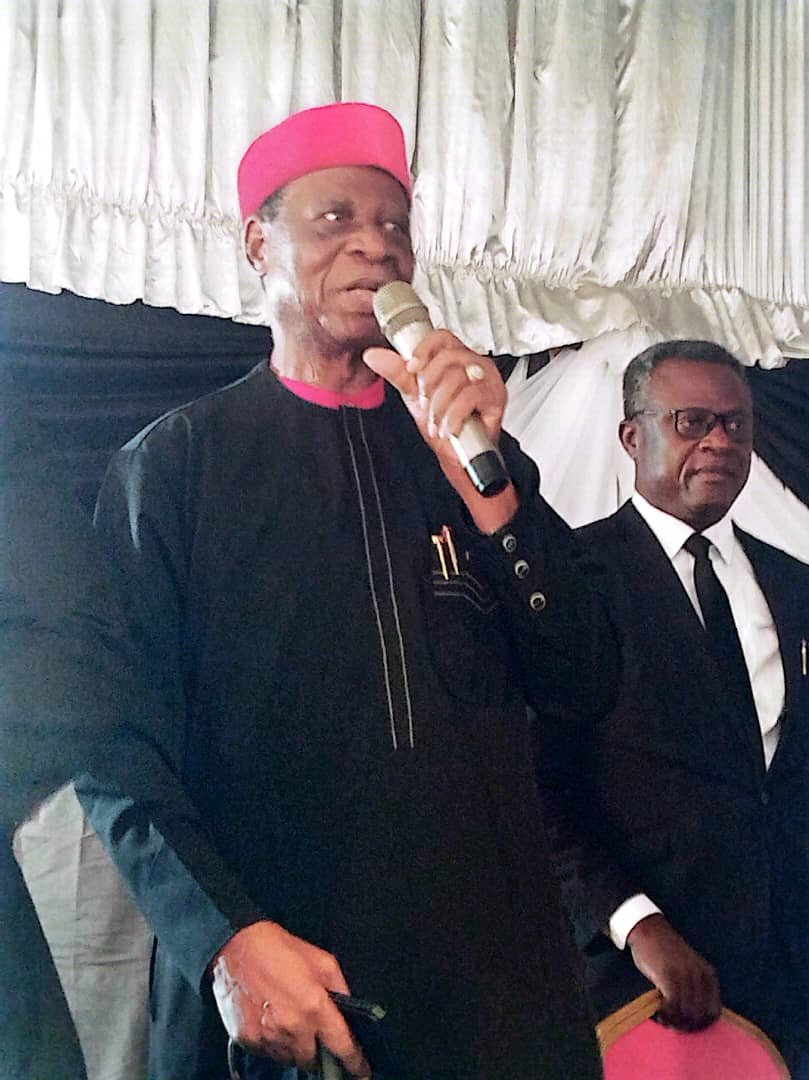
Former Chairman of the Police Service Commission (PSC), Chief (Dr.) Simon N. Okeke, OON, OFR, has called on Nigeria’s judiciary and security institutions to uphold the highest standards of professionalism, independence, and constitutional responsibility, warning that democracy in the country could face grave danger if key state institutions fail to discharge their duties impartially.
Chief Okeke made the remarks while delivering a goodwill message as the Father of the Day at the 2026 Law Dinner and Award Ceremony of the Law Students’ Association of Chukwuemeka Odumegwu Ojukwu University (COOU), Anambra State, held on July 3, 2026. Speaking on the theme, “The Role of Law and Security Institutions in Protecting Democracy,” the elder statesman reflected on his remarkable journey through Nigeria’s history, drawing from his experiences during the Nigerian Civil War, his distinguished professional career, and his tenure as Chairman of the Police Service Commission.
Addressing an audience comprising students, academics, legal practitioners, traditional rulers, public officials, and invited guests, Chief Okeke stressed that while democracy depends on strong legal and security institutions, those same institutions must remain faithful to the Constitution and resist political interference if Nigeria is to preserve democratic governance.

Beginning his address on a deeply personal note, the former PSC Chairman said that every visit to Chukwuemeka Odumegwu Ojukwu University evokes memories of his long association with the late Dim Chukwuemeka Odumegwu Ojukwu, whom he described as both his military commander and a cherished friend. According to him, during the Nigerian Civil War, he served as the Head of the Directorate of Military Intelligence (DMI) of the 11 Division of the Biafran Army under Brigadier Patrick Amadi, with his operational office located at Nnewi High School while the division was headquartered at Nnewi Central School.
He recalled the difficult years of the war, particularly the final stages that culminated in the surrender of Biafra on January 13, 1970, in his hometown of Amichi, where the late General Philip Effiong and Justice Philip Mbanefo formally handed over the instrument of surrender to the then Commissioner of the Third Marine Commando, Lt. Col. Olusegun Obasanjo.
Chief Okeke recounted that General Ojukwu had earlier departed for exile in Abidjan before eventually receiving a presidential pardon in 1982 under the administration of President Shehu Shagari and Vice President Dr. Alex Ekwueme. He revealed that following the pardon, Dr. Ekwueme personally requested him to mobilize private funds to charter an aircraft to bring Ojukwu back to Nigeria after the Federal Government decided that public funds would not be used for the purpose.
According to him, after successfully raising the required funds, he handed them over to the late Professor Chuba Okadigbo on the instruction of the Vice President. He vividly remembered the historic return of the Biafran leader, describing how thousands of supporters converged on the Ikeja Airport in Lagos to welcome Ojukwu home, resulting in the collapse of the airport’s arrival wing due to the overwhelming crowd.
Chief Okeke paid glowing tribute to Ojukwu’s legacy, noting that their friendship endured until the former Biafran leader’s death. He commended the Anambra State Government for immortalizing Ojukwu by naming the state-owned university after him, describing the decision as a fitting recognition of one of the most influential figures in Igbo history.
DDM News reports that beyond his military experience, Chief Okeke also reflected extensively on his professional life, revealing that many Nigerians know him primarily because of his service at the Police Service Commission without realizing that he built a distinguished career as one of Nigeria’s pioneering chartered estate surveyors.
He disclosed that after studying at the University of London between 1961 and 1964 as a Federal Government Scholar, he co-founded the Nigerian arm of the international real estate firm Knight Frank & Rutley in February 1965 alongside two British partners. However, his promising professional career was disrupted by Nigeria’s political instability following the January 1966 military coup, subsequent counter-coup, ethnic violence against the Igbo, and eventually the civil war.
Like millions of other Igbos, Chief Okeke said he had to rebuild his life after the war, returning to Lagos in 1970 with only the £20 permitted by the Federal Government despite whatever savings individuals previously had in their bank accounts. He eventually rose through the ranks to become Chairman and Chief Executive Officer of Knight Frank & Rutley (Nigeria), serving until his voluntary retirement in 1991.
Ten years later, former President Olusegun Obasanjo invited him to pioneer the re-established Police Service Commission, where he served from 2001 to 2006. During his tenure, Chief Okeke said the commission introduced several landmark reforms that continue to shape policing and electoral security in Nigeria today.
One of the reforms he highlighted was the expansion of the office of Deputy Inspector General of Police from one or two positions to six, ensuring that each of Nigeria’s six geopolitical zones would have representation in the top management hierarchy of the Nigeria Police Force. He praised President Obasanjo for approving the proposal without hesitation, describing it as a major step toward inclusiveness and national balance within the police leadership structure.
Chief Okeke also recalled that his commission was among the earliest advocates of State Police, revealing that he formally presented the proposal to President Obasanjo as far back as 2003. At the time, he said, the recommendation generated widespread criticism, with the then Inspector General of Police accusing him of attempting to divide Nigeria by promoting ideas allegedly influenced by his Biafran background.
Today, however, Chief Okeke observed that the same proposal has become one of the most debated constitutional reforms in Nigeria, with various stakeholders now openly supporting the establishment of state police as a strategy for improving internal security.
Perhaps one of the most enduring achievements of his administration at the Police Service Commission, he noted, was the development of the Guidelines for the Conduct of Police Officers on Electoral Duties, which he described as the first document of its kind anywhere in the world.
He explained that the initiative was developed after careful consideration of the critical role police officers play during elections and the reality that electoral malpractice often succeeds with the cooperation of compromised security personnel. To address the challenge, the commission collaborated with the then Attorney General of the Federation, Chief Kanu Agabi (SAN), former INEC Chairman Dr. Abel Guobadia, former Inspector General of Police Tafa Balogun, the National Human Rights Commission, National Orientation Agency, CLEEN Foundation, the United Nations Development Programme (UNDP), the British Department for International Development (DFID), the Open Society Justice Initiative, and several other civil society organizations and development partners.
The result was a comprehensive operational guideline that established standards for police conduct during elections and formed the basis for nationwide monitoring of officers deployed for electoral duties. According to Chief Okeke, the framework has since evolved into an internationally recognized model and remains the foundation upon which INEC currently manages the conduct of security personnel during elections across Nigeria.
DDM News gathered that despite acknowledging the important roles expected of legal and security institutions in safeguarding democratic governance, Chief Okeke expressed deep concern over what he described as emerging threats to democracy from within the judiciary itself.
He lamented that recent developments in Nigeria have witnessed court decisions and judicial interventions that appear to undermine democratic principles rather than strengthen them. According to him, democracy can only survive where institutions operate independently, uphold the rule of law, and remain guided solely by constitutional provisions rather than political interests.
He warned that if the judiciary and security institutions fail to perform their constitutional responsibilities with fairness, integrity, courage, and professionalism, Nigeria’s democratic experiment could face serious consequences. Stressing the need for institutional independence, he urged judicial officers and security agencies to place national interest above personal or political considerations.
Concluding his address, Chief Okeke challenged the students of Chukwuemeka Odumegwu Ojukwu University to uphold the ideals represented by the institution’s namesake through integrity, courage, patriotism, and service to humanity. He encouraged the future lawyers to become defenders of justice and constitutional democracy, reminding them that the future of Nigeria rests largely in the hands of principled professionals willing to stand for truth and the rule of law.
His address was received with sustained applause as participants reflected on the experiences and insights shared by one of Nigeria’s most accomplished public servants, whose career has spanned military service, professional excellence, public administration, and democratic institution-building over several decades.




