


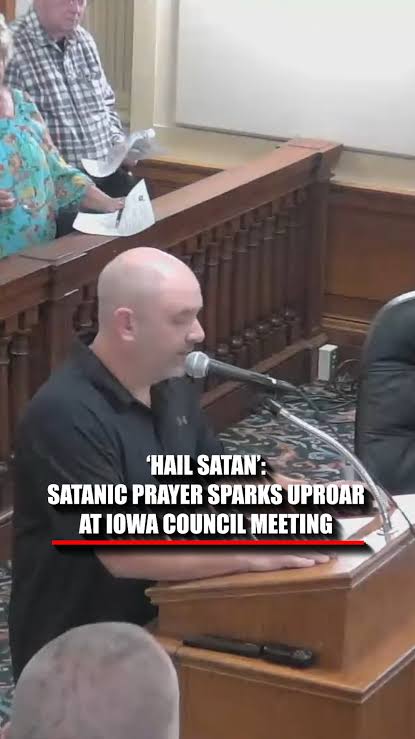
A city council meeting in Ottumwa, Iowa, has sparked controversy after former council member Matt Dalbey delivered an invocation ending with the words, “It is done. Hail Satan.”
Dalbey delivered the invocation at the Ottumwa City Council’s October 6, 2026, meeting, drawing attention to the city’s policy allowing residents to offer opening prayers regardless of their religious affiliation or belief system. member Dalbey began his address with the words, “Dear dark father,” before urging attendees to embrace what he described as the “Luciferian impulse to eat of the tree of knowledge.”
The invocation prompted an immediate reaction from Rick Bick, pastor of New Life Center, who objected to the remarks and called on officials to reverse what he described as a curse placed on the city.
“That was a curse put on a city when he said, ‘Hail Satan and oh dark god,’” Bick said, demanding that the council address the situation.

Mayor Benjamin Foote subsequently called for a 30-second moment of silence before the meeting continued.
The controversy centres on a policy adopted by the council in January 2026. The rules permit any Ottumwa resident to volunteer to deliver an invocation and state that the practice is intended to recognise the diversity of religious beliefs, philosophical viewpoints and nonbelief among residents. The policy also provides that participation is voluntary and that officials should not review or restrict the content of an invocation beforehand.
Council member Cara Galloway, who opposed the policy, said the incident reflected concerns she had raised when the rules were being considered. She argued that allowing invocations from different belief systems could lead to precisely this type of controversy.
Dalbey, however, clarified that the invocation was associated with the Satanic Temple of Iowa but was not an expression of belief in a literal Satanic deity. The organisation identifies itself as non-theistic, meaning it does not believe in Satan or other supernatural beings.
The incident has reignited debate over religious expression, freedom of belief and the role of religion in public institutions. It also raises questions about how local governments can maintain neutrality while allowing residents with differing religious and philosophical convictions equal access to public forums.
Credit: Fox News




