


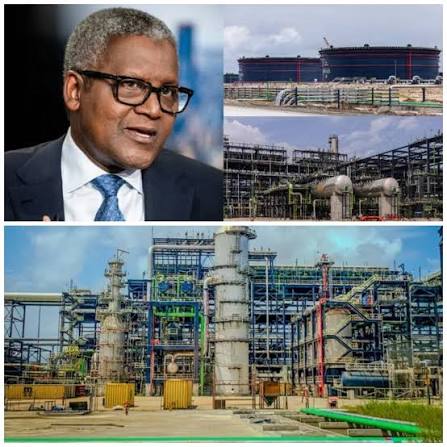
Long before the name Dangote became associated with cement factories, massive industrial plants, billion-dollar investments and one of Africa’s most recognised business empires, the story began with something much simpler: trading. What eventually became the Dangote Group was built from a modest commercial foundation and gradually transformed into a diversified industrial empire with interests stretching across cement, sugar, salt, flour, fertiliser, energy, petrochemicals and other sectors.
The story of Aliko Dangote is particularly significant because it reflects a different side of Nigerian entrepreneurship. Nigeria has millions of traders and small business owners, but only a small number successfully move from buying and selling products to building large-scale manufacturing and industrial businesses. Dangote’s journey demonstrates how a business can evolve when its owner repeatedly looks for opportunities to move further up the value chain.
Dangote’s business journey began in the late 1970s and early 1980s, when he started trading commodities. According to the Dangote Group, the business began in 1977 and was incorporated as Dangote Industries Limited in 1981. The company initially focused on trading commodities before expanding into manufacturing.
The early business model was relatively straightforward. Products were purchased and distributed to consumers and businesses, creating profits through trading and distribution. But rather than remaining permanently dependent on imported products, Dangote gradually began looking at how those products could be manufactured locally.

That shift became one of the most important decisions in the company’s history.
Nigeria has historically depended heavily on imports for many essential products. For entrepreneurs, that dependence creates an opportunity, but it also creates vulnerability. Import businesses can be affected by foreign exchange shortages, changes in international prices, shipping costs, tariffs and government policies. Manufacturing, on the other hand, requires more capital and carries greater operational challenges, but it can create a stronger position in the market.
Dangote increasingly chose the second path.
The company expanded into manufacturing and began building businesses around products that Nigerians consumed every day. Cement became one of the most important areas of expansion. Instead of simply participating in the distribution of cement, Dangote invested heavily in production capacity, eventually turning Dangote Cement into one of the largest cement producers in Africa.
This strategy changed the scale of the business.
Cement is not a glamorous product in the traditional sense, but it is fundamental to economic development. Every road, house, bridge, factory, shopping centre and office building requires construction materials. By investing in cement production, Dangote positioned his company around an essential product connected directly to Nigeria’s growing population and infrastructure needs.
The company’s cement operations eventually expanded beyond Nigeria into other African markets. Dangote Cement now has operations across several African countries, making the cement business a major part of the group’s continental footprint.
But cement was only one part of the strategy.
Dangote also expanded into industries such as sugar, salt and flour, products that are consumed regularly by millions of Nigerians. The thinking behind this diversification was important: rather than building a company around one product, the group could establish businesses across different parts of the economy while maintaining a strong focus on products with large and recurring markets.
This created an important advantage. When one part of the economy experienced pressure, other businesses within the group could continue generating activity. It also allowed the company to build expertise in manufacturing, logistics, distribution and large-scale operations across multiple sectors.
The next major stage in Dangote’s development was an even bigger bet: energy and petroleum refining.
For years, Nigeria produced crude oil but remained dependent on imported refined petroleum products. Dangote saw an opportunity to address this contradiction by investing in one of the largest privately owned oil refineries in the world. The Dangote Petroleum Refinery, located in the Lekki Free Zone in Lagos, has a nameplate capacity of 650,000 barrels per day and represents one of the largest industrial investments in Africa.
The refinery demonstrates how far the Dangote business philosophy has moved from its original trading roots.
A trader buys a product and sells it. An industrialist seeks to control more of the process that creates and delivers that product.
The Dangote Group increasingly adopted the second approach. Instead of simply participating in markets as a distributor, it invested in factories, production facilities and infrastructure capable of supplying markets at enormous scale.
The refinery is perhaps the clearest example of this transformation. It is designed to produce petrol, diesel, aviation fuel and other petroleum products for Nigeria and international markets. The project also forms part of a wider petrochemical ambition that could create additional industrial opportunities around the refinery.
DDM News notes that this evolution from trading to manufacturing is one of the most important lessons in Dangote’s business story. The group did not abandon the knowledge it gained from trading; instead, it used that experience to identify products with strong demand and then moved into producing them.
Another major factor behind the empire’s growth has been scale.
Dangote’s businesses have generally targeted markets where demand is enormous. Cement, sugar, fertiliser and petroleum products are not niche products purchased by a small group of consumers. They are essential inputs into everyday life and economic activity.
That strategy gives a company the possibility of generating significant revenue when it can produce efficiently and distribute widely.
However, scale also comes with enormous risks. Building factories requires huge amounts of capital. Maintaining industrial equipment requires technical expertise. Supply chains must remain functional. Governments can change regulations. Foreign exchange movements can affect costs. Global commodity prices can rise or fall. Large companies must also manage thousands of employees, contractors and suppliers.
The ability to navigate these challenges has been central to Dangote’s growth.
Another defining characteristic has been long-term thinking. Many businesses focus on recovering their investment as quickly as possible, but large industrial projects often require years of planning and construction before they begin producing returns. The Dangote Refinery, for example, took years of development before becoming operational.
This willingness to make enormous investments in projects with long timelines has helped transform the group from a traditional trading business into an industrial conglomerate.
The company’s evolution has also had a significant impact on Nigeria’s business environment. Dangote’s factories create demand for raw materials, transportation, engineering, maintenance, logistics and professional services. This means the company’s impact extends beyond the products it manufactures.
A large cement plant, for instance, requires transportation companies to move materials and finished cement. It requires engineers and technicians to maintain equipment. It needs suppliers and contractors. It also creates opportunities for businesses operating around its facilities.
The same principle applies to the refinery and the group’s other industrial operations.
For Nigeria, the importance of this model goes beyond one businessman. The country continues to face the challenge of reducing its dependence on imported goods while increasing local production. Businesses that move into manufacturing can contribute to that process by creating jobs, developing skills and increasing domestic productive capacity.
Dangote’s story also demonstrates the importance of understanding a market before attempting to dominate it. His businesses have largely focused on products that people and companies already need. Instead of trying to persuade Nigerians to create demand for completely unfamiliar products, the group has invested in supplying products with established markets.
That does not mean the journey has been without criticism or challenges. The enormous size of Dangote’s businesses means that decisions made by the group can have consequences across entire industries. Its influence in sectors such as cement and petroleum has attracted intense public and business attention, while questions surrounding competition, pricing, regulation and market power continue to be part of conversations about large Nigerian companies.
Nevertheless, the scale of the empire is difficult to ignore.
From an early trading operation, Dangote has developed a business group with interests spanning major parts of the Nigerian and African economy. The transformation reflects a broader shift from commerce to industrialisation: importing and distributing products is one stage of business development, while producing those products locally and eventually exporting them represents another.
For aspiring Nigerian entrepreneurs, perhaps the biggest lesson is that a small beginning does not necessarily determine the final size of a business. A company can begin by trading a few products, learn what customers want, understand its market and gradually reinvest its profits into larger opportunities.
The challenge is knowing when to move to the next stage.
Dangote’s journey shows that growth is not simply about selling more. It can involve controlling production, improving distribution, investing in infrastructure, entering new markets and building businesses around essential needs.
Today, the Dangote name is associated with industrial projects that would have seemed almost unimaginable from the company’s early trading days. Cement plants, fertiliser facilities, sugar operations and the massive petroleum refinery all represent different chapters of the same business philosophy: identify a market, understand its demand, invest in production and build the capacity to serve that market at scale.
The story is therefore bigger than the wealth of one entrepreneur. It is a story about what can happen when commercial experience is combined with industrial ambition.
DDM News understands that one of the most important lessons from Dangote’s rise is that Nigeria’s biggest business opportunities may not always be found in creating something completely new. Sometimes, they are hidden inside products Nigerians already buy every day. The real opportunity may be to find a better way to produce them, distribute them and eventually serve markets beyond Nigeria.
From trading commodities to building factories, from serving Nigerian consumers to expanding across Africa, the Dangote journey represents one of the most remarkable transformations in African business. Its next chapter will depend on how successfully the group manages its enormous industrial investments, navigates changing markets and continues expanding its position in strategic sectors.
What began as a trading business has become a model of Nigerian industrial ambition, and the story of that transformation continues to shape how entrepreneurs, investors and businesses think about what is possible in Africa.




