


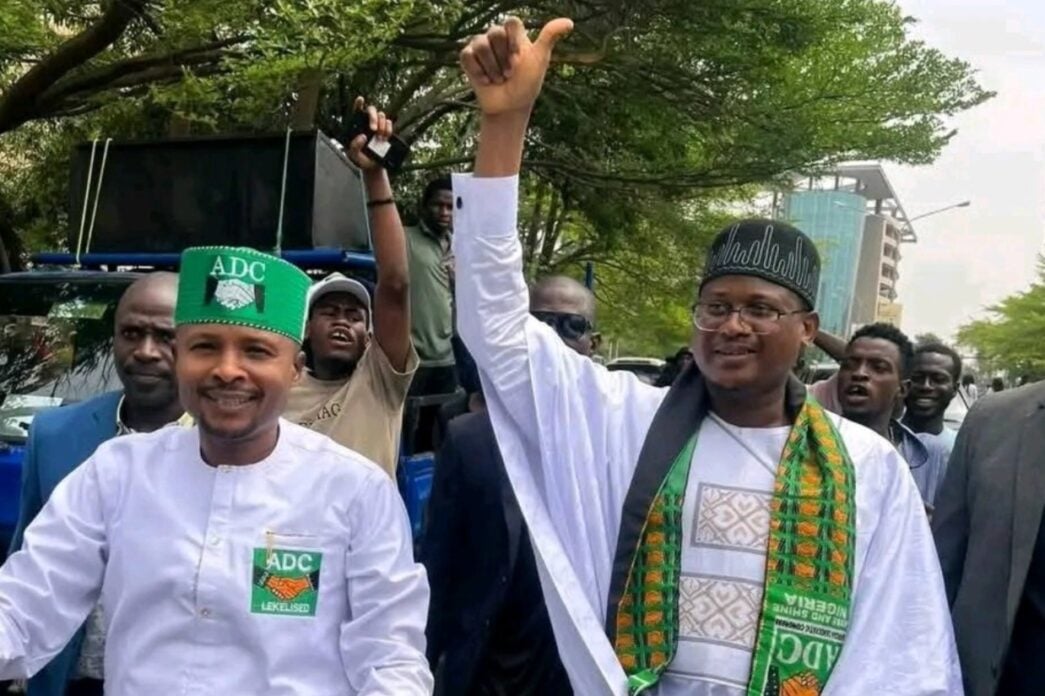
Fresh controversy has erupted within the African Democratic Congress (ADC) as the much-publicised national convention of the Nafiu Bala-led faction failed to hold on Tuesday at the National Stadium in Abuja, with the venue completely deserted and no sign of delegates, party officials, or any form of preparation for the event. The unexpected emptiness of the venue has further deepened the leadership crisis currently rocking the opposition party ahead of the 2027 general elections.
The convention, which had been scheduled for April 21, 2026, was expected to serve as a major political statement by the faction loyal to Nafiu Bala, who has been locked in a fierce battle for control of the party against another powerful bloc led by former Senate President, David Mark. However, instead of the anticipated gathering of party faithful, journalists and political observers who arrived at the Abuja National Stadium were met with silence, locked gates, and an empty arena.
A correspondent from TV Platinum, whose live report was monitored by SaharaReporters through Facebook, painted a striking picture of the scene. Broadcasting directly from the venue, the reporter confirmed that there was no activity whatsoever at the stadium.
“We are live at the National Stadium in Abuja where the Nafiu Bala-led faction of ADC is expected to hold their national convention,” the journalist said during the broadcast.

“Now as you can see, the venue is empty. There is nobody here. No preparation ongoing. No delegate, no party members. The whole place is empty. Everywhere is empty. The velodrome is locked.”
The absence of party members and the total lack of logistical arrangements immediately triggered fresh speculation about the strength and legitimacy of Bala’s faction, especially as the party remains deeply divided over leadership claims and the future direction of the ADC.
The latest development comes amid growing tension between the Bala camp and the rival faction aligned with former Senate President David Mark. Both groups have been laying claim to the party’s national structure, each insisting that they represent the legitimate leadership of the ADC. The conflict has created confusion among members and observers, especially as preparations intensify for political realignments ahead of the 2027 elections.
Only days before the failed convention, Nafiu Bala had strongly rejected the April 14 national convention organised by the David Mark-led faction, describing it as unconstitutional, illegal, and lacking any legal standing. He declared the exercise a complete nullity and insisted that it violated a subsisting judgment of the Court of Appeal delivered on March 12, 2026.
According to Bala, any action taken outside the authority of that court ruling would be invalid and incapable of standing judicial scrutiny. He also pointed to the noticeable absence of the Independent National Electoral Commission (INEC) at the rival convention as further evidence that the process lacked legitimacy.
“The noticeable absence of the Independent National Electoral Commission from the convention strongly indicates that the process lacks official recognition and cannot stand judicial scrutiny as to its legitimacy,” Bala had stated.
He went further to accuse the Mark-led camp of engaging in lawlessness and attempting to hijack the structure of the party through unconstitutional means. Among his allegations were claims of document forgery involving papers bearing his signature and efforts to manipulate internal party processes in order to wrest control of the ADC from its established leadership.
Bala also dismissed the suggestion that the David Mark-led coalition had legitimately adopted the ADC as its political platform ahead of the 2027 general elections. According to him, what was initially presented as a routine political alliance quickly transformed into what he described as a coordinated attempt to take over the party through backdoor arrangements and disregard for due process.
He insisted that his faction remains the authentic leadership of the party and maintained that members of the opposing camp lack the legal authority to convene conventions, issue party directives, or make binding decisions on behalf of the ADC.
The crisis has now firmly entered the legal arena. Bala confirmed that the dispute over party leadership is currently before Justice Emeka Nwite, following the refusal of INEC to recognise his position as acting national chairman. The electoral commission’s stance has further complicated the power struggle, leaving party members uncertain about which faction carries official recognition.
Political analysts say the unfolding drama reflects deeper structural problems within the ADC, as opposition parties continue to battle internal divisions while trying to position themselves as credible alternatives ahead of 2027. For many observers, the failure of the Bala-led convention to attract members or even basic preparations raises serious questions about internal support and organisational strength.
Some believe the empty venue may indicate that delegates deliberately stayed away in order to avoid being caught in the legal and political uncertainty surrounding the party’s leadership. Others suggest it may be a sign that the Bala faction underestimated the influence of the rival camp led by David Mark, whose national political profile and coalition-building capacity remain significant.
The silence from Bala’s faction after the failed convention has only intensified the uncertainty. As of the time this report was filed, there was no official explanation regarding why the venue remained deserted or whether the convention had been postponed, cancelled, or moved elsewhere. This lack of clarity has added another layer of confusion to an already tense political atmosphere.
For many party members, the crisis is becoming increasingly frustrating, as energy that should be focused on strengthening the party and preparing for future elections is instead being consumed by internal battles, court cases, and legitimacy disputes. DDM News gathered that several stakeholders within the ADC are quietly pushing for reconciliation efforts to prevent a total collapse of party unity.
The wider implications of the leadership crisis could be significant. With major political actors seeking new platforms and alliances ahead of 2027, the ADC had been seen by some as a possible destination for a broad opposition coalition. However, continued infighting threatens to weaken that possibility and may discourage new entrants who fear instability and legal uncertainty.
As Nigeria’s political landscape begins to shift toward the next election cycle, the ADC finds itself at a critical crossroads. Whether the party emerges stronger through legal resolution and reconciliation or descends deeper into factional chaos may determine its relevance in the national political conversation.
For now, the image of an empty stadium, locked gates, and absent delegates has become a powerful symbol of the unresolved crisis within the party. DDM News continues to monitor developments as Nigerians watch closely to see whether the ADC can survive its internal storm or become another casualty of political division.




