


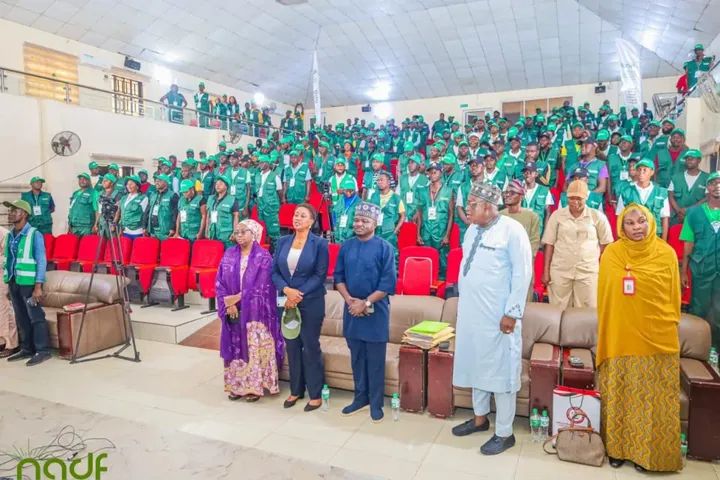
ABUJA, NIGERIA — The National Agricultural Development Fund has graduated 250 participants in an intensive agricultural mechanisation training program, marking a significant milestone in Nigeria’s quest to transform its farming sector and achieve food security.
The graduation ceremony, held on Thursday at the NADF headquarters in Abuja, celebrated the successful completion of a comprehensive training curriculum designed to equip participants with the technical skills required to operate, maintain, and repair modern agricultural machinery. The initiative is part of the federal government’s broader strategy to modernise farming practices and reduce post-harvest losses that have plagued the sector for decades.
NADF Executive Secretary Alhaji Mohammed Ibrahim described the occasion as a watershed moment for Nigerian agriculture. “Today, we are not just graduating 250 individuals,” Ibrahim declared. “We are graduating hope. We are graduating competence. We are building a new generation of agricultural entrepreneurs who will drive the mechanisation revolution that this country desperately needs.”

The participants, drawn from all six geopolitical zones, underwent rigorous training covering tractor operation, combine harvester maintenance, irrigation systems management, and precision farming techniques. The program, which ran for six months, combined classroom instruction with extensive hands-on field experience, ensuring graduates are job-ready upon completion.
Speaking at the event, Minister of Agriculture and Food Security Senator Abubakar Kyari commended the NADF for its foresight and commitment to agricultural development. He reiterated the administration’s determination to make Nigeria self-sufficient in food production, describing mechanisation as the cornerstone of that vision.
“We cannot feed 200 million people with hoes and cutlasses,” Kyari stated emphatically. “The future of Nigerian agriculture lies in mechanisation, and today’s graduates are the foot soldiers of that future. They will return to their communities equipped to transform farming from subsistence to commercial enterprise.”
The minister also announced plans to establish a national agricultural equipment leasing scheme, which will allow farmers to access tractors and other machinery at subsidised rates. The graduates of the NADF program are expected to serve as key operators and service providers under this scheme, creating a sustainable ecosystem of mechanisation services across the country.
For the graduates, the certification represents a life-changing opportunity. Many arrived at the program with little more than a determination to succeed. Among them was 32-year-old Grace Okonkwo from Enugu State, a mother of three who left her teaching job to pursue agricultural mechanisation.
“When I told my family I was going to learn to drive tractors, they thought I had lost my mind,” Okonkwo recounted with a smile. “But I knew that agriculture is where the future lies. Today, I am certified. Tomorrow, I will be employing others. This is not just about me; it is about transforming my entire community.”
Okonkwo’s story mirrors the aspirations of countless young Nigerians who are increasingly turning to agriculture as a viable career path. With unemployment rates stubbornly high and the non-oil sector receiving renewed attention, agricultural mechanisation presents a compelling opportunity for wealth creation and national development.
Industry experts have lauded the NADF initiative, noting that mechanisation can increase agricultural productivity by up to 500 percent while significantly reducing the drudgery associated with traditional farming methods. However, they caution that training alone is insufficient without accompanying access to capital and equipment.
“Graduating 250 service providers is an excellent start,” said Dr. Adebayo Olawale, an agricultural economist at the University of Ibadan. “But these graduates must now have access to affordable machinery and financing to truly make an impact. The government must ensure that this initiative is fully integrated with broader agricultural policies.”
The NADF has indicated that it is working with financial institutions to provide soft loans and credit facilities to graduates, enabling them to acquire machinery and establish their own mechanisation service businesses. Additionally, the fund is exploring partnerships with private sector equipment manufacturers to ensure the availability of spare parts and after-sales support.
The graduation ceremony concluded with the distribution of certificates and starter toolkits to all participants. Many of the graduates have already secured contracts with local farming cooperatives and state agricultural development programs, signaling strong demand for their newly acquired skills.
As Nigeria grapples with rising food prices and the threat of food insecurity, initiatives like the NADF mechanisation program offer a tangible pathway toward self-sufficiency. The 250 graduates now fanning out across the country represent more than just a statistic; they are ambassadors of a new agricultural order that promises to feed the nation and create prosperity for millions.
For now, the challenge lies in sustaining momentum. With the next cohort already being recruited, the NADF has signaled its commitment to scaling up the program, aiming to train thousands more over the coming years. If successful, Nigeria may finally be on the cusp of an agricultural revolution that has been decades in the making.




