


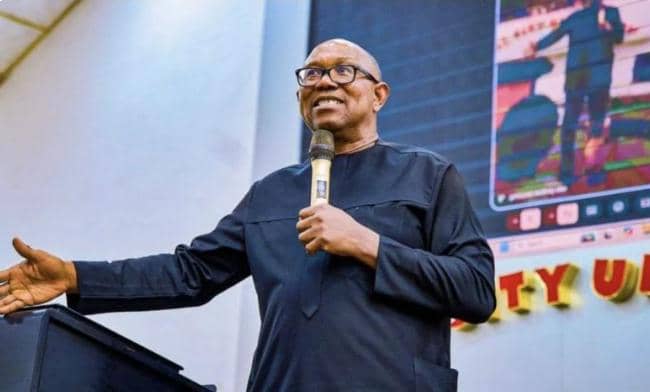
ASABA, NIGERIA — Nigeria Democratic Congress presidential candidate Peter Obi took his campaign to Delta State on Thursday, September 24, where he called for national unity, improved security, and a fundamental shift from consumption to production as part of his approach to tackling unemployment and poverty ahead of the 2027 election.
Obi made the remarks while recounting his visit to Delta State, where he joined the NDC governorship candidate in the state, Deacon Chris Iyovwaye, party leaders, candidates, and supporters at the inauguration of the party’s campaign office in Asaba. He said the event provided an opportunity to further communicate the party’s message and its commitment to building a better Nigeria.
“We must unite, secure our dear nation, and move it from consumption to production, create jobs, and pull our people out of poverty,” Obi said. He thanked Iyovwaye, other party leaders, and members in Delta for their commitment to the party and the development of the state and the country.
Electoral Reform and Democratic Inclusion

The NDC presidential candidate’s Delta visit came against the backdrop of his wider campaign activities and his renewed emphasis on electoral reform, democratic inclusion, and governance ahead of the 2027 presidential election. Obi reiterated his commitment to ensuring that elections are free, fair, and credible, warning that anyone who rigs elections under his watch would face severe consequences.
“I’ve said it, and I’ll say it again: if I am the serving president of this country, whoever rigs elections will be in jail. Even for one vote, you will be in jail,” he declared.
Obi also promised that opposition parties would not be harassed under his administration, saying they would be involved in major decisions affecting the country. “No political party will be harassed; we will support them,” he said. He added that opposition parties would be consulted on matters of national importance, including when the president travels outside the country. “It’s a country, everyone is involved, and I want to involve everybody,” he stated.
The former Anambra governor further pledged to remain accessible and physically present in Nigeria if elected president, saying Nigerians would not have to search for him while he was in office. “Nobody will look for me and say, ‘Where is Peter?’ I won’t be on holiday; I must be in Nigeria,” he said.
Campaign Restrictions Criticised
On campaign activities, Obi criticised restrictions allegedly placed on political candidates in some states, arguing that all contestants should be allowed to campaign regardless of their opponents’ political affiliations. He cited his tenure as Anambra governor, recalling instances when political opponents were allowed to campaign in the state without hindrance.
Obi said he provided his official vehicle for then-Lagos State Governor Babatunde Fashola when Fashola visited Anambra to campaign. He also recalled accompanying former President Olusegun Obasanjo during a campaign for Andy Uba, despite the fact that Uba was not his preferred candidate. “That’s democracy, because I wanted the people to vote. There was no issue,” he said.
Anambra Debt Question
Obi also addressed renewed claims concerning Anambra State’s debt profile at the end of his tenure as governor. He rejected claims that he left the state with $123 million in debt, insisting that he did not obtain loans or issue bonds through financial institutions during his eight years in office.
“I, Mr. Peter Obi, did not approach any financial institution to borrow money or issue bonds on behalf of Anambra State in the eight years that I was in government,” he said.
Obi further claimed that Anambra had no outstanding obligations to workers, pensioners, contractors, or suppliers whose completed projects had been certified and verified when he left office in March 2014. He explained that the World Bank and International Fund for Agricultural Development facilities cited in discussions about the state’s debt were concessionary development funds obtained by the Federal Government and subsequently on-lent to qualifying states.
According to Obi, Anambra’s foreign debt stood at about $18 million when he assumed office and rose to about $30 million by the time he left office. He also said the state had more than $150 million in dollar-denominated savings invested in bonds, which he claimed generated about $10 million annually. He challenged those questioning his financial record to verify the figures with the World Bank and Nigerian banks, saying he had made available documents relating to the state’s finances.
“The World Bank is in Abuja; they can give you the history of the drawdowns. The banks mentioned here are Nigerian banks; you have access to their headquarters. Ask them whether this money was there,” he said.
Otti’s Claim
The visit comes amid a fresh claim by Abia State Governor Alex Otti that Obi left $155 million in three banks in Anambra State when he left office in 2014. Otti made the claim during an interview, saying the funds were in addition to the savings Obi had acknowledged. The claim has added a new dimension to the ongoing debate over Obi’s financial record, with supporters of the former governor describing it as vindication and critics questioning the timing of the disclosure.
Obi’s campaign has continued to focus on economic transformation, security, and good governance as the 2027 elections approach, with the NDC positioning itself as a credible alternative to the ruling All Progressives Congress. For now, Obi’s message to Nigerians is clear: unity, security, and a shift to production are the keys to unlocking the country’s potential.




