


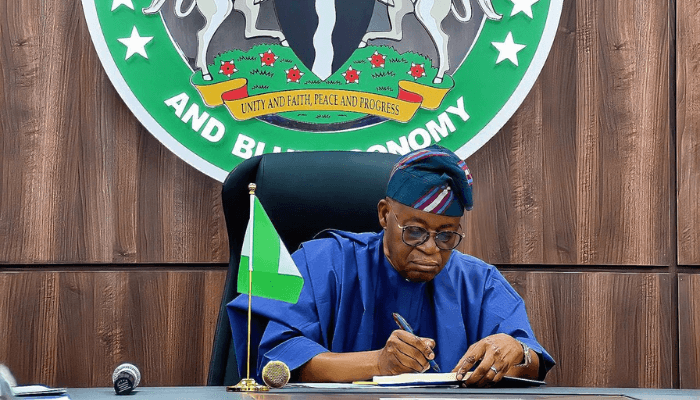
The Federal Government has stepped up efforts to unlock Nigeria’s long-delayed $700 million Cabotage Vessel Financing Fund, CVFF, with the Minister of Marine and Blue Economy, Adegboyega Oyetola, directing the Nigerian Maritime Administration and Safety Agency, NIMASA, to work with participating banks to accelerate the disbursement process.
The directive comes after concerns over the slow movement of applications from indigenous shipowners, with a recent BusinessDay report revealing that operators were still waiting for their first payments months after submitting applications for the financing.
According to the latest update from the Ministry of Marine and Blue Economy, NIMASA has so far received 92 applications for the fund.
Of these, 20 applications have been forwarded to the 12 approved Primary Lending Institutions, PLIs, for assessment, while only one application had been reviewed by a lending institution and returned to NIMASA for further approval. (Business Day)

The development has renewed attention on a financing scheme that has existed for more than two decades but has struggled to translate into actual funding for Nigerian shipowners.
The CVFF was established under Nigeria’s 2003 Cabotage Act as a dedicated financing mechanism to strengthen indigenous participation in coastal and inland shipping.
The fund is designed to assist qualified Nigerian-owned shipping companies in acquiring, constructing and maintaining vessels, thereby allowing local operators to compete more effectively with foreign companies that dominate significant portions of Nigeria’s maritime trade.
For years, however, the fund accumulated without a functional disbursement framework.
The Federal Government revived the scheme in January 2026 by opening an application portal for eligible operators, creating renewed expectations within the maritime industry that Nigerian shipowners would finally gain access to the financing.
The current structure allows eligible fully Nigerian-owned operators to apply for financing of up to $25 million.
Under the arrangement, beneficiaries are expected to contribute 15 percent of the project cost as equity, while NIMASA provides 50 percent and participating financial institutions provide the remaining 35 percent while assuming the associated credit risk. (Business Day)
The arrangement means that banks play a critical role in determining how quickly the fund reaches successful applicants.
Financial institutions are expected to examine the creditworthiness of applicants, assess the commercial viability of proposed vessels and ensure that projects have sufficient revenue-generating potential before applications are returned to NIMASA for further consideration.
That process has become a major source of concern for operators who expected the revived scheme to move more quickly.
BusinessDay had earlier reported that shipowners had been waiting for more than 200 days without receiving disbursements, despite assurances that the application and approval process would not exceed 90 days.
The report highlighted concerns over delays between NIMASA and participating banks, with some elements of the financing framework still undergoing adjustments. (Business Day)
Oyetola’s latest directive is therefore an attempt to remove some of the bottlenecks slowing down the programme.
The minister’s intervention also reflects the wider economic importance attached to the maritime sector by the Federal Government.
Nigeria handles more than 180 million tonnes of seaborne trade annually, generating over $6 billion in freight revenue. Yet, according to government estimates, about 80 percent of that freight revenue goes to foreign shipping companies because of the country’s limited indigenous vessel capacity. (Business Day)
The implication is significant.
While Nigeria remains one of Africa’s largest economies and has extensive maritime trade linked to its oil, gas, agricultural and manufacturing sectors, a large portion of the economic value generated by transporting those goods is captured by foreign operators.
Increasing the number and capacity of Nigerian-owned vessels could therefore help retain more maritime revenue within the domestic economy.
The government also expects the vessel-financing programme to generate more than 30,000 direct and indirect jobs across shipbuilding, marine engineering, vessel maintenance, logistics and other supporting areas. (Business Day)
For indigenous shipowners, access to affordable long-term financing is particularly important because acquiring commercial vessels requires significant capital.
Without intervention funds such as the CVFF, many Nigerian operators face difficulties competing with international companies that have access to deeper pools of financing and larger fleets.
The financing conditions attached to the CVFF are also expected to make the programme more attractive to qualified operators.
NIMASA had previously disclosed that the facility would attract a single-digit interest rate, with a two-year moratorium and an eight-year repayment period. The agency said the financing would be channelled through 12 Primary Lending Institutions. (NIMASA)
However, access to the fund is not expected to be automatic. Banks are required to assess applicants before successful applications move through the subsequent approval stages.
This is intended to protect the fund from being used to finance vessels or projects that cannot generate enough revenue to support repayment.
Some lenders have already indicated that they are more comfortable with applications supported by clear commercial opportunities.
Zenith Bank, for instance, previously disclosed that it had processed applications involving vessels intended for Nigeria’s oil and gas cabotage market, with commercial contracts or identifiable business opportunities being important considerations in its assessment. (Business Day)
The Federal Government’s renewed push therefore comes at a crucial stage for the programme.
While the opening of the application portal was presented as a major step toward ending years of inactivity, the real measure of success will ultimately be whether approved shipowners receive the money and use it to expand Nigeria’s maritime capacity.
The latest development also places greater responsibility on NIMASA and the participating banks to ensure that the approval process is both faster and transparent.
Delays could undermine confidence among shipowners and weaken the government’s broader plans for developing Nigeria’s blue economy.
The administration has repeatedly positioned the maritime sector as an important source of economic diversification, particularly as Nigeria seeks to increase non-oil revenues, create employment and strengthen domestic participation in international trade.
For DDM News, the significance of the $700 million fund extends beyond the immediate beneficiaries.
If properly implemented, the financing could help Nigerian operators acquire modern vessels, compete for domestic and international shipping contracts and gradually reduce the country’s dependence on foreign-owned ships.
The government is now under pressure to turn the latest directive into measurable action.
With only one of the applications submitted to the participating lenders reportedly having reached the stage of being returned to NIMASA for approval, the gap between policy announcement and actual disbursement remains substantial.
The coming weeks will therefore be important for determining whether Oyetola’s intervention can accelerate the process and restore confidence among operators who have waited years for access to the fund.
Ultimately, the success of the CVFF will not be judged by the size of the fund alone.
Its impact will be measured by the number of Nigerian-owned vessels financed, the jobs created, the growth of indigenous shipping companies and the amount of freight revenue that can eventually be retained within Nigeria.
For a country seeking to build a stronger blue economy, the $700 million Cabotage Vessel Financing Fund represents an opportunity to move from dependence on foreign maritime capacity towards a more competitive Nigerian-owned shipping industry.
DDM News will continue to monitor the disbursement process and its impact on Nigeria’s maritime sector as the Federal Government pushes to turn the long-awaited fund into tangible opportunities for indigenous shipowners.




