


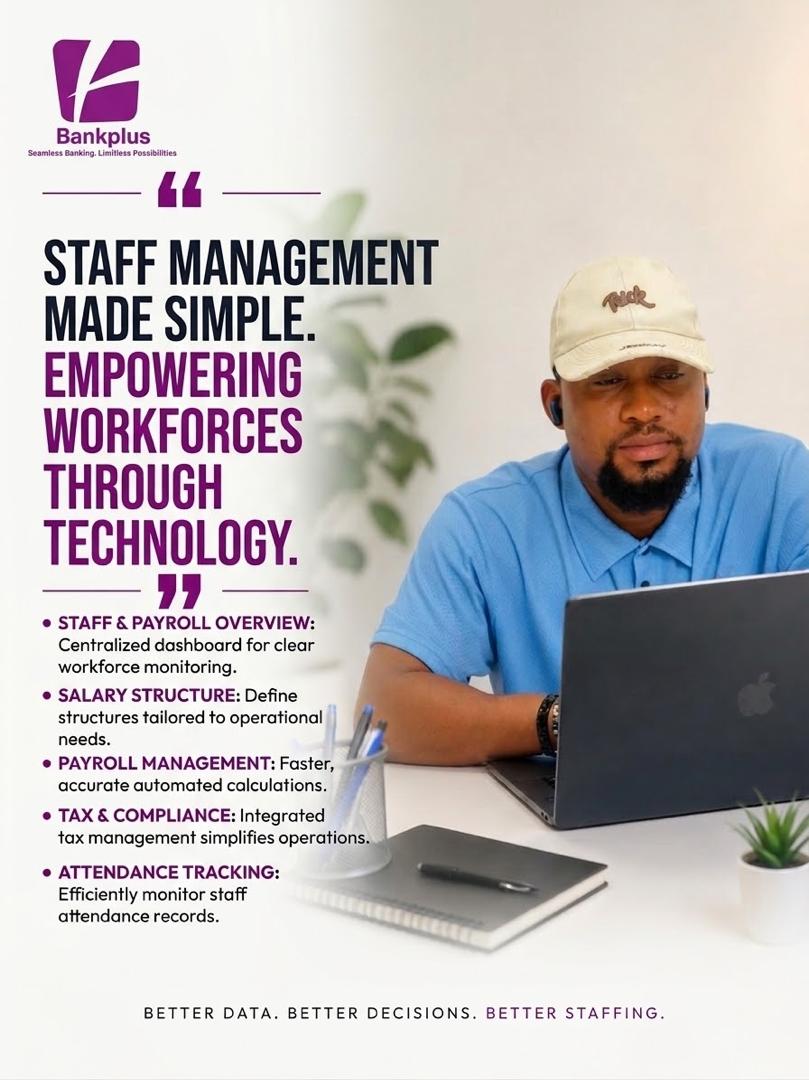
Staff Management Made Simple: How BankPlus Helps Businesses Manage Their Workforce
Every successful financial institution is powered by more than technology, capital and sophisticated banking infrastructure. At the centre of every organization are people. From customer service representatives and tellers to accountants, auditors, loan officers, compliance personnel and senior managers, employees determine how efficiently an institution operates and how customers experience its services.
As financial institutions grow, however, managing this workforce can become increasingly complicated. What may begin as a simple process involving a few employees can eventually become a major administrative responsibility involving hundreds of staff across different departments and locations.
Employee records must be maintained. Salaries have to be calculated and paid on time. Attendance needs to be monitored. Tax deductions and other statutory obligations must be handled correctly. Employees need proper departmental and position assignments, while management requires accurate information to make decisions about staffing and organizational performance.

When all these responsibilities are handled manually or through several disconnected systems, the possibility of errors increases significantly.
This is where digital staff management solutions are becoming increasingly important.
Rather than treating human resources as a collection of spreadsheets, paper files and separate administrative processes, modern financial institutions can use integrated technology to manage their workforce from a centralized platform.
BankPlus, an AI-powered cloud core banking infrastructure, is designed to provide financial institutions with tools that extend beyond traditional banking operations. Its Staff Management module brings several workforce administration functions together, helping institutions organize employee information, manage payroll and improve operational efficiency.
Why Staff Management Becomes Difficult as Businesses Grow
Managing five employees is very different from managing 50, 100 or several hundred.
At a small organization, a business owner or administrator may personally know every employee and manually track salaries, attendance and other information. As the workforce expands, this approach becomes increasingly difficult.
Human resource teams may spend significant amounts of time updating employee records, preparing payroll, calculating deductions, producing payslips and monitoring attendance.
The problem becomes even greater when different departments maintain their own records.
One spreadsheet may contain employee information, another may contain salary details, while attendance records may exist somewhere else. Payroll calculations may be handled separately, creating opportunities for inconsistencies.
A single mistake can affect an employee’s salary, tax calculation or record.
For a financial institution, where accuracy and accountability are particularly important, such problems can have consequences beyond the human resources department.
DDM News reports that digital workforce management is becoming an increasingly important part of organizational efficiency because businesses are under constant pressure to reduce administrative waste while improving employee experience. When staff-related processes are faster and more accurate, management can dedicate more attention to customers and core business operations.
Bringing Staff Information Into One Place
One of the key advantages of an integrated staff management system is centralization.
Instead of maintaining employee information across disconnected files and systems, BankPlus allows administrators to create and manage staff profiles through a centralized environment.
Staff information can be organized and retrieved more efficiently, making it easier for authorized personnel to update employee details when circumstances change.
This can be particularly useful in growing organizations where employees are joining, leaving, changing positions or moving between departments regularly.
A centralized record can also give management a clearer picture of the institution’s workforce.
Organizing Departments and Positions
A growing financial institution requires a clear organizational structure.
Employees need to be assigned to appropriate departments and positions so management can understand how the workforce is distributed.
BankPlus allows institutions to organize employees according to departments and positions, helping create a more structured workforce database.
This can make it easier to identify who works where, understand staffing levels and maintain accurate organizational records.
For management, such information can support workforce planning and help identify areas where additional employees may be required.
Simplifying Salary Structures
Salary management can become complicated when an organization has employees at different levels and positions.
Different staff members may have different basic salaries, allowances, bonuses and deductions.
Without a structured system, maintaining consistency can become challenging.
BankPlus’s Staff Management module allows organizations to configure salary structures according to their internal policies. This can help businesses organize compensation information and reduce the dependence on manual calculations.
A structured salary system can also make payroll administration easier because compensation information is already organized within the platform.
Making Payroll More Efficient
Payroll is one of the most sensitive responsibilities within any organization.
Employees expect to receive the correct salary at the agreed time. Even a small error can create frustration, especially when employees depend on their salaries for rent, transportation, family responsibilities and other expenses.
Manual payroll processing increases the possibility of mistakes.
An employee may be left out of a payroll cycle, a deduction may be calculated incorrectly or an allowance may not be included.
BankPlus is designed to reduce the amount of manual intervention required in payroll processing. By bringing relevant staff and salary information together, institutions can streamline payroll administration and improve accuracy.
This does not eliminate the need for appropriate oversight. Instead, it gives administrators a more organized system through which payroll processes can be managed and reviewed.
Digital Payslips Improve Transparency
Payslips provide employees with important information about how their salaries were calculated.
They can show earnings, deductions, bonuses and the final amount paid.
With BankPlus, digital payslips can be generated efficiently, providing employees with professional records of their salary information.
This can improve transparency because employees can better understand the components of their compensation instead of relying entirely on verbal explanations from administrative staff.
It can also reduce the amount of paperwork associated with salary documentation.
Managing Taxes and Deductions
Tax and other deductions are another area where accuracy is important.
Payroll may involve various deductions depending on an employee’s circumstances and applicable regulations. When calculations are handled manually, mistakes can occur.
BankPlus includes functionality for managing tax deductions and other payroll deductions, helping organizations structure these processes more efficiently.
However, businesses should still ensure that their payroll practices remain aligned with current Nigerian laws and applicable regulatory requirements. Technology can simplify calculations and administration, but organizations remain responsible for ensuring that their compliance processes are appropriate.
Attendance Management
Employee attendance is another important component of workforce administration.
Knowing when employees report to work and understanding attendance patterns can help management identify operational challenges and make better staffing decisions.
BankPlus provides attendance management functionality that can help institutions organize employee attendance information.
For businesses with large workforces, having a centralized attendance system can reduce the need for manual records and make it easier for management to review workforce patterns.
Managing Bonuses and Other Compensation
Employees may receive more than their basic salaries.
Depending on an institution’s policies, compensation may include bonuses, allowances, incentives and other payments.
Managing these components manually can create additional administrative complexity.
A centralized staff management system can help organizations record and manage these payments more systematically.
This can improve transparency and reduce confusion around employee compensation.
Connecting Staff Accounts for Salary Payments
Salary payments are another critical part of workforce management.
BankPlus allows employee bank account information to be managed within the staff management environment, supporting the process of salary payments.
By connecting employee information with payroll administration, institutions can create a more organized process from salary calculation through to payment.
For employees, this can contribute to a more predictable salary experience.
For management, it can reduce administrative fragmentation.
Staff Management Is Bigger Than Human Resources
Perhaps the most important point is that staff management should not be viewed simply as an HR responsibility.
Employees influence every part of a financial institution.
If payroll is consistently delayed, employee morale can decline. If staff records are inaccurate, administrative decisions can become difficult. If attendance information is unavailable, workforce planning becomes harder.
Conversely, when employee administration is organized, staff can spend less time dealing with administrative problems and more time serving customers.
This is particularly important in financial institutions, where customer experience is closely connected to employee performance.
DDM News notes that automation is increasingly changing how businesses approach routine administrative work. The objective is not necessarily to remove people from the process but to reduce repetitive tasks so employees can focus on responsibilities that require judgment, communication and expertise.
Building a Smarter Financial Institution
The financial services industry continues to evolve, and institutions need systems capable of supporting that growth.
A business may start with a small workforce, but expansion can quickly introduce administrative complexity. Technology therefore needs to grow alongside the organization.
BankPlus’s Staff Management module represents an approach in which workforce administration is incorporated into a broader digital banking infrastructure.
Instead of treating employee management as a completely separate administrative function, financial institutions can bring staff information, payroll, attendance, salary structures and related processes into a more centralized environment.
This can improve visibility while reducing repetitive administrative work.
Ultimately, managing money effectively is only one part of running a successful financial institution. Managing the people responsible for delivering those financial services is equally important.
A strong workforce requires accurate records, reliable payroll, clear organizational structures and efficient administration.
For financial institutions looking to modernize their operations, digital staff management can provide a practical way to achieve these goals.
The future of banking will not be defined by technology alone. It will also depend on how effectively institutions use technology to empower the people behind the services.
With tools such as BankPlus’s Staff Management module, financial institutions can move away from fragmented administrative processes and toward a more organized, transparent and efficient approach to managing their most important resource: their people.




