


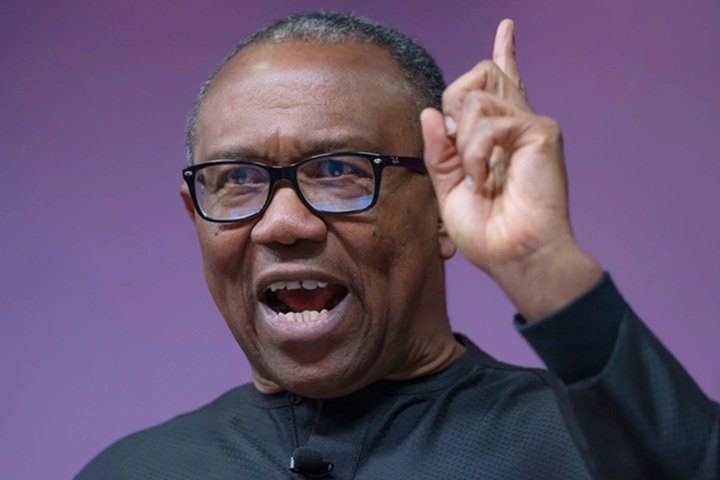
Former Labour Party presidential candidate Peter Obi has stated that he would have backed United States President Donald Trump’s proposed military action against terrorist groups in Nigeria if he had been commander-in-chief at the time.
Obi made the declaration while speaking at a leadership and governance forum, where he discussed the type of decisive security measures he believes Nigeria urgently requires to dismantle violent non-state groups responsible for nationwide instability.
Obi explained that any foreign intervention aimed at eliminating terrorist networks within Nigeria would have received his full support, provided such operations were targeted, lawful, and aligned with Nigeria’s national security priorities.
He noted that Trump’s controversial statement years earlier—suggesting direct U.S. military involvement if Nigerian authorities failed to curb extremist killings—reflected global frustration with Nigeria’s worsening insecurity rather than an attack on Nigerian sovereignty.
The former Anambra governor emphasized that terrorism has grown into a national emergency that demands both domestic reforms and international cooperation.
Obi said leadership at the highest level must demonstrate zero tolerance for armed groups, bandits, insurgents, and religious extremists who continue to operate across states with minimal resistance from security agencies.
During his address, he outlined the core priorities he would pursue if elected president, beginning with comprehensive security reforms.
He said Nigeria must modernize its armed forces, invest in intelligence, improve surveillance technology, and strengthen inter-agency coordination to track, deter, and neutralize terrorist cells.
Obi added that failure to act decisively allows extremist groups to grow stronger, attack vulnerable communities, and undermine national unity.

NIGERIA’S LONG BATTLE WITH INSURGENCY
Nigeria has endured relentless waves of terrorism for more than 15 years, beginning with Boko Haram’s violent uprising in 2009.
The group later splintered, giving birth to ISWAP, which expanded operations across the North-East, attacking civilians, farmers, schools, and military bases.
The global community has repeatedly raised concerns over Nigeria’s inability to permanently suppress these groups despite massive annual security budgets.
During Trump’s presidency, he publicly criticized Nigerian leaders over persistent Christian killings and terrorist attacks, at one point threatening that the United States would intervene militarily if the situation continued.
The comment generated outrage among sections of Nigeria’s political elite, who viewed it as an infringement on sovereignty, while many citizens—particularly victims of terrorism—welcomed the remark as a sign of international pressure.
OBI SAYS NIGERIA NEEDS “UNCOMPROMISING LEADERSHIP”
Peter Obi told the audience that effective governance requires honesty, courage, and prioritizing human lives over political considerations.
He insisted that any president who fails to secure the country has failed in the most fundamental responsibility of leadership.
Obi said he would not hesitate to adopt unconventional partnerships if they would help restore peace and protect Nigerian lives.
He concluded that Nigeria must choose between the painful truth and comfortable failure.
According to him, the time has come for leaders willing to make difficult decisions, collaborate globally, and defend citizens with the urgency the crisis demands.




