



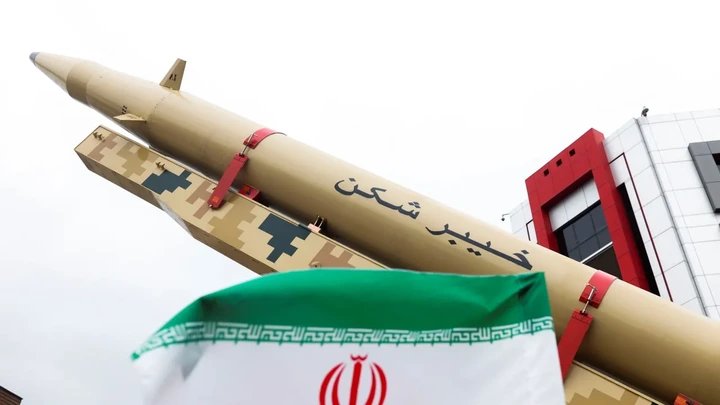
(DDM) – Iran’s military has launched a wave of ballistic missile strikes across parts of the Middle East, just hours after state media confirmed the death of Supreme Leader Ayatollah Ali Khamenei, marking one of the most volatile moments in the country’s recent history.
Diaspora Digital Media (DDM) reports that the announcement ended days of intense speculation and unverified reports surrounding the condition of the longtime leader, whose passing now triggers a sensitive and complex succession process within the Islamic Republic’s political and religious establishment.
According to Iranian state media, the Islamic Revolutionary Guard Corps (IRGC) initiated what it described as large-scale retaliatory operations targeting what officials called terrorist bases in neighboring regions.
Missiles were reportedly launched toward positions in northern Iraq and Syria, areas where Iran has previously claimed hostile armed groups operate.
Iranian authorities have insisted that the strikes are not directly linked to the leadership transition, maintaining that they are part of ongoing security operations.
However, regional analysts suggest the timing sends a calculated message of strength at a moment of national uncertainty.
Ayatollah Ali Khamenei led Iran for decades, shaping its domestic governance and foreign policy posture with an emphasis on resistance against Western influence and opposition to Israel.
His death sets in motion a constitutional procedure involving the Assembly of Experts, the clerical body responsible for appointing a new Supreme Leader.
The transition period is widely viewed as one of the most delicate phases in the Islamic Republic’s political system, given the concentration of authority vested in the office.
Shortly after confirmation of his passing, a senior IRGC commander was quoted by state media as declaring, “Our enemies must understand that the passing of our beloved leader will only strengthen our resolve and unity.”
The commander added that Iran’s retaliatory capability remains intact and warned that adversaries would face consequences for any perceived provocation.
The military escalation has already prompted international reactions.
The United States has urged its citizens to leave Iraq immediately, citing heightened security risks.
Israel, long identified by Tehran as a primary adversary, has reportedly placed its air defense systems on high alert amid fears of potential spillover.
The broader regional context amplifies the tension.
Iran has, in recent years, expanded its missile capabilities and deepened its network of allied groups across Iraq, Syria, Lebanon, and Yemen.
These alliances have positioned Tehran as a central actor in multiple regional flashpoints.
Observers say the immediate military action may serve dual purposes: deterring foreign adversaries and signaling internal stability during the leadership vacuum.
Moments of transition often create perceived vulnerabilities, and projecting military readiness can function as both reassurance to supporters and warning to rivals.
Yet the risk of escalation remains high.
Ballistic missile launches across borders carry the potential for miscalculation, especially in areas where multiple armed actors operate in close proximity.
International observers are closely monitoring both the succession process and Iran’s military posture in the days ahead.
The coming weeks will likely determine whether the current show of force stabilizes the situation or deepens instability in an already fragile region.
For now, Iran stands at a historic crossroads, balancing mourning, political transition, and rising geopolitical confrontation.




