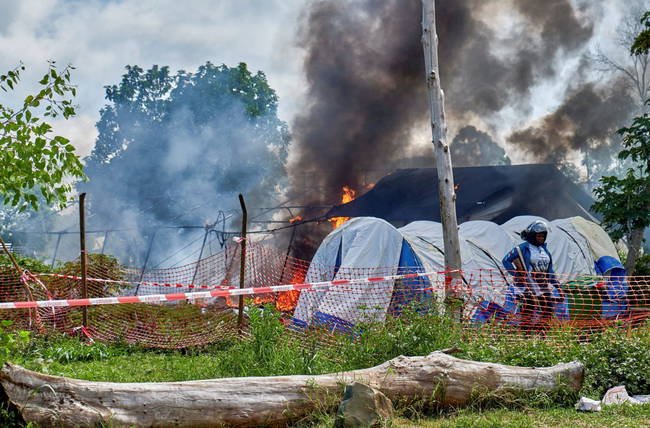
Fresh unrest has disrupted efforts to contain the Ebola outbreak in the Democratic Republic of Congo after rioters set fire to treatment tents at a hospital in the country’s northeast.
The violence occurred at Rwampara Hospital in Ituri Province, where health workers have been battling to control the spread of the disease amid growing fear and mistrust among local communities.
According to reports, the crisis began following the death of a 24-year-old patient believed to have contracted Ebola. The deceased, said to be the son of a soldier, became the centre of a dispute after relatives demanded custody of his body for burial.
Hospital officials said the request could not be granted because of strict Ebola safety protocols designed to prevent further transmission of the virus.
“The family wanted us to release the body for burial, but under the circumstances that was impossible,” a hospital source reportedly said.
The disagreement quickly spiralled into violence, with angry youths storming parts of the hospital. Soldiers were eventually deployed and reportedly fired warning shots to disperse the crowd and restore order.
During the chaos, tents used to isolate and treat Ebola patients were set ablaze, leaving sections of the emergency facility destroyed.
Health workers later conducted controlled burials for three suspected Ebola victims while grieving relatives watched from a distance.
One distressed family member questioned the handling of the situation, saying, “He was just sick, let the government come to our aid.”
The attack highlights the growing challenge confronting health officials as they struggle not only with the disease itself but also with fear, misinformation and distrust in affected communities.
The outbreak is linked to the Bundibugyo strain of Ebola, a rare variant for which there is currently no approved vaccine or specific treatment.
Health authorities say more than 177 suspected deaths have already been recorded, making contact tracing, isolation and safe burials the primary tools for slowing transmission.
Medical teams say insecurity, poor communication and limited isolation facilities are complicating the response, especially in remote communities where some residents still doubt the existence of Ebola or blame authorities for the crisis.
With security now tightened around treatment centres and burial operations, officials fear that attacks on health facilities could further undermine efforts to contain the deadly outbreak.