


Wabi says it raised $55 million at a $1.25 billion valuation to develop its AI assistant and personalized mini-apps.
Wabi said on October 29 that it raised $55 million at a $1.25 billion valuation, as the startup expands its AI assistant into a shared tool for everyday life. The San Francisco company was founded by Eugenia Kuyda, who also founded Replika. The round was led by IVP, according to Wabi’s  funding announcement and reporting by TechCrunch. The deal follows Wabi’s shift from a prompt-based app builder toward an AI agent that can build small, task-specific apps.
Wabi funding round reaches $1.25 billion valuation
Wabi disclosed the $55 million financing on Thursday, describing it as a response to strong interest after its public launch. The company’s announcement named Andreessen Horowitz, Forerunner and Amazon’s Alexa Fund among the other participants. It also listed individual backers, including Shopify chief executive Tobi Lütke, Salesforce chief executive Marc Benioff, former Yahoo chief Marissa Mayer, former Twitter chief Dick Costolo and Alex Pall of The Chainsmokers.
The valuation is a company-reported figure, rather than an independently audited measure. Neither the announcement nor TechCrunch’s account described the share class, ownership dilution or other terms. Wabi said the new capital will support continued product development and expansion, but it did not provide a timetable or spending breakdown.
Wabi AI agent shifts from app builder to messenger
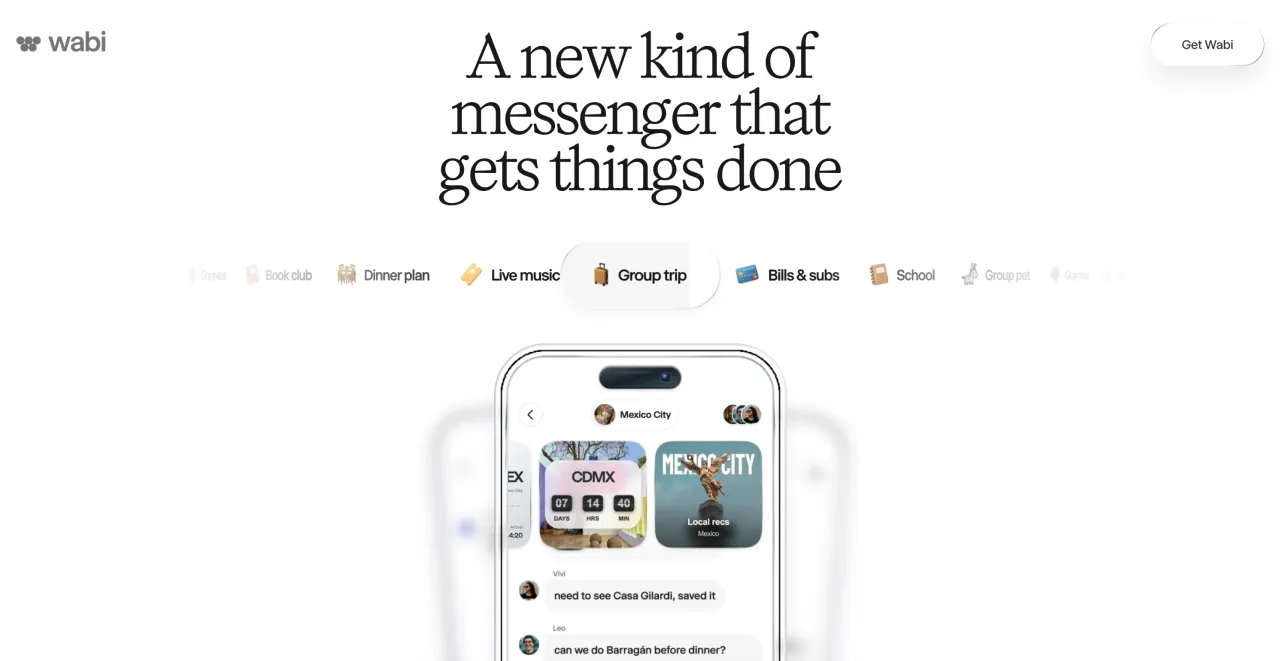
Wabi first presented itself as a way for users to create apps with prompts. In September, the company introduced Wabi 2.0 as an AI messenger that can still create apps, according to  TechCrunch’s report on the pivot. That change puts conversation, task assistance and custom interfaces into one product, rather than treating app creation as the main activity.
The company’s product concept is to generate lightweight interfaces around a user’s needs. Wabi has described examples such as meal plans that become grocery lists, shared restaurant lists, fitness challenges and trivia games. These are product examples supplied by the company; its announcement does not independently establish how widely customers use each feature.
Wabi also frames its service as collaborative. Its announcement says friends, couples and families can use shared spaces to plan activities and coordinate responsibilities. The startup argues that this approach differs from assistants built for one person using a single chat window. It has not published usage figures to quantify that difference.
Why mini-apps matter to Wabi’s strategy
Mini-apps are small, focused software tools designed for a particular task. Wabi’s stated aim is to let an AI agent create them when a user needs one, then keep them available for repeated use. For example, a group could maintain a shared list or tracker instead of recreating instructions in separate conversations.
That approach connects generative AI with familiar software interfaces. In September, Kuyda called Wabi a “personal agent that does stuff for you and builds the interface you need in the moment,” as quoted by TechCrunch. The idea is that users could interact through buttons, lists or other controls, not only written prompts. Whether that model brings lasting engagement remains an open question; the company has not released retention or revenue data.
Wabi’s investors and next steps
The latest financing adds to investor support for Kuyda’s attempt to build consumer-facing AI software. Wabi’s release also quoted IVP general partner Alex Lim praising Kuyda’s product vision. “She has a clear vision for how people will interact with AI, one that goes far beyond the text box or command line,” Lim said. This is an investor’s assessment, not an independent evaluation of the product or its prospects.
The company says the funding will finance development and expansion. Its release states that Wabi is available on iOS, Android and Mac, with Windows “coming soon.” It directs readers to  Wabi’s website for access information, but gives no specific launch date for Windows. Investor backing signals confidence, while the company’s ability to turn that support into sustained use will depend on execution and customer response.
Ultimately, Wabi’s new round gives it more capital to develop an AI assistant that combines shared conversations with custom mini-apps. The $1.25 billion valuation and $55 million raise come from the company’s announcement, with TechCrunch independently reporting the same deal. The next test is whether people return to the tools and find enough value to make them part of daily routines. Wabi has not published figures that answer that question.




