




The political atmosphere within the African Democratic Congress has grown increasingly unsettled following the resignation of its Anambra State chairman, Chris Nwosu, who stepped down from his position in the aftermath of Peter Obi’s departure from the party.
Nwosu’s resignation, which comes barely weeks after his emergence as state chairman, underscores the widening cracks within the party’s structure, particularly in the South-East where Obi commands significant political influence. His decision is widely seen as a direct response to the shifting political alignment triggered by Obi’s exit, a development that has continued to reverberate across party ranks.
In a formal resignation letter dated May 2 and addressed to his ward leadership in Ekwusigo Local Government Area of Anambra State, Nwosu announced his immediate withdrawal from the party. He explained that his continued stay in the ADC would no longer align with his political convictions, especially following the departure of Obi, whom he described as a central figure in his political journey.

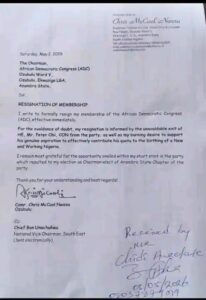
According to him, his decision was guided by the need to remain consistent with his principles and political direction. He emphasized his commitment to supporting Obi’s vision and aspirations, suggesting that his future political engagements would be shaped by that alignment.
Nwosu expressed appreciation to members of the party for the opportunity to serve, even though his tenure was short. He acknowledged the support he received during his brief leadership and wished the party well in its future endeavors. His exit, however, has raised concerns among party stakeholders about the stability of the ADC in Anambra and beyond.
His emergence as chairman had initially been viewed as part of the party’s strategy to strengthen its grassroots presence and consolidate support ahead of the 2027 general elections. The expectation was that a restructured leadership would help position the party as a viable alternative within Nigeria’s evolving political landscape. However, recent developments appear to have disrupted those efforts.
Obi’s departure from the ADC has proven to be a significant turning point. The former presidential candidate, who joined the party as part of a broader opposition coalition, had attracted a large following, particularly among young voters and grassroots mobilizers. His exit, reportedly influenced by internal disagreements and legal uncertainties within the party, has now triggered a chain reaction affecting party cohesion.
In Anambra, where Obi remains a dominant political figure, his exit has had a pronounced impact. Many party members who aligned with him are reportedly reconsidering their positions, with some already resigning or exploring alternative platforms. Nwosu’s resignation is among the most prominent so far, given his leadership role at the state level.
Political analysts note that the situation reflects a broader pattern in Nigerian politics, where party structures are often influenced by the presence or absence of key personalities. Loyalty to influential figures frequently shapes political decisions, sometimes outweighing institutional affiliations.
The ADC, which had positioned itself as a unifying platform for opposition figures seeking to challenge established parties, is now grappling with internal tensions that threaten its cohesion. The departure of high-profile members has raised questions about the party’s ability to maintain unity and sustain its political relevance in the lead-up to the next general elections.
Efforts to build a formidable opposition coalition have faced persistent challenges, including leadership disputes, ideological differences, and competition among political actors. The current situation within the ADC highlights the complexity of managing diverse interests within a single political platform.
Despite these challenges, some party leaders have expressed confidence in the ADC’s resilience, insisting that the party remains committed to its ideals and long-term goals. They argue that internal restructuring and renewed engagement with members could help stabilize the situation and restore confidence.
However, the resignation of a state chairman so soon after his appointment has inevitably cast a shadow over those assurances. It signals not only internal dissatisfaction but also the difficulty of maintaining organizational stability in a rapidly changing political environment.
For observers, the developments in Anambra serve as a microcosm of the broader shifts taking place within Nigeria’s opposition politics. As alliances continue to evolve and political actors reposition themselves, parties like the ADC face the task of redefining their identity and strengthening their structures to remain competitive.
Nwosu’s exit adds to the growing list of departures linked to Obi’s political movement, reinforcing the perception that the former governor’s influence extends well beyond formal party boundaries. His next political steps are likely to shape the direction of many of his supporters, including those who have begun to disengage from the ADC.
As the political landscape gradually takes shape ahead of the 2027 elections, the unfolding events within the ADC highlight the fluid nature of party affiliations and the ongoing search for stable and credible platforms among opposition figures.




