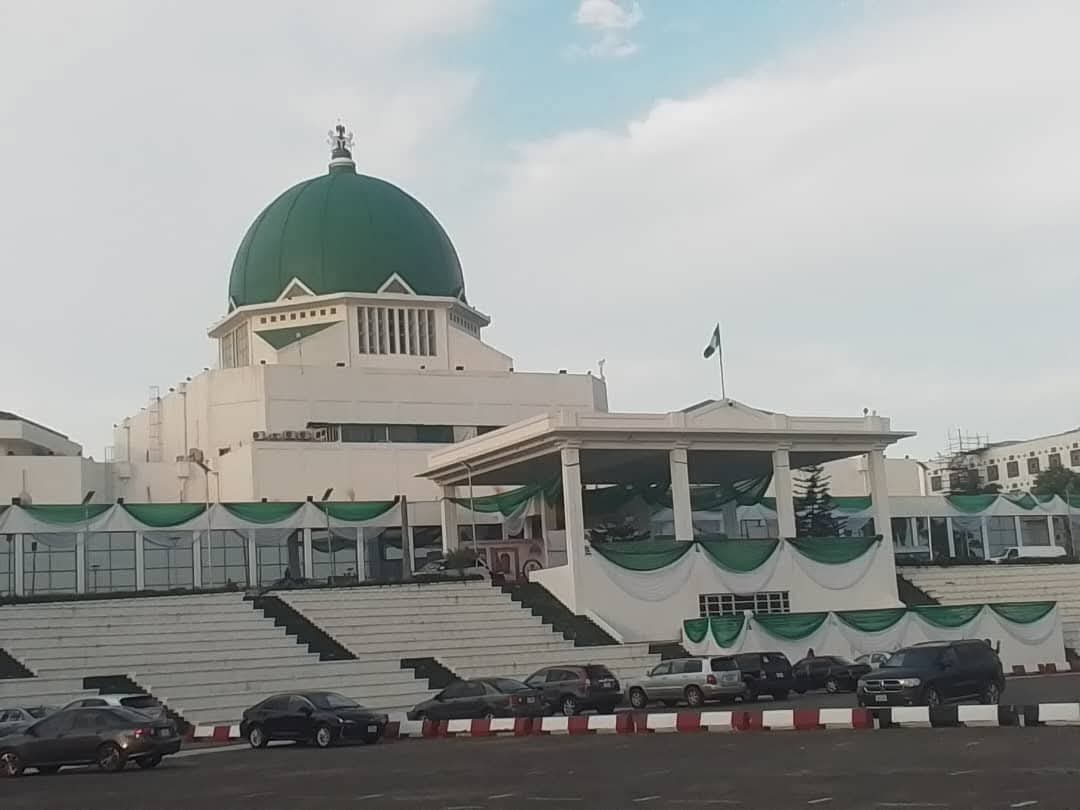
(DDM) – Operations at the National Assembly in Abuja were brought to a standstill on Wednesday as hundreds of furious local contractors, lawyers, and civil society activists stormed the complex to demand payment of an alleged ₦3 trillion debt owed them by the Federal Government.
According to Diaspora Digital Media (DDM), the demonstrators blocked all major entrances and exits to the legislative complex, preventing lawmakers, staff, and visitors from entering or leaving the premises.
The protest, which began early in the morning, caused heavy gridlock in the Three Arms Zone and disrupted legislative activities for several hours.
The protesters, chanting solidarity songs and holding placards with inscriptions such as “Pay Us Our Money Now!” and “Stop Killing Nigerian Businesses,” accused the government of deliberately frustrating local contractors by refusing to release long-approved payments for completed projects.
Leaders of the contractors’ association claimed that many of their members have died while waiting for payment, while others are facing bankruptcy and family hardship due to the non-settlement of contracts executed across ministries, departments, and agencies.
One of the spokespersons for the group, identified as Barrister Francis Udoka, said the protest was their “last resort” after several failed attempts to get the attention of the National Assembly leadership and the Ministry of Finance.
He lamented that despite numerous verification exercises, committees, and promises from government officials, the debt, estimated at over ₦3 trillion, has remained unpaid.
“This government owes us money for contracts duly executed under previous administrations,” Udoka said. “We are not politicians.
We delivered projects. Yet, our people are dying in silence while a few enjoy privileges at the top.”
Background findings by DDM reveal that the issue of unpaid contractors has persisted for over a decade, spanning administrations from Goodluck Jonathan to Muhammadu Buhari, and now under President Bola Ahmed Tinubu.
Several audit reports have confirmed that thousands of local contractors are being owed for projects ranging from rural electrification to road rehabilitation and school construction.
Many of the contracts were reportedly completed but not captured in subsequent national budgets, leaving them in limbo.
Security agents, including operatives of the Nigeria Police Force and the Department of State Services (DSS), were deployed to the scene to maintain order and prevent a possible breakdown of law and order.
Despite appeals from security personnel, the protesters refused to leave, insisting they would remain at the National Assembly until they receive a firm commitment from lawmakers.
A senior legislative aide told DDM that both the Senate President, Godswill Akpabio, and the Speaker of the House of Representatives, Tajudeen Abbas, were briefed about the protest and may invite representatives of the contractors for an emergency dialogue.
Economic analysts who spoke to DDM described the ₦3 trillion debt claim as a potential fiscal crisis, warning that unresolved contractor liabilities could erode investor confidence and worsen Nigeria’s already fragile business environment.
Some civil society groups have expressed solidarity with the protesters, urging the government to prioritise the payment of genuine debts to local businesses as part of its commitment to economic recovery and job creation.
As of press time, the blockade had yet to be lifted, and the National Assembly premises remained tense, with armed security officers standing guard to prevent escalation.