



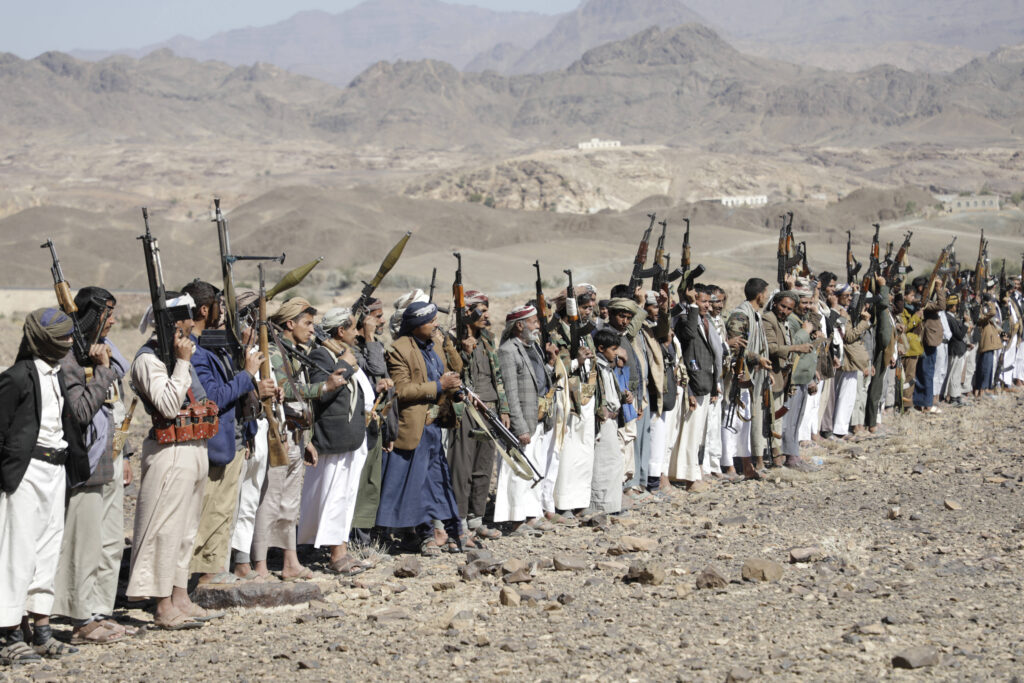
Yemen’s Iran-backed Houthi movement on Monday announced a naval blockade against Saudi Arabia, opening a new front in the escalating confrontation between the United States and Iran and raising fresh concerns over global energy supplies and maritime trade.
The announcement came even as diplomatic efforts gathered pace to prevent the conflict from spiralling further.
Oil prices initially climbed after the Houthi declaration but later retreated on hopes that renewed negotiations could ease tensions.
The Houthis said the blockade takes effect immediately, describing it as a “maritime embargo against the criminal Saudi enemy” in retaliation for what they called Riyadh’s continued blockade of Yemen.

Saudi Arabia did not immediately respond.
Iran has reportedly urged the Houthis to shut the Bab el-Mandeb Strait if the United States continues targeting Iranian infrastructure. A full closure of the strategic Red Sea gateway would disrupt roughly seven percent of global oil supplies by restricting most Saudi crude exports, adding to the wider supply disruptions already caused by the Gulf conflict.
Despite the latest escalation, diplomatic channels remain active.
A senior Iranian official told Reuters that mediators had presented Tehran with a proposal for a 10-day ceasefire aimed at preserving the fragile interim agreement reached last month between Iran and the United States.
Iran’s Foreign Ministry confirmed that mediation proposals had recently been received but declined to provide details.
Meanwhile, two Pakistani government sources said Iranian Interior Minister Eskandar Momeni, during his second visit to Islamabad in less than a week, asked Pakistan to resume its mediation efforts between Tehran and Washington.
The diplomatic push follows another night of U.S. airstrikes across Iran and retaliatory Iranian attacks on American military assets in the region.
United States President Donald Trump defended the latest military operations, saying they were carried out in honour of American service members killed in recent Iranian attacks in Jordan and Iraq, while also facing growing domestic criticism over rising fuel prices.
Iran’s Islamic Revolutionary Guard Corps (IRGC) claimed two oil tankers exploded while attempting to transit what it described as an unsafe route through the Strait of Hormuz. The military did not identify the vessels or report casualties, and Reuters could not independently verify the claim.
Separately, the United Kingdom Maritime Trade Operations (UKMTO) said a vessel was struck by an unidentified projectile off Oman’s coast near the Strait of Hormuz. The ship remained disabled, but all crew members were reported safe.
The U.S. Central Command said it had carried out its ninth consecutive night of strikes against Iranian targets, saying the operations were intended to weaken Iran’s ability to threaten commercial shipping in the strategic waterway.
Inside Iran, explosions were reported in Tabriz, Chabahar, Konarak, Bandar Mahshahr and Bandar Imam Khomeini. Iranian state media said one person was killed and several others injured in attacks near Tabriz.
The IRGC also said it fired ballistic missiles at U.S. military facilities, including Jordan’s Aqaba airport, Kuwait’s Al-Adiri camp and Ali Al Salem Air Base, as well as American positions in Syria.
Air raid sirens sounded across Bahrain, while Kuwait’s military said it intercepted another wave of Iranian drones.
Kuwait said one of its desalination plants was struck for a second consecutive day, causing a fire at what it described as critical civilian infrastructure.
Desalination facilities provide most of the drinking water for Gulf countries, making them strategically important.
Iran has repeatedly warned it would target desalination plants across the Gulf in retaliation for attacks on similar facilities inside its territory. Tehran accused the United States of striking one of its desalination plants over the weekend, although Washington has not confirmed the allegation.
Despite the military escalation, neither side has ruled out returning to negotiations.
U.S. Secretary of State Marco Rubio said Washington would continue targeting Iran as long as it threatened international shipping but stressed that the United States remained open to a diplomatic solution.
Iran also signalled that talks remain possible.
Foreign Ministry spokesman Esmaeil Baghaei confirmed Tehran had received proposals from mediators, saying diplomatic efforts had remained active in recent days, although he declined to elaborate.
The conflict, which began on February 28 following joint U.S.-Israeli strikes on Iran, has killed thousands of people, most of them in Iran and Lebanon, while fuelling one of the most serious threats to global energy markets in years.




