



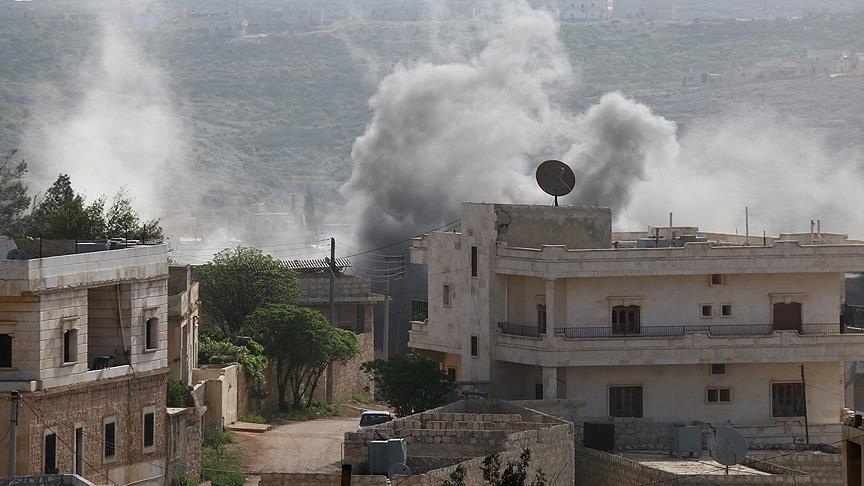
Israel has carried out a new round of airstrikes in southern Lebanon, even as US President Donald Trump publicly criticised the country’s continued military operations.
Lebanon’s National News Agency (NNA) reported that Israeli warplanes targeted areas around Nabatieh al-Fawqa and the outskirts of Kfar Tebnit on Wednesday.
The Israeli military had not commented at the time of filing this report, though it has consistently maintained that its operations are aimed at Hezbollah positions.
The latest strikes come amid efforts to implement a US-Iran agreement announced on Sunday, which Pakistani mediators say includes provisions relating to Lebanon, although the full details of the deal have not yet been made public.
Speaking during the G7 summit in France on Tuesday, Trump urged Israeli Prime Minister Benjamin Netanyahu to exercise greater restraint in Lebanon.
“Netanyahu needs to be more responsible with respect to Lebanon,” Trump said, adding that Israel had been engaged in conflict with Hezbollah for too long and that too many lives had been lost.
Despite the diplomatic breakthrough between Washington and Tehran, tensions along the Israel-Lebanon border remain high.
Both Israel and Hezbollah have continued exchanging attacks since the agreement was announced.
An Israeli airstrike on Beirut earlier this week, launched in response to a Hezbollah rocket attack, raised concerns that the fragile peace efforts could unravel before the agreement is formally signed.
Trump, while reaffirming his close relationship with Netanyahu, expressed displeasure over the scale of Israel’s recent military actions.
“I didn’t like that he carried out an attack that was too much,” the US president said.
Netanyahu, however, defended Israel’s position, insisting on Monday that Israeli forces would remain in Lebanon “for as long as necessary.”
Iran has also weighed in on the situation. Foreign Minister Abbas Araghchi warned that any future Israeli attack on Lebanon or continued Israeli military presence on Lebanese territory would be viewed as a violation of the interim understanding reached with the United States.
Although the text of the agreement remains confidential, officials expect both Washington and Tehran to formally sign the memorandum of understanding on Friday in Bürgenstock, Switzerland.
Trump has indicated he may publicly read the agreement “word by word” during a planned news conference.
He also claimed the deal would permanently prevent Iran from acquiring nuclear weapons and ensure the reopening of the Strait of Hormuz without restrictions on shipping.
The president further argued that the agreement represents a stronger outcome than the 2015 nuclear accord negotiated under former President Barack Obama.
“We didn’t pay for it like Obama did. He paid billions of dollars,” Trump said.
Under the 2015 Joint Comprehensive Plan of Action (JCPOA), Iran agreed to limit its nuclear programme and submit to international inspections in exchange for sanctions relief and access to frozen assets.
Analysts say while the US-Iran breakthrough has reduced fears of a wider regional conflict, ongoing hostilities between Israel and Hezbollah continue to cast uncertainty over the prospects for lasting peace in Lebanon.




