


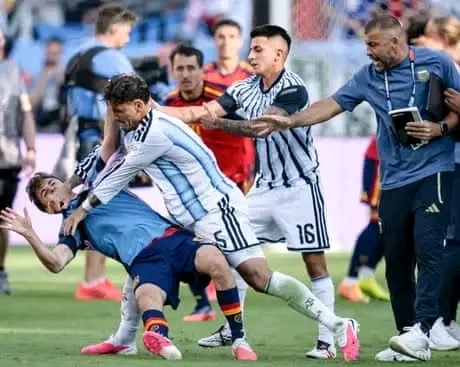
FIFA has imposed heavy disciplinary sanctions on Argentina following the heated scenes that erupted after the 2026 FIFA World Cup final, with midfielder Leandro Paredes receiving a 10 match suspension and defender Nahuel Molina banned for seven matches.
The sanctions follow Argentina’s 1-0 defeat to Spain in the World Cup final on July 19, when tensions boiled over immediately after the final whistle. Paredes and Molina were among the Argentina players involved in confrontations with Spanish opponents during the post match chaos.
Paredes has received the most severe punishment, with FIFA handing him a 10 match international suspension in addition to a $90,000 fine. Molina was also fined $90,000 and will miss seven international fixtures as a result of his involvement in the altercation.

The incident occurred moments after Spain secured a dramatic victory over the defending champions. Rather than ending quietly, the final was followed by a confrontation involving players from both teams. Paredes was accused of initiating part of the physical confrontation, while footage showed him involved in an altercation with Spanish players.
The disciplinary action is a significant blow to Argentina as the national team begins the next phase of its development following the disappointment of losing the World Cup final.
Paredes, who has been an important member of Argentina’s midfield in recent years, will now be unavailable for a substantial portion of the team’s upcoming international schedule. His absence could force Argentina coach Lionel Scaloni to make important changes in midfield as the team prepares for future competitive and friendly fixtures.
Molina’s seven match suspension is similarly significant. The right back has become an established option for Argentina and has played an important role in the team’s recent success. His suspension will give other defenders an opportunity to establish themselves in the national team.
FIFA’s disciplinary committee did not limit its punishment to the two players. Argentina midfielder Thiago Almada was handed a one match suspension and a $30,000 fine, while Spain’s Gavi also received a one match ban and a $30,000 fine for unsporting behaviour connected to the incident. Argentina assistant coach Roberto Ayala was suspended for three matches and fined $30,000.
The Argentine Football Association has also been punished over several incidents connected to the tournament. FIFA imposed a combined fine of about $321,000, including sanctions relating to a political banner displayed following Argentina’s semi final victory over England, discriminatory behaviour and security related breaches.
Argentina will additionally face restrictions on stadium attendance for its next two home matches, with the games subject to a 50 percent spectator capacity. Some elements of the sanctions have been suspended under a probationary arrangement, while the affected parties retain the right to appeal the decisions.
The punishment brings an official conclusion to a disciplinary case that FIFA opened after the final. The governing body had previously begun proceedings against Paredes and Molina over alleged assaults during the confrontation, while Ayala was also investigated for his conduct.
The post match confrontation overshadowed what had otherwise been a dramatic World Cup final. Spain’s victory ended Argentina’s hopes of retaining the global title, with the South American giants unable to respond after conceding the decisive goal.
For Paredes, the suspension represents one of the most serious disciplinary setbacks of his international career. The midfielder has long been recognised for his aggressive style, competitiveness and willingness to challenge opponents, qualities that have made him an important part of Argentina’s midfield but have occasionally brought controversy.
Molina has also been a key figure for Argentina since establishing himself at international level. His ability to contribute defensively while supporting attacks has made him an important part of the team’s tactical structure.
The lengthy bans now mean both players must wait before returning to competitive international football.
Argentina will therefore enter its next international window without two experienced members of the squad, while Scaloni will be expected to find replacements capable of maintaining the team’s high standards.
The FIFA ruling also sends a strong message about player conduct after matches. Football’s governing body has increasingly emphasised that players and officials remain subject to disciplinary regulations even after the final whistle, particularly when confrontations become physical.
For Argentina, the challenge is now to put the controversy behind them and focus on rebuilding after the disappointment of the World Cup final.
The bans may dominate headlines in the short term, but the bigger priority for Scaloni will be preparing a new generation of players while ensuring the national team’s competitive standards remain intact.
Paredes and Molina will eventually return to the Argentina squad, provided their suspensions are served without further disciplinary action. Until then, their lengthy FIFA bans will remain a major talking point surrounding the world champions’ post World Cup transition.




