


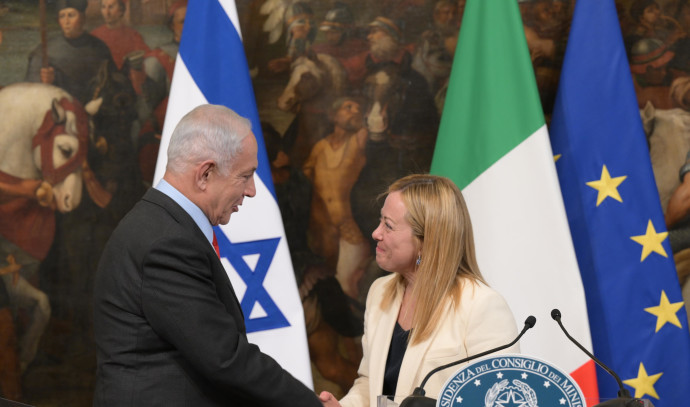
The Italian government has announced it will not renew its long-standing defence agreement with Israel, signalling a notable shift in relations between the two countries.
Prime Minister Giorgia Meloni said the decision was taken “in view of the current situation”, as tensions between Rome and Tel Aviv continue to rise.
The agreement, which is typically renewed every five years, will now be suspended, although the government has yet to outline the full legal and operational implications of the move.
Officials within Italy’s defence ministry say discussions are ongoing to determine how the suspension will affect military cooperation and existing frameworks between both countries.

The decision follows a series of diplomatic clashes.
Last week, Italy summoned Israel’s ambassador after
Israeli forces fired warning shots near a convoy of Italian UN peacekeepers in Lebanon. Although no injuries were reported, one vehicle was damaged, prompting strong concern from Rome.
In response, Israel later summoned Italy’s ambassador over remarks by Foreign Minister Antonio Tajani, who had condemned what he described as “unacceptable attacks” on civilians in Lebanon.
Despite historically strong ties, relations between the two nations have come under increasing strain in recent months.
Italy has long been one of Israel’s key European partners, though it accounts for a relatively small share of its arms imports compared to the United States and Germany.
The broader backdrop is the ongoing conflict in the Middle East, which was triggered by the October 7 Hamas attack on Israel and has since escalated into prolonged military operations in Gaza and beyond.
The war has drawn widespread international criticism and led several European countries to reconsider or restrict arms exports to Israel.
Domestically, pressure has been mounting on the Italian government. Large-scale protests and strikes have taken place in recent years, with many calling for a tougher stance against Israel’s military actions.
While Meloni’s administration has traditionally maintained strong support for Israel and resisted recognising Palestinian statehood, public sentiment appears to be shifting.
Political analysts say the move may also reflect internal dynamics ahead of Italy’s next general election, now less than two years away.
Meloni’s coalition recently suffered a setback in a referendum on judicial reforms, widely seen as a test of the government’s popularity.
In recent weeks, Meloni has also adjusted her tone on international issues, describing the U.S.-Israeli war with Iran as part of a troubling pattern of actions outside international law.
She has further distanced herself from Washington following a public disagreement with Donald Trump over his criticism of Pope Leo XIV.
Trump responded sharply, expressing disappointment in Meloni and questioning her stance on security issues, particularly Iran’s nuclear ambitions.
Despite these tensions, Italian officials insist that the country’s alliance with the United States remains intact.
Tajani said the partnership is built on “loyalty, respect and honesty,” while Defence Minister Guido Crosetto stressed that being allies does not mean agreeing on every issue.
Italy’s decision to suspend the defence pact marks one of the clearest signs yet of a recalibration in its foreign policy, as it balances longstanding alliances with growing domestic and international pressure.




