


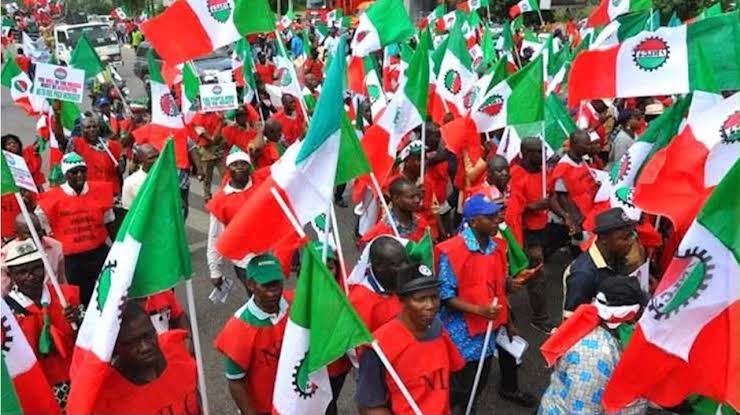
The Nigeria Labour Congress (NLC) has given the Federal Government a two-week ultimatum to reduce petrol prices, begin negotiations on a new minimum wage and address outstanding demands by workers.
The ultimatum, which begins on Friday, October 9, expires after two weeks. The union warned that it could take further action if the government fails to meet its demands within the period.
The demands were contained in a communiqué issued after a joint meeting of the NLC’s National Executive Council and Central Working Committee in Abuja on October 7. The document was signed by the union’s president, Joe Ajaero.
The labour union wants the government to reduce petrol prices to the level they stood at when the current national minimum wage was signed into law in 2024.

It also called for negotiations on a new minimum wage to begin before the end of October, arguing that rising living costs and the depreciation of the naira have weakened workers’ purchasing power.
According to the NLC, high petrol prices have pushed up transportation fares, food prices and other essential expenses, making it increasingly difficult for workers and their families to afford basic necessities.
The union also demanded the implementation of agreed tax relief measures and wage awards intended to cushion workers against rising costs.
Beyond fuel prices and wage negotiations, the NLC urged the government to honour outstanding agreements with public-sector and health-sector workers.
These include the February 5, 2026, settlement involving the Joint Health Sector Unions and Assembly of Healthcare Professionals (JOHESU), as well as the outstanding demands of the Joint Public Sector Negotiating Council.
The union warned that failure to address its demands within the two-week window could lead to further action.
The ultimatum comes as the Federal Government pursues measures to ease the impact of high petrol prices on Nigerians.
Finance Minister and Coordinating Minister of the Economy, Taiwo Oyedele, recently announced a 30-day discount on petrol sold at Nigerian National Petroleum Company Limited (NNPC Ltd) retail outlets.
The government described the initiative as a margin discount rather than a return to the former fuel subsidy regime. NNPC has also extended its N66-per-litre discount until October 31, 2026.
Oyedele outlined other proposed interventions, including forward sales of crude oil to domestic refineries, a proposed N1,350-per-litre ceiling on petrol’s ex-gantry or landing cost, and the removal of illegal levies that increase transportation and logistics expenses.
Other measures include support for vulnerable households, faster deployment of compressed natural gas (CNG) vehicles, and tax and duty waivers.
The minister warned that restoring petrol to its pre-reform price could cost more than N20 trillion annually.
He also estimated that an intervention of N500 per litre could cost the government more than N16 trillion a year.
According to Oyedele, the government prefers targeted interventions, local refining and other cost-reduction measures to restoring a blanket petrol subsidy.
Several states pay above N70,000 minimum wage
The NLC’s demand for fresh wage negotiations comes as several state governments have approved minimum wages above the N70,000 national benchmark signed into law by President Bola Tinubu in July 2024.
Nairametrics Research reported that Imo State had the highest reported minimum wage at N104,000 as of April 2026, followed by Ebonyi State at N90,000.
Lagos and Rivers states were reported to be paying N85,000, while Niger, Enugu, Akwa Ibom, Bayelsa and Oyo had approved N80,000.
Other states, including Ogun, Edo, Kebbi, Benue and Osun, had also approved wages above the federal benchmark, although implementation varied. Several states remained at N70,000.
The 2024 minimum wage law also reduced the wage review cycle from five years to three, bringing renewed attention to wage negotiations as workers continue to face rising living costs.
With its two-week ultimatum now in effect, the NLC is pressing the Federal Government to translate its economic relief measures into meaningful improvements in workers’ purchasing power.




