


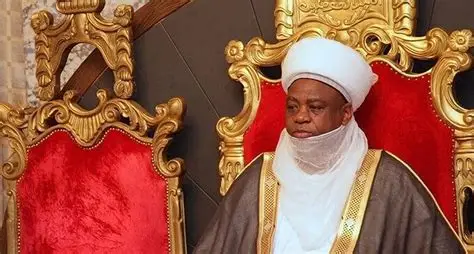
The Sultan of Sokoto, Sa’ad Abubakar III, has dismissed claims that Muslims in Nigeria are pursuing an agenda to eliminate Christians, insisting that the country’s security crisis should not be reduced to a religious conflict.
Speaking on Tuesday at the first triannual meeting of the Nigeria Inter-Religious Council in Abuja, the Sultan said the growing tendency to frame violence along religious lines was dangerous and misleading.
“Muslims are not planning to wipe out Christians in Nigeria,” he said. “It is not possible, and it is not true.”
The religious leader stressed that criminals should be identified for what they are, rather than being labelled according to religion.

“Let us stop calling them Muslim terrorists or Muslim bandits,” he said. “Even if someone claims to be a Muslim, what they are doing is completely against Islam.”
The meeting brought together key religious and government figures, including CAN President Daniel Okoh and Secretary to the Government of the Federation George Akume.
The Sultan said dialogue remained the only realistic path to peace, urging Nigerians to move beyond mere tolerance and learn to genuinely understand one another.
“In NIREC, we believe in dialogue no matter how difficult things become,” he said. “We must trust one another because nobody can open another person’s heart to see what is inside.”
He also condemned extremists who use religion to justify violence.
“Someone may attack innocent people while shouting ‘Allahu Akbar,’ but that does not make the act Islamic,” he said. “Anyone who kills innocent people will answer for it.”
CAN President Daniel Okoh echoed the call for deeper understanding between religious groups, saying many of the country’s conflicts were rooted more in political, economic and social problems than faith itself.
“Religious literacy is about understanding and respecting the beliefs of others,” Okoh said. “Too many tensions are wrongly presented as purely religious issues.”
SGF George Akume also warned against divisive narratives, saying ignorance and misinformation often fuel distrust and conflict.
“Where there is understanding and empathy, trust can grow,” he said, while calling for schools and institutions to promote more inclusive education about religion and coexistence.
The meeting comes amid rising tensions in parts of the country, including renewed attacks in Plateau State that have triggered fresh debates over insecurity and religious divisions in Nigeria.




