
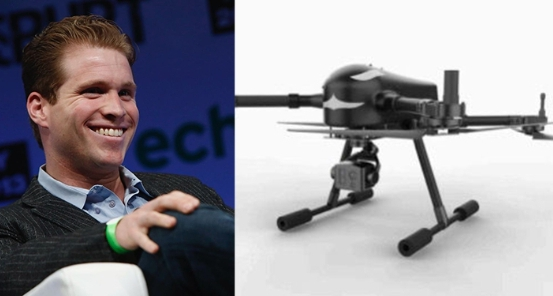
In a major boost to Africa’s emerging defence and security technology ecosystem, United States tech billionaire and investor Joe Lonsdale has led an $11.8 million investment into Terra, a Nigerian drone and security technology company, in a move aimed at strengthening the continent’s capacity to confront rising insecurity and terrorism. The funding round, announced on Monday, January 12, 2026, underscores growing global confidence in African-led technological solutions to some of the region’s most pressing challenges.
The investment was spearheaded by 8VC, Lonsdale’s venture capital firm known for backing companies operating at the intersection of national security, defence, and advanced technology. As part of the deal, Alex Moore, a defence-focused partner at 8VC and a non-executive director at Palantir Technologies, joined Terra’s board last year, further strengthening the startup’s strategic and governance framework.
Terra, which is headquartered in Abuja, was founded in 2024 by two young Nigerian entrepreneurs, Nathan Nwachuku, 22, and Maxwell Maduka, 24. Despite their youth, the founders have positioned the company as a key player in Africa’s fast-evolving security technology landscape. The startup designs and manufactures long-range and mid-range unmanned aerial vehicles (UAVs), autonomous sentry towers, and uncrewed ground vehicles, all tailored to meet the unique terrain, climate, and security challenges across the African continent.
DDM NEWS understands that Terra currently provides security solutions for infrastructure assets across Africa valued at approximately $11 billion. These assets include critical hydropower facilities in Nigeria, as well as gold and lithium mining operations in Ghana, sectors that have increasingly become targets for sabotage, theft, and militant attacks. By deploying advanced surveillance and autonomous monitoring systems, Terra aims to help governments and private operators safeguard strategic investments that are vital to economic growth and energy security.

Speaking on the company’s mission, Terra’s co-founder and chief executive, Nathan Nwachuku, highlighted the urgency of addressing insecurity as Africa undergoes rapid industrial expansion. He noted that while the continent is witnessing unprecedented growth in industrial projects, the benefits of that progress risk being undermined if security challenges are not decisively confronted.

“Africa is industrialising faster than any other region in the world, with new mines, refineries, power plants, and infrastructure projects emerging every month,” Nwachuku said. “But none of that progress will matter if we don’t solve the continent’s greatest Achilles’ heel, which is insecurity and terrorism.”
The timing of the investment is particularly significant. West Africa has in recent years experienced a sharp escalation in violent attacks linked to extremist groups affiliated with the Islamic State and al-Qaeda. These groups have expanded their reach beyond traditional hotspots, threatening economic corridors, mining operations, energy infrastructure, and civilian populations. In response to the deteriorating security situation, the Economic Community of West African States (ECOWAS) has declared a regional state of emergency, highlighting the scale and urgency of the challenge.
DDM NEWS reports that Terra plans to deploy the new funding to expand its manufacturing capacity, strengthen its research and development operations, and accelerate cross-border deployments of its security and counter-terrorism technologies. The company is also expected to scale its operations beyond West Africa, positioning itself as a continental provider of advanced security solutions.
Beyond 8VC, the funding round attracted a strong lineup of global institutional and angel investors, reflecting broad international interest in Terra’s model and mission. Among the participating firms are Valor Equity Partners, Lux Capital, SV Angel, Leblon Capital, Silent Ventures LLC, Nova Global, and several high-profile angel investors. Notably, Meyer Malka, managing partner at Ribbit Capital—widely known for early investments in fintech giants such as Revolut and Credit Karma—also took part in the round, lending further credibility to the startup’s growth prospects.
One of Terra’s defining features, according to industry observers, is its emphasis on homegrown innovation. Unlike many defence technology firms operating in Africa that rely heavily on imported systems, Terra designs, builds, and produces its technologies on the continent. The majority of its engineering team is based in Africa, a deliberate strategy aimed at developing solutions that are both cost-effective and context-specific.
Company officials say this approach not only reduces dependency on foreign defence suppliers but also builds local technical capacity and creates high-skilled jobs within Africa’s growing technology ecosystem. DDM NEWS understands that Terra’s systems are designed to operate reliably in harsh environments, from arid Sahelian zones to dense forest regions, where conventional security infrastructure often struggles.
For Joe Lonsdale and 8VC, the investment aligns with a broader focus on defence innovation and national security technologies. Lonsdale, who co-founded Palantir Technologies, has consistently argued that advanced technology plays a critical role in addressing modern security threats. His decision to back a Nigerian-founded startup signals a recognition that Africa’s security challenges also present opportunities for scalable, technology-driven solutions.
Analysts say the deal places Terra at a strategic crossroads between African technological ingenuity and the urgent security demands confronting the continent. As governments and private sector operators seek more effective ways to protect critical infrastructure and communities, companies like Terra are increasingly seen as vital partners.
With fresh capital, high-profile backers, and a rapidly expanding market, Terra appears poised to play a significant role in shaping the future of security technology in Africa. For Nigeria’s tech ecosystem in particular, the investment stands as a powerful signal that local innovation, when aligned with global expertise and capital, can attract serious international attention and address challenges of continental importance.