


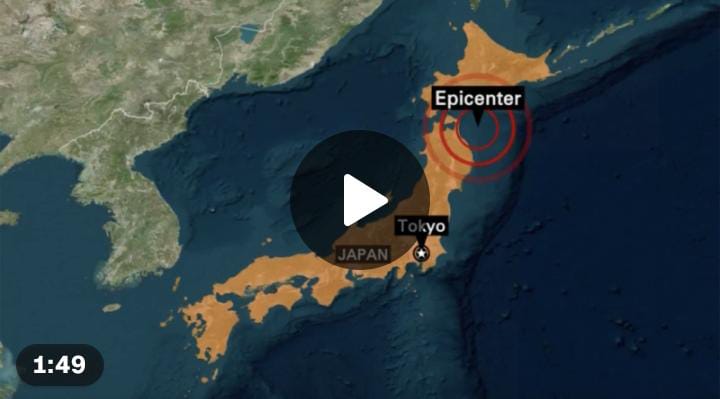
(DDM) – A powerful magnitude-7.5 earthquake struck off Japan’s northeastern coast late Monday, forcing authorities to issue urgent evacuation orders and activate a tsunami warning across multiple coastal communities.
DDM gathered that the quake, initially measured at 7.6, sent residents fleeing to higher ground as emergency sirens echoed across Iwate, Aomori, and Hokkaido.
Japan’s Meteorological Agency later confirmed that tsunami waves had reached affected areas in the early hours of Tuesday.

Officials reported a 2.3-foot tsunami at Kuji Port in Iwate Prefecture.
Smaller waves of about 16 inches were observed in Aomori and Hokkaido, adding to fears of further sea-level disturbances.
The JMA subsequently downgraded the full tsunami warning to an advisory after several hours of monitoring.
The United States Geological Survey said the earthquake struck at 11:15 p.m. local time, approximately 44 miles off the northeastern coast.
The quake generated strong shaking across northern Japan and occurred at a depth of around 33 miles beneath the ocean floor.
Background reports show that Japan remains one of the world’s most earthquake-prone countries due to its location along the Pacific Ring of Fire.
Major earthquakes in 2011 and 2016 have left lasting trauma, leading authorities to strengthen their early-warning systems and tsunami response protocols.
Residents in coastal towns rushed to designated evacuation shelters, a routine practice in Japan’s disaster-preparedness culture.
Local officials issued repeated announcements urging citizens to stay away from the shoreline until all advisories were lifted.
Japan’s Self-Defense Forces and disaster agencies were placed on alert but reported no immediate large-scale damage.
However, authorities warned that aftershocks remained highly likely.
Meteorological teams continued monitoring changes along the coastline as fears of secondary waves persisted.
Emergency services checked bridges, transportation routes, and utility systems for potential disruption.
Airports in the region conducted rapid safety inspections to ensure runway stability.
Train operators temporarily halted services as a precaution, a common response in the country’s strict safety framework.
Experts told DDM that deep-focus earthquakes of this magnitude can still produce dangerous tsunamis despite being centered far offshore.
The tremor was felt across wide areas, including Sapporo, Hakodate, and parts of northern Honshu.
Graphic models from the USGS mapped the quake’s epicenter in the North Pacific Ocean, highlighting the region’s vulnerability to seismic shifts.
As of early Tuesday, emergency officials urged residents to remain cautious until all advisories were officially lifted.
Japan remains on high alert as authorities continue assessing the situation, gathering damage reports, and preparing for potential aftershocks.