



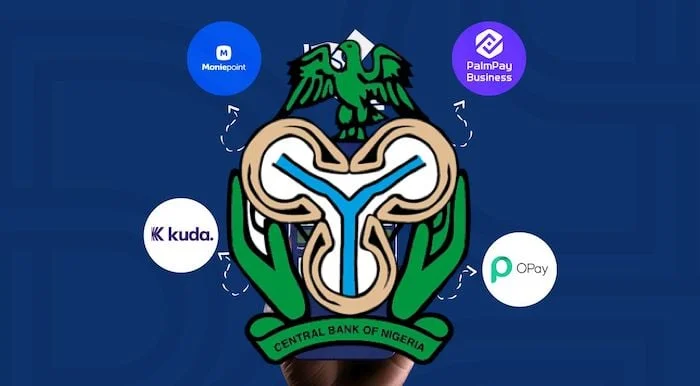
Nigeria’s rapidly evolving financial technology ecosystem has entered a decisive new phase as the Central Bank of Nigeria (CBN) officially upgrades several leading FinTech companies and microfinance banks to national operating licences, a move that both validates their explosive growth and tightens regulatory expectations around their operations. The upgrade, which affects some of the country’s most widely used digital finance platforms, effectively grants them the authority to operate across all states of the federation, marking a major milestone in Nigeria’s journey toward a more inclusive, technology-driven financial system.
Among the institutions whose licences have now been elevated to national status are Moniepoint Microfinance Bank, Opay, Kuda Bank, Palmpay, and Paga. These firms, which began largely as regionally licensed operators or niche digital platforms, have over the past few years expanded at a pace that far outstripped the geographical and regulatory limits of their earlier approvals. Through aggressive deployment of mobile applications, extensive agent banking networks, and user-friendly digital payment solutions, they have embedded themselves deeply into the daily economic lives of millions of Nigerians.
The confirmation of the licence upgrades came from Mr. Yemi Solaja, Director of the Other Financial Institutions Supervision Department at the CBN, who spoke in Lagos during the annual conference of the Committee of Heads of Banks’ Operations. According to Solaja, the decision to elevate these institutions was not merely aspirational but rather a formal recognition of an operational reality that had already taken shape on the ground.
“In practice, their operations are already nationwide,” Solaja said, noting that institutions such as Moniepoint MFB, Opay and Kuda Bank have long transcended the boundaries implied by their previous licences. For the regulator, the upgrade was therefore a necessary step to align legal authorisation with actual market behaviour, while bringing these fast-growing players more firmly under enhanced supervisory standards.

For years, FinTech platforms have been the backbone of Nigeria’s informal and semi-formal economy, filling gaps left by traditional banks. Millions of small traders, transport operators, artisans and micro-entrepreneurs rely on agent banking points, mobile wallets and instant payment services offered by these companies to receive payments, access credit, and move money seamlessly. DDM NEWS understands that this deep penetration into the informal sector was a critical factor considered by the CBN in its decision-making process.
However, the licence upgrade comes with significant new obligations. Solaja stressed that national authorisation is not simply a badge of prestige but a responsibility that requires greater transparency, stronger governance and a more tangible physical presence. While digital platforms have transformed financial access, the CBN has repeatedly emphasised that technology must not completely replace accountability.
“Most of their customers operate in the informal sector,” Solaja explained. “They need a clear point of contact if any issues arise.” This insistence on physical offices for dispute resolution reflects growing regulatory concern about customer complaints, transaction reversals and fraud-related disputes in the digital finance space. Under the new framework, nationally licensed FinTechs and microfinance banks are expected to maintain accessible offices where customers can lodge complaints and seek redress, rather than relying solely on in-app support or call centres.
The financial implications of the upgrade are equally significant. National licences attract much higher capital requirements, with national microfinance banks, for instance, required to maintain a minimum capital base of ₦5 billion. This threshold is designed to strengthen balance sheets, enhance resilience, and ensure that institutions with nationwide reach are adequately equipped to absorb shocks and protect depositors. According to industry analysts monitored by DDM NEWS, this move could trigger further consolidation within the FinTech and microfinance space, as smaller players either scale up or seek partnerships to meet regulatory demands.
The CBN’s decision also fits into a broader pattern of regulatory recalibration. While the apex bank has consistently promoted financial inclusion and digital innovation, it has simultaneously shown increasing intolerance for regulatory breaches. In 2024, both Moniepoint and Opay were fined ₦1 billion each for violations related to Know Your Customer (KYC) requirements. Those penalties sent a strong signal that rapid growth would not excuse lapses in compliance, particularly in areas linked to financial crime prevention and consumer protection.
Industry observers see the licence upgrade as a continuation of that balancing act: encouraging innovation while enforcing discipline. By granting national licences, the CBN is effectively saying that these FinTechs have earned a seat at the same table as established financial institutions, but must now operate under stricter scrutiny. For customers, this could translate into greater confidence in digital platforms, knowing that they are backed by stronger capital bases and subject to closer regulatory oversight.
At the same time, the move is expected to further accelerate financial inclusion. With national authorisation, these platforms can deepen their reach into underserved rural and peri-urban communities, deploy more agents, and roll out additional services without regulatory uncertainty. DDM NEWS notes that for many Nigerians who remain outside the traditional banking system, FinTechs are not an alternative but the primary gateway to formal finance.
Yet, challenges remain. As these companies scale nationally, issues such as data protection, cybersecurity, customer education and systemic risk will loom larger. The CBN’s insistence on physical presence suggests an awareness that trust in digital finance is built not only on convenience but also on accountability and human contact when things go wrong.
Ultimately, the upgrade of Opay, Moniepoint, Palmpay, Kuda and others to national licences represents a defining moment for Nigeria’s digital finance landscape. It underscores how far the sector has come—from fringe innovation to mainstream infrastructure—and how seriously regulators now view its role in the economy. As the lines between traditional banking and FinTech continue to blur, the real test will be whether these newly empowered institutions can balance speed with stability, innovation with compliance, and inclusion with integrity.
For now, the message from the CBN is clear: Nigeria’s FinTech giants have arrived on the national stage, and with that arrival comes both opportunity and responsibility.




