


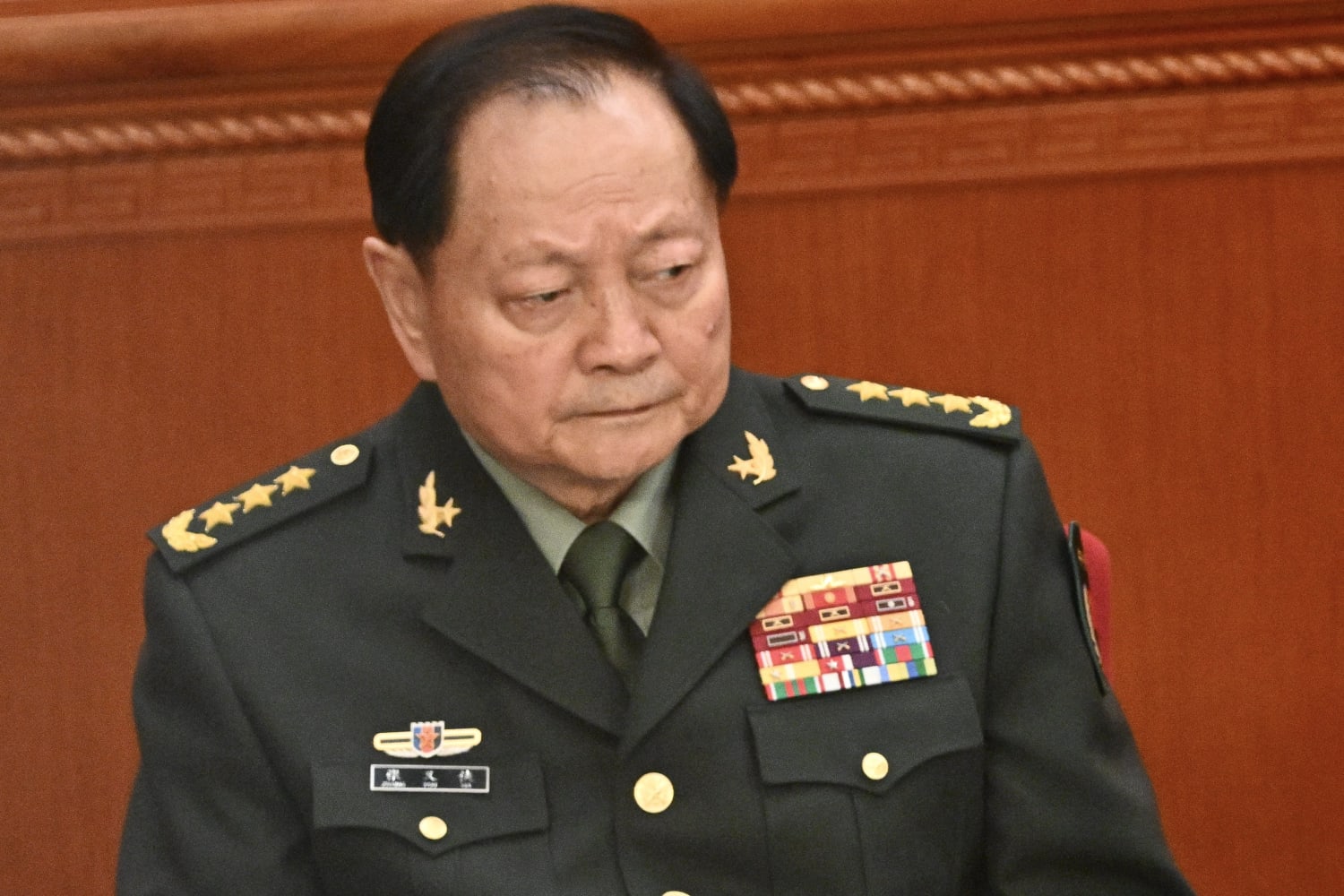
China’s tightly guarded political and military establishment has been thrown into profound turmoil following revelations that one of its most powerful and trusted figures, General Zhang Youxia, is under investigation for alleged espionage, massive corruption, and grave violations of Communist Party discipline — charges that could ultimately attract the death penalty. The unfolding scandal is already being described by analysts as one of the most dramatic purges in the history of the People’s Liberation Army (PLA), rivaling even the upheavals of the Mao Zedong era.
General Zhang Youxia, long regarded as the most senior uniformed officer in China and a personal ally of President Xi Jinping, is accused of leaking sensitive information about China’s nuclear weapons programme to the United States while also presiding over an extensive bribery network tied to military promotions and defence procurement contracts. The allegations emerged from a high-level internal briefing held on Saturday morning, attended by some of the highest-ranking officers in the Chinese military, according to sources familiar with the proceedings.
The briefing reportedly took place just hours before China’s Ministry of National Defense issued a terse public statement confirming that Zhang was under investigation for “serious violations of party discipline and state laws.” While the official announcement offered no details, insiders say the closed-door session laid bare a catalogue of accusations that have stunned even veteran members of China’s political elite.
According to those briefed, Zhang is suspected of forming political cliques within the military — a grave offence in the Communist Party lexicon that implies building personal networks of loyalty capable of undermining central authority. He is also accused of abusing his influence within the Central Military Commission (CMC), the apex body that controls the PLA and is chaired by President Xi himself. For a man once seen as Xi’s most reliable enforcer within the armed forces, the allegations represent a catastrophic fall from grace.

Perhaps most alarming is Zhang’s alleged involvement in a security breach at the heart of China’s nuclear establishment. Sources say authorities believe he leaked core technical data related to China’s nuclear weapons to the United States, an accusation that elevates the case from corruption to one of national betrayal. In China’s political system, espionage involving nuclear secrets is among the gravest crimes imaginable, often carrying the ultimate punishment.
DDM NEWS understands that part of the evidence against Zhang has been linked to the investigation of Gu Jun, the former general manager of the China National Nuclear Corporation, the state-owned entity overseeing both civilian and military nuclear programmes. Gu himself was placed under investigation last week for suspected severe violations of party discipline and state laws. During Saturday’s briefing, officials reportedly disclosed that the probe into Gu uncovered links to Zhang and pointed to a breach within China’s nuclear sector, although specific details of the leak were not shared.
Zhang, now 75, could not be reached for comment, nor could Gu. In a brief response to international media, Chinese Embassy spokesman Liu Pengyu said the investigation underscored the Communist Party’s “full-coverage, zero-tolerance approach to combating corruption,” stopping short of addressing the espionage allegations directly.
The scale and symbolism of Zhang’s downfall have reverberated far beyond Beijing. Zhang is a member of the Communist Party’s elite Politburo and belongs to China’s so-called “princelings,” the descendants of revolutionary leaders who helped found the People’s Republic in 1949. His father fought alongside Xi Jinping’s father during the Chinese Civil War, forging a family bond that later translated into political trust. For years, Zhang was viewed as untouchable — a pillar of Xi’s authority within the military.
“This move is unprecedented in the history of the Chinese military and represents the total annihilation of the high command,” said Christopher Johnson, head of the China Strategies Group and a former senior China analyst for the CIA. According to Johnson, the decision to take down someone of Zhang’s stature signals that no rank or relationship now offers protection in Xi’s sweeping campaign against corruption and disloyalty.
Saturday’s briefing also reportedly linked Zhang to the rise and fall of former Defence Minister Li Shangfu. Zhang is accused of facilitating Li’s promotion in exchange for substantial bribes. Li disappeared from public view in 2023, was later removed as defence minister, and was formally expelled from the Communist Party in 2024 for corruption. His case had already raised questions about the integrity of senior military appointments, but the connection to Zhang has added a new layer of gravity.
In another sign of the depth of the investigation, President Xi has reportedly authorised a special task force to conduct a forensic review of Zhang’s tenure as commander of the Shenyang Military Region between 2007 and 2012. The team has reportedly arrived in Shenyang and, unusually, is operating from civilian hotels rather than military facilities — a move seen as an effort to prevent interference from officers loyal to Zhang.
Authorities have also seized mobile phones and electronic devices belonging to officers who rose through the ranks alongside Zhang and General Liu Zhenli, the Chief of the PLA’s Joint Staff Department, whose own investigation was announced the same day. With thousands of officers potentially implicated through personal or professional ties, the purge threatens to hollow out the upper echelons of the Chinese military.
Analysts say the simultaneous targeting of Zhang and Liu marks a decisive escalation in Xi Jinping’s long-running effort to remake the PLA into a force defined by absolute loyalty to him personally. Since 2023, the Communist Party has removed or investigated senior figures across the army, navy, air force, strategic missile force, paramilitary police and defence industry. More than 50 top officers and executives have been unseated in just over two years, according to official disclosures reviewed by DDM NEWS.
The political dimension of Zhang’s case was underscored by an editorial in the PLA Daily, the military’s official newspaper, which accused him of “severely trampling on and undermining” the authority of the CMC chairman — a veiled but unmistakable reference to Xi. According to Lyle Morris of the Asia Society Policy Institute, this language suggests that Zhang’s real sin may have been accumulating too much power outside of Xi’s direct control.
For Xi, the purge appears to be both a consolidation of power and a warning. By decapitating the military’s command structure, he is signalling that corruption, patronage networks and the compromise of state secrets pose existential threats to China’s ambitions, particularly its long-stated goal of reclaiming Taiwan. Yet some analysts caution that the resulting vacuum at the top could undermine the PLA’s readiness for large-scale operations in the near term.
“Given the size and complexity of the PLA, this vacuum is untenable,” said MIT security scholar M. Taylor Fravel, warning that the purge is likely to affect combat effectiveness in the short to medium term.
Whether driven by genuine security concerns, political calculations, or both, the case of Zhang Youxia marks a turning point. As DDM NEWS observes, the downfall of a man once seen as Xi Jinping’s closest military ally sends an unmistakable message: in today’s China, loyalty is absolute, power is conditional, and even the highest generals are expendable.




