


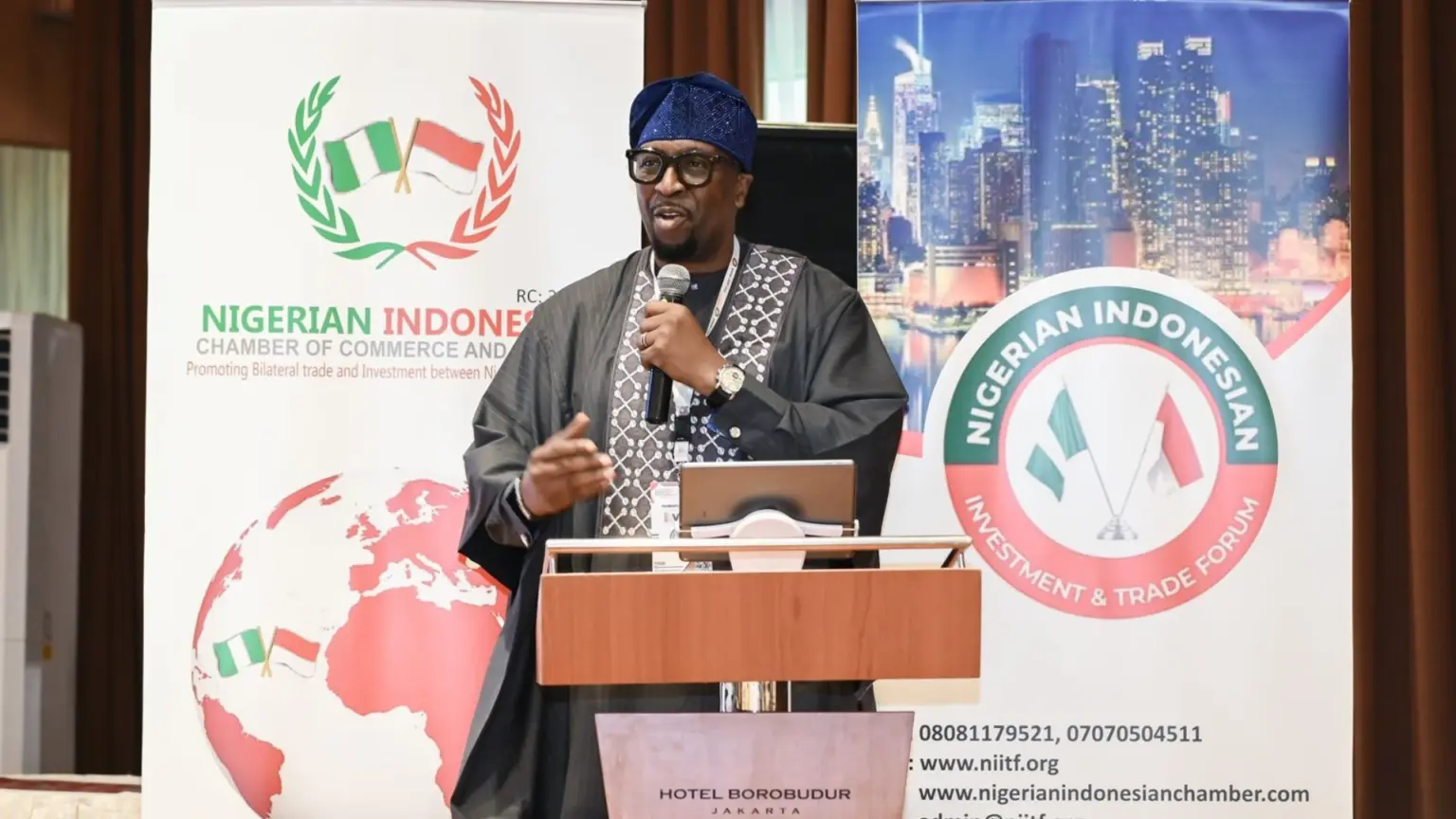
Nigeria and Indonesia are preparing to take their economic relationship into a deeper phase as government officials, investors, manufacturers, exporters and business leaders from both countries converge in Jakarta for the fifth edition of the Nigerian Indonesian Investment and Trade Forum, NIITF 2026.
Scheduled for October 20 and 21, 2026, the forum is expected to provide a major platform for both countries to move beyond traditional diplomatic engagement and focus more directly on trade, investment, industrial partnerships, technology transfer and private-sector collaboration.
The event is being organised by the Nigerian Indonesian Chamber of Commerce and Industry, with strategic support from the Office of the Vice President and coordination involving the Presidential Enabling Business Environment Council, PEBEC.
The development comes at a time when economic relations between Nigeria and Indonesia are attracting renewed attention, with bilateral trade estimated at about $4.7 billion in 2025, according to organisers of the forum.

The figure represents significant growth from the estimated $2.6 billion recorded in 2021 and highlights the expanding commercial relationship between the two emerging economies.
Under the theme, “Building Continents, Building Prosperity: Solidifying Nigerian-Indonesian Economic Partnership for Strategic Alliances and Shared Growth,” NIITF 2026 is positioned as more than a conventional business conference.
Its central objective is to create practical channels through which companies, investors and institutions can identify opportunities, negotiate partnerships and convert discussions into actual commercial activity.
For Nigeria, one of the most important opportunities lies in using the forum to promote its non-oil economy.
Agriculture, manufacturing, renewable energy, mining, infrastructure, logistics, healthcare, aviation, digital services, consumer goods, tourism and oil and gas are among the sectors expected to attract attention during the event.
The emphasis on non-oil exports is particularly significant as Nigeria continues to seek ways to diversify its sources of foreign exchange and reduce excessive dependence on crude oil.
A stronger relationship with Indonesia could provide Nigerian producers with access to another major Asian market while also opening opportunities for Indonesian businesses seeking a foothold in Africa.
DDM News reports that the potential value of the relationship lies not simply in increasing the amount of goods traded between both countries, but in creating a more balanced ecosystem of investment, production and knowledge exchange.
Nigeria offers Indonesia access to one of Africa’s largest consumer markets and a strategic base for reaching other African economies, while Indonesia brings industrial experience, manufacturing capacity, technology and access to the wider Southeast Asian market.
The forum is therefore expected to attract businesses interested in partnerships that go beyond import and export transactions.
Manufacturing is one area where such collaboration could become particularly important.
Indonesia has developed significant industrial capabilities across several sectors, while Nigeria is seeking greater domestic production capacity.
Partnerships between companies in both countries could support joint ventures, local manufacturing, technology transfer and the development of supply chains.
Agriculture and agro-processing also offer considerable room for cooperation.
Nigeria has extensive agricultural resources and a large domestic market, but continues to face challenges around processing, storage, logistics and value addition. Indonesian investment and technical expertise could potentially support businesses seeking to transform agricultural commodities into higher-value products.
Renewable energy is another sector where cooperation could become increasingly relevant.
As Nigerian businesses and households continue to face energy challenges, investment in alternative power generation, energy infrastructure and related technologies remains an important economic priority.
Mining and infrastructure are similarly expected to feature prominently as investors look for opportunities connected to Nigeria’s natural resources and growing infrastructure needs.
The Nigerian Indonesian Investment and Trade Forum has already established itself as a platform for bringing public and private-sector stakeholders together.
Previous editions have featured government officials, business executives, financial institutions, manufacturers and representatives of trade organisations.
The 2025 edition also facilitated discussions around investment, business matchmaking, strategic partnerships and memoranda of understanding.
The 2026 edition is expected to build on that foundation with investment presentations, panel discussions, strategic roundtables, business-to-business meetings, government-to-business engagements and industrial visits.
This structure is important because many international trade discussions often generate considerable interest without necessarily producing measurable commercial outcomes.
NIITF organisers are seeking to address that gap by creating opportunities for companies to meet directly with potential partners and investors.
For Nigerian exporters, the forum provides an opportunity to present products and services to Indonesian buyers and businesses.
It could also help companies understand the requirements for entering the Indonesian market, identify potential distributors and establish long-term commercial relationships.
For Indonesian businesses, Nigeria represents a market with a large population, significant consumer demand and opportunities across sectors ranging from manufacturing and energy to agriculture, healthcare and technology.
The relationship also has a broader South-South cooperation dimension.
Both countries are major emerging economies with large populations, growing consumer markets and ambitions to strengthen their positions within their respective regions.
Nigeria plays a significant economic role in West Africa, while Indonesia is one of the major economies in Southeast Asia.
Stronger commercial ties between them could therefore create opportunities that extend beyond bilateral trade.
A Nigerian company partnering with an Indonesian manufacturer, for instance, could potentially use Nigeria as a production or distribution base for the West African market.
Similarly, Nigerian exporters could use Indonesian partnerships to gain access to Southeast Asian supply chains.
This regional dimension gives NIITF 2026 a significance beyond the two countries themselves.
The forum will also take place alongside Trade Expo Indonesia 2026, Indonesia’s major international trade exhibition, and a tourism programme in Bali.
The combination is expected to provide Nigerian participants with opportunities to interact with a broader international business community.
Trade Expo Indonesia reportedly attracted more than 41,000 visitors from over 140 countries and generated trade transactions worth more than $22.8 billion in 2025.
DDM News understands that this wider platform could give Nigerian businesses additional exposure at a time when companies are increasingly searching for new international markets and investment partners.
However, deeper trade relations will require more than high-level meetings. Businesses on both sides will need predictable policies, efficient logistics, accessible trade finance, reliable payment systems and clear regulatory procedures if the opportunities identified at the forum are to translate into sustainable commercial activity.
Trade financing is particularly important for smaller businesses.
Nigerian SMEs may have competitive products but lack the capital required to produce at scale, meet export standards or finance international orders.
Greater involvement from institutions such as the Nigeria Export-Import Bank could therefore help bridge some of the financing gaps that businesses encounter when attempting to enter new markets.
There is also the question of trade balance. Increasing the value of bilateral trade is beneficial, but Nigeria will need to ensure that stronger commercial ties also translate into increased exports of Nigerian goods and services.
This makes the forum’s focus on non-oil exports particularly important.
The organisers have indicated that previous editions have supported business matchmaking, investment discussions, industrial visits and Government-to-Government, Government-to-Business and Business-to-Business engagements.
The objective for 2026 is to build on those relationships and create partnerships capable of generating investment, jobs, exports, industrial development and technology transfer.
For Nigeria, the opportunity is therefore two-sided.
The country can seek Indonesian investment while simultaneously using the forum to promote Nigerian businesses and products.
For Indonesia, deeper engagement with Nigeria could strengthen its commercial presence in Africa and provide Indonesian companies with access to opportunities in one of the continent’s largest economies.
Ultimately, NIITF 2026 will test whether the growing trade relationship between Nigeria and Indonesia can move from promising figures and diplomatic commitments into deeper private-sector partnerships.
With bilateral trade already estimated at $4.7 billion in 2025, the next phase will depend on how effectively both countries can turn existing momentum into investment, production, exports and long-term commercial relationships.
As Nigerian and Indonesian businesses prepare to meet in Jakarta, the message is increasingly clear: the relationship is no longer being defined only by what both countries can sell to each other, but by what they can build together.
NIITF 2026 therefore arrives at a critical moment for both economies.
If the forum succeeds in converting discussions into concrete deals, joint ventures and investment commitments, it could strengthen a trade corridor that has the potential to become an increasingly important bridge between Africa and Southeast Asia.




