


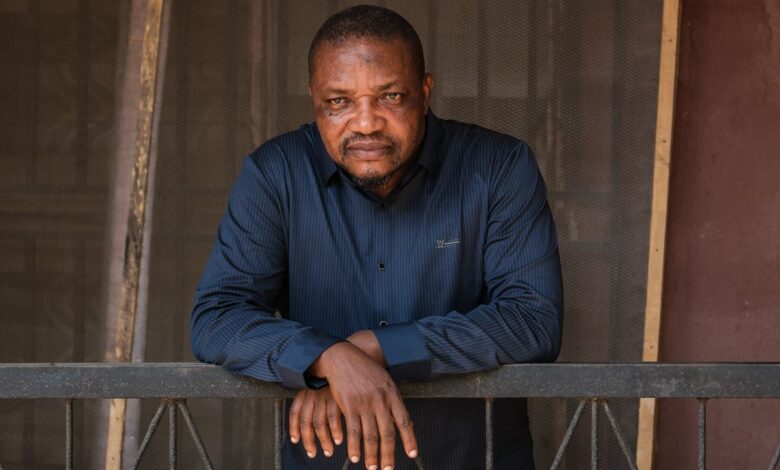
A New York Times investigation has revealed that intelligence used to justify recent US airstrikes in Nigeria was partly based on information provided by a screwdriver trader and small NGO operator in Onitsha, Anambra State, raising serious concerns about the credibility of the data that influenced US policy decisions.
According to the report, Emeka Umeagbalasi, a market trader who also runs a little-known advocacy group, supplied figures alleging widespread killings of Christians in Nigeria.
His claims were later cited by U.S. lawmakers and referenced in arguments supporting American military action in the country.

The Times reported that Umeagbalasi claimed to have documented about 125,000 Christian deaths in Nigeria since 2009.
He said his figures were compiled using Google searches, Nigerian media reports, secondary sources, and data from advocacy groups such as Open Doors.
However, he acknowledged that he rarely verified the information and often assumed the religious identity of victims based on the location of attacks.
“If a mass abduction or killing happens in an area where he thinks many Christians live, he assumes the victims are Christians,” the New York Times noted.
Umeagbalasi also claimed that roughly 20,000 churches had been destroyed across Nigeria over the past 16 years, figures he admitted were also obtained through online searches rather than systematic field research.
Despite the informal nature of his data collection, the report said his claims were cited by prominent US politicians, including Senator Ted Cruz, Representative Riley Moore, and Representative Chris Smith.
US President Donald Trump also referenced similar figures while accusing Nigeria of failing to stop what he described as a genocide of Christians.
The revelations have sparked debate over the reliability of the intelligence that shaped recent US actions.
In October, Trump redesignated Nigeria as a “country of particular concern” over alleged religious persecution.
A month later, he warned that the U.S. military could intervene forcefully if the Nigerian government failed to act.
On December 26, US forces carried out airstrikes on suspected ISIS targets in Sokoto State, an operation the US said was conducted at the request of Nigerian authorities.
The New York Times investigation suggests that these moves were influenced by a narrative increasingly driven by unverified and politically charged claims.
Security analysts warn that relying on questionable data to justify military intervention carries significant risks. Actions based on flawed intelligence may lead to misdirected strikes, civilian harm, and heightened tensions.
They also caution that portraying Nigeria’s complex security crisis solely through a religious lens could inflame sectarian divisions and distort international policy responses.
Nigeria has faced persistent violence from multiple armed groups for more than a decade, including Boko Haram and other jihadist factions that have attacked both Christian and Muslim communities.
While US military involvement in Nigeria has been limited and typically coordinated with Abuja, experts stress that the legitimacy of such operations depends heavily on credible, independently verified intelligence.
The New York Times report has renewed calls for greater scrutiny of the sources used in shaping foreign policy and military decisions, particularly in fragile and conflict-prone regions like Nigeria.