


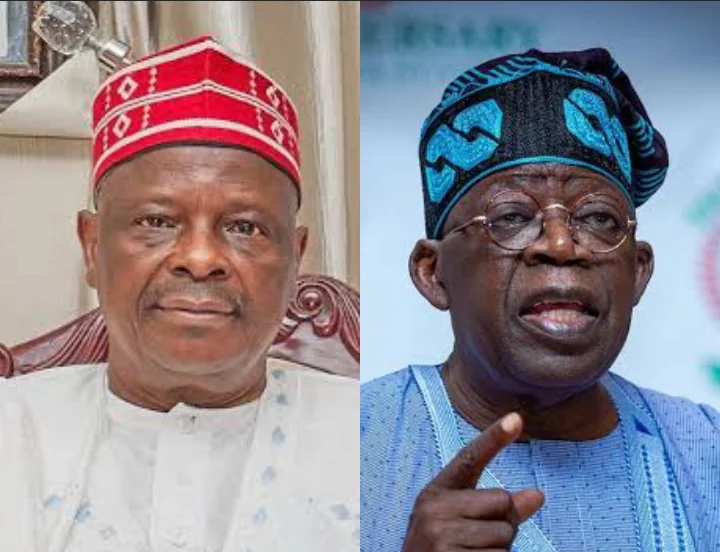
Fresh revelations have emerged on why prolonged efforts by President Bola Ahmed Tinubu and the leadership of the All Progressives Congress (APC) to strike a political alliance with Senator Rabiu Musa Kwankwaso ultimately collapsed, despite months of quiet engagements and back-channel negotiations. Once widely regarded as Kano’s political “beautiful bride” and a potential game-changer ahead of future elections, Kwankwaso’s negotiating position appears to have weakened considerably, leaving him increasingly isolated within Nigeria’s shifting political landscape.
Sources with direct knowledge of the discussions say that talks between Kwankwaso and the presidency stretched over several months, with multiple meetings held mainly in Abuja. At the early stages, APC power brokers and presidential strategists viewed the former Kano governor as a valuable asset, largely because of the perceived electoral strength of his Kwankwasiyya movement and the NNPP’s surprise showing in Kano during the 2023 general elections.
Within the ruling party, there was a strong belief that Kwankwaso could serve as a strategic bridge into Kano and the wider North-west, a region that remains critical to any winning national coalition. His red-cap political base, cultivated over decades, was seen as an organised structure that could be leveraged to shore up APC dominance ahead of the 2027 polls.
However, optimism around the talks gradually gave way to concern as the scale and tone of Kwankwaso’s demands became clearer. What initially began as exploratory political engagement soon stalled over what insiders described as excessive, unrealistic, and politically untenable conditions.

Central to the collapse of the negotiations was Kwankwaso’s reported demand for control of up to 20 per cent of the APC’s national political structure. Party leaders were said to be stunned by the request, viewing it as a non-starter that cut against the very foundations of the ruling party. One highly placed APC source told DDM NEWS that even President Tinubu, as party leader and sitting president, had never sought or demanded any formal percentage ownership of the APC’s structure.
“That single demand changed the entire tone of the conversation,” the source explained. “Asking for 20 per cent of the APC nationwide was simply unrealistic. It raised immediate red flags and made it clear that we were not dealing with a conventional alliance discussion.”
Beyond structural control, Kwankwaso was also said to have pushed strongly for the vice-presidential slot, despite the fact that the position was already occupied and not subject to renegotiation. APC negotiators reportedly made it clear from the outset that the vice presidency was not vacant and could not be part of any deal.
Even more troubling for APC leaders, DDM NEWS gathered, was Kwankwaso’s insistence on long-term guarantees stretching far beyond the immediate political cycle. Sources said he sought assurances that would extend to 2031, signalling an ambition not just for short-term accommodation but for sustained influence over the party’s future leadership and succession plans.
To APC strategists and the presidency, the package of demands painted the picture of a politician negotiating not as a prospective ally, but as a near-equal stakeholder in a party he neither founded nor nurtured. “He was clearly overreaching,” a senior APC chieftain said, adding that the demands suggested an inflated sense of indispensability at a time when political realities were shifting.
Indeed, as negotiations dragged on, presidency insiders began to reassess Kwankwaso’s actual grip on Kano politics. While he had long projected himself as the undisputed political leader of the state, growing cracks within the NNPP, particularly his deteriorating relationship with Governor Abba Yusuf, raised doubts about his capacity to deliver a unified Kano bloc.
According to reliable sources, APC strategists identified the friction between Kwankwaso and Yusuf as a critical weakness. They reasoned that the governor’s incumbency, combined with federal influence and direct engagement, could yield more tangible political dividends than continued courtship of Kwankwaso. This recalibration marked a decisive turning point in the negotiations.
“Once it became clear that Kwankwaso no longer controlled the entire Kano political space the way he claimed, especially with divisions between him and his former political protégé, the presidency shifted focus,” another source familiar with the talks disclosed. “At that point, it made more sense to deal directly with the governor.”
The strategic pivot proved costly for Kwankwaso. His bargaining power, once rooted in the assumption that he alone could deliver Kano, diminished rapidly. Without the ability to guarantee a cohesive political bloc, his expansive demands appeared increasingly disconnected from political realities.
This backdrop also helps explain the growing internal crisis within the NNPP. The Dr. Boniface Aniebonam-led bloc of the party has openly accused Kwankwaso of domineering behaviour and “slavish intentions,” alleging that his leadership style played a key role in Governor Yusuf’s eventual defection to the APC.
In a statement monitored by DDM NEWS, the NNPP National Vice Chairman (North-west), Alhaji Sani Danmasani, dismissed claims by Kwankwaso ally Buba Galadima that Yusuf’s defection was an act of betrayal. Instead, Danmasani argued that Yusuf was forced out by what he described as Kwankwaso’s suffocating control and intolerance of dissent.
According to Danmasani, Yusuf’s move was not driven by selfish ambition but by a desire to escape an overbearing political environment. He accused Kwankwaso of betraying the trust of NNPP founder, Dr. Boniface Aniebonam, and attempting to hijack the party’s structure for personal gain.
Danmasani also recalled the sacrifices made by Aniebonam to provide a political platform for Kwankwaso and his allies ahead of the 2023 elections, suggesting that those now crying foul were themselves guilty of betrayal. He described the outrage expressed by Kwankwaso and Galadima as hypocritical, given their alleged role in sidelining the party’s founder.
“The bitterness and pain are evident in their speeches,” Danmasani said, reacting to Galadima’s appearance on Arise News Television. He added that rather than disturb public peace with accusations, Kwankwaso and his group should reflect on their actions and seek reconciliation.
As the dust settles, DDM NEWS observes that Kwankwaso’s failed negotiations with the APC highlight a broader lesson in Nigeria’s evolving power politics: influence is fluid, and past dominance does not always translate into present leverage. With the APC consolidating its grip on Kano through direct engagement with the sitting governor, Kwankwaso now faces the challenge of redefining his relevance in a political environment that appears to be moving on without him.




