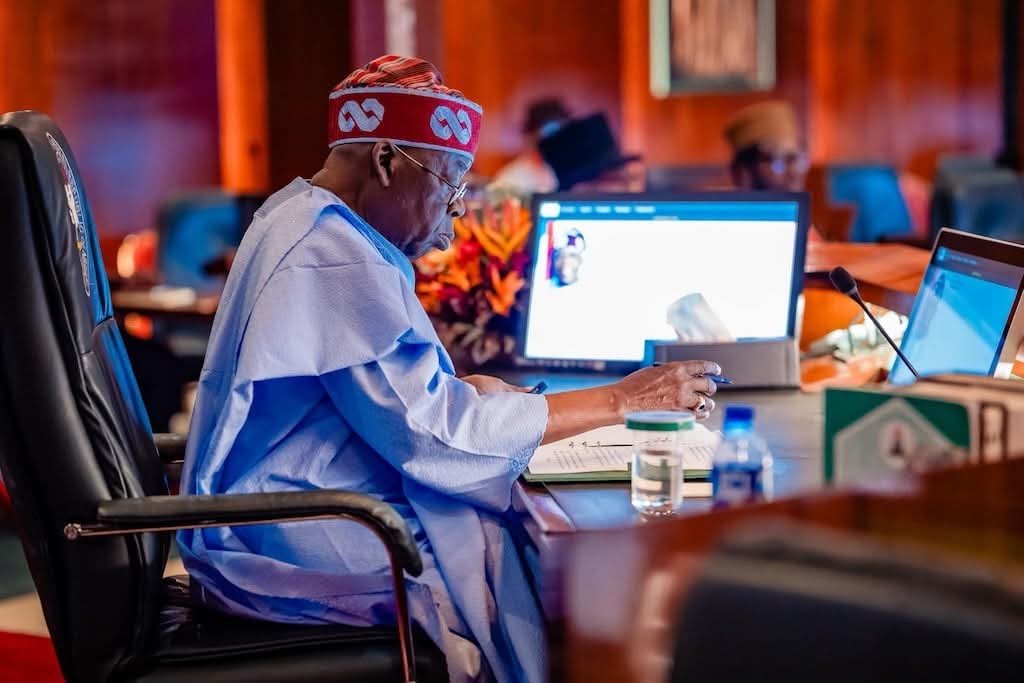
President Bola Ahmed Tinubu has reportedly begun strategic political calculations aimed at securing overwhelming bloc votes from the South and North-Central regions ahead of the 2027 presidential election.
DDM gathered that emerging plans within the ruling All Progressives Congress indicate a renewed focus on regional power balancing, alliance-building, and voter consolidation as preparations quietly intensify.
Sources familiar with the strategy say the President’s camp believes the South and North-Central remain critical battlegrounds capable of determining the outcome of the next general election.
Political insiders note that Tinubu’s victory in 2023 relied heavily on complex regional permutations rather than outright national dominance.
The President won the election with strong backing from the South-West, divided support in the South-South and South-East, and mixed results across the North.

Analysts argue that lessons from the 2023 contest are shaping current thinking within the Presidency.
The North-Central, often described as Nigeria’s political swing zone, has historically played a decisive role in close presidential races.
States such as Benue, Kogi, Kwara, Niger, Nasarawa, and Plateau have frequently shifted allegiance depending on prevailing political sentiments.
In 2023, voter discontent in parts of the North-Central over insecurity and farmer-herder violence affected turnout and voting patterns.
Observers believe Tinubu’s new calculations are designed to address those grievances directly.
Similarly, the broader Southern region remains fragmented along ethnic, political, and ideological lines.
Despite producing the President, the South has not always voted as a single bloc.
The South-East continues to agitate for greater political inclusion at the federal level.
The South-South has expressed concerns over resource control, economic marginalisation, and environmental degradation.
Political strategists say Tinubu’s outreach is expected to involve policy concessions, strategic appointments, and infrastructural commitments.
There are indications that increased federal presence and targeted development projects may be used to rebuild trust in sceptical regions.
Party sources also suggest renewed engagement with traditional rulers, religious leaders, and influential political stakeholders.
The ruling APC is reportedly reviewing its internal structures in the North-Central to resolve factional disputes that weakened the party in past elections.
Reconciliation efforts are said to be underway to bring aggrieved party leaders back into the fold.
Background checks show that Nigerian presidential elections are rarely won without strong regional coalitions.
Since 1999, every successful presidential candidate has relied on a careful mix of regional alliances.
The principle of zoning, though informal, continues to influence voter expectations and elite negotiations.
Tinubu’s camp is believed to be sensitive to growing debates about equity, rotation of power, and national unity.
Opposition parties are also closely watching these developments.
The Peoples Democratic Party and emerging third-force movements are expected to counter Tinubu’s strategy with their own regional mobilisation plans.
Critics argue that excessive focus on bloc politics risks deepening ethnic and regional divisions.
Supporters, however, insist that bloc voting reflects Nigeria’s political reality and cannot be ignored.
As 2027 approaches, political temperature across the country is expected to rise steadily.
What is unfolding now, analysts say, is an early battle for loyalty, perception, and regional confidence.
For President Tinubu, securing the South and North-Central may not just be a strategy, but a necessity for political survival in 2027.