


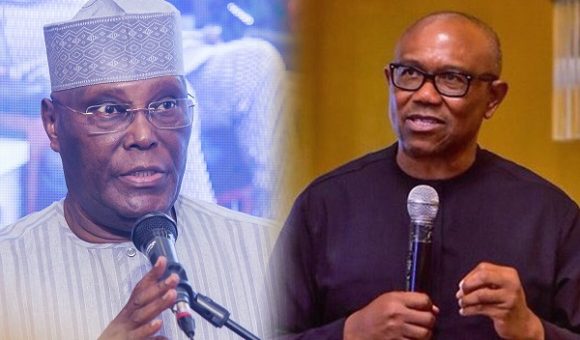
Former Vice President Atiku Abubakar has issued a strong call for restraint and unity within the African Democratic Congress (ADC) following escalating online clashes between his supporters and members of the Obidient Movement over the party’s 2027 presidential ticket. The intervention comes amid growing tensions triggered by the recent defection of former Anambra State governor and 2023 Labour Party presidential candidate, Peter Obi, to the ADC, a move that has significantly reshaped Nigeria’s opposition political landscape.
In a pointed message shared on his verified X (formerly Twitter) handle on Tuesday, Atiku warned that personal attacks against party leaders, including himself and Peter Obi, undermine the collective interests of the ADC and weaken the broader opposition coalition seeking to challenge the ruling All Progressives Congress (APC) in the 2027 general election. According to Atiku, the internal hostility brewing among supporters amounts to a destructive “civil war” that ultimately serves the political interests of the APC.
DDM NEWS reports that Atiku’s remarks were a direct response to an X post by political commentator Novie Everest, who accused Atiku’s loyalists of attacking Peter Obi while expecting the former vice president to remain immune from criticism. The post reignited an already heated debate on social media, where fault lines within the opposition coalition have become increasingly visible.
“Atiku’s people want to insult Peter Obi without Atiku getting the heat back. Maybe they feel Atiku deserves respect and Peter Obi does not,” Everest wrote, echoing sentiments that have gained traction among Obi’s supporters since his entry into the ADC.

In his response, Atiku rejected the notion that attacks on any opposition leader could be justified or productive. He stressed that such infighting only strengthens the ruling party, which he described in characteristically blunt language as “urban bandits” determined to preserve what he termed Nigeria’s “satanic status quo.”
“Dear Everest,” Atiku wrote, “anyone who insults Obi or Atiku does not mean well for the leaders, the Coalition ADC and for Nigeria and Nigerians. The only people who benefit from such a civil war are the APC urban bandits who want to maintain the satanic status quo. We are better together.”
The former vice president’s intervention underscores the growing anxiety within opposition ranks as the 2027 election cycle gathers momentum. DDM NEWS observes that while the ADC has emerged as a potential rallying platform for disaffected politicians and voters seeking an alternative to the APC, internal cohesion remains a major test for the party’s credibility and electoral viability.
Peter Obi’s defection from the Labour Party to the ADC in December marked a turning point in opposition politics. Obi, who galvanized millions of young voters and urban professionals during the 2023 presidential election, said his decision was driven by the need to build a broader, more effective coalition capable of addressing Nigeria’s deepening economic crisis, rising insecurity, and widespread public disillusionment with governance.
However, Obi’s arrival in the ADC has also intensified competition for the party’s presidential ticket. His supporters, popularly known as the Obidients, have since mounted sustained pressure on Atiku to step aside and support Obi as the consensus candidate for 2027. They argue that Obi’s performance in 2023, particularly his appeal among youth and first-time voters, positions him as the strongest challenger to the APC.
This campaign has not gone down well with Atiku’s loyalists, many of whom believe the former vice president remains the most experienced and nationally networked figure within the coalition. They argue that Atiku’s long-standing political structure, cross-regional appeal, and prior presidential runs give him a strategic advantage in a high-stakes contest against the APC.
The resulting clash has spilled onto social media, especially X, where supporters from both camps have traded accusations, insults, and political threats. DDM NEWS gathered that the tone of the exchanges has alarmed some ADC leaders, who fear that unchecked hostility could fracture the party before it even conducts its presidential primary.
Political analysts say Atiku’s public call for unity reflects an awareness of the dangers posed by internal discord. While competition is inevitable in a democratic party, they argue that allowing supporter-driven conflicts to spiral out of control could erode public confidence in the ADC as a serious alternative to the ruling party.
Beyond the personalities involved, the controversy highlights a broader challenge confronting Nigeria’s opposition: how to balance ambition, ideology, and coalition-building in a political environment dominated by incumbency power and entrenched interests. DDM NEWS notes that previous opposition efforts have often collapsed under the weight of internal rivalries, leaving the APC to coast to victory.
Atiku’s framing of the conflict as a “civil war” is particularly striking. By warning that such divisions only benefit the APC, he appears to be appealing not just to party loyalty but to a shared sense of urgency among opposition supporters who believe Nigeria cannot afford another cycle of fragmented resistance.
“The question is not Atiku versus Obi,” a senior ADC insider told DDM NEWS on condition of anonymity. “The real question is whether the opposition can stay united long enough to present a credible alternative to Nigerians. If we destroy ourselves from within, the APC doesn’t even need to campaign.”
As debates over the ADC presidential ticket continue, attention is now turning to the party’s internal processes and leadership capacity. Observers say the manner in which the ADC manages its primaries, reconciles competing interests, and enforces discipline among supporters will be critical in determining its prospects for 2027.
For now, Atiku’s message appears aimed at lowering the temperature and reminding supporters that political change requires collaboration rather than confrontation. Whether that appeal will be heeded remains uncertain, especially in an era where social media amplifies division as much as it mobilizes support.
As Nigeria inches closer to another decisive election, DDM NEWS will continue to monitor developments within the ADC and the broader opposition coalition. The battle for unity may ultimately prove just as consequential as the battle at the ballot box.




